

83
posed within very short time if these are used as roofing materials. They, therefore,
let those to be decomposed in the field which in turn add organic matter, mainly
nitrogen, in soil and also reduce saline intensity, which is beneficial for the growth
of their next crop. Moreover, those who are landless, grow vegetables on sheds or
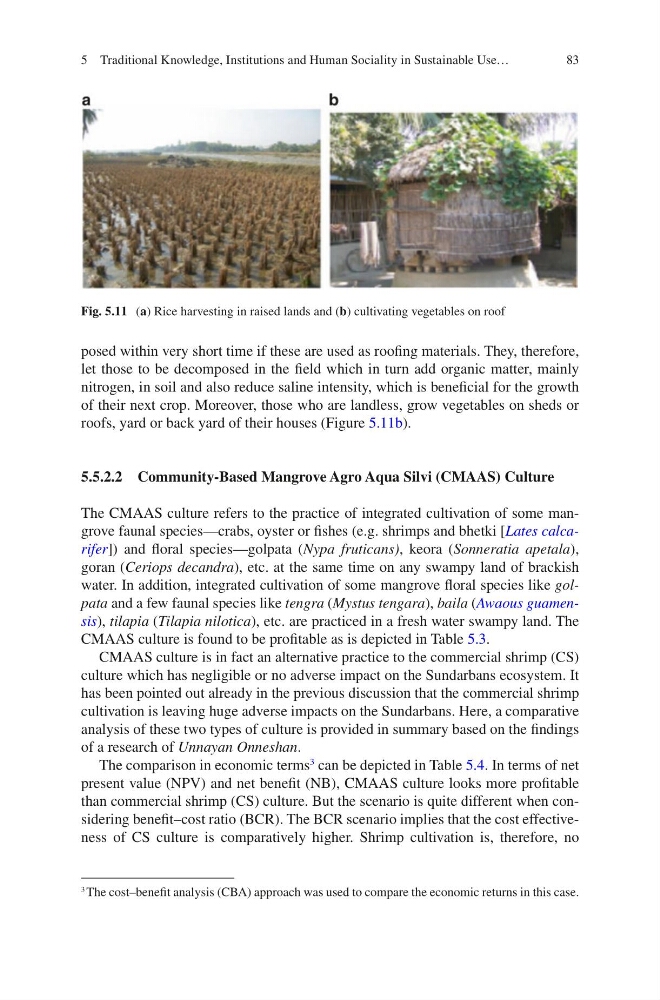
roofs, yard or back yard of their houses (Figure 5.11b).
5.5.2.2 Community-Based Mangrove Agro Aqua Silvi (CMAAS) Culture
The CMAAS culture refers to the practice of integrated cultivation of some mangrove faunal species—crabs, oyster or fishes (e.g. shrimps and bhetki [Lates calcarifer]) and floral species—golpata (Nypa fruticans), keora (Sonneratia apetala),
goran (Ceriops decandra), etc. at the same time on any swampy land of brackish
water. In addition, integrated cultivation of some mangrove floral species like golpata and a few faunal species like tengra (Mystus tengara), baila (Awaous guamensis), tilapia (Tilapia nilotica), etc. are practiced in a fresh water swampy land. The
CMAAS culture is found to be profitable as is depicted in Table 5.3.
CMAAS culture is in fact an alternative practice to the commercial shrimp (CS)
culture which has negligible or no adverse impact on the Sundarbans ecosystem. It
has been pointed out already in the previous discussion that the commercial shrimp
cultivation is leaving huge adverse impacts on the Sundarbans. Here, a comparative
analysis of these two types of culture is provided in summary based on the findings
of a research of Unnayan Onneshan.
The comparison in economic terms
3
can be depicted in Table 5.4. In terms of net
present value (NPV) and net benefit (NB), CMAAS culture looks more profitable
than commercial shrimp (CS) culture. But the scenario is quite different when considering benefit–cost ratio (BCR). The BCR scenario implies that the cost effectiveness of CS culture is comparatively higher. Shrimp cultivation is, therefore, no
3 The cost–benefit analysis (CBA) approach was used to compare the economic returns in this case.
Fig. 5.11 (a) Rice harvesting in raised lands and (b) cultivating vegetables on roof
5 Traditional Knowledge, Institutions and Human Sociality in Sustainable Use…
posed within very short time if these are used as roofing materials. They, therefore,
let those to be decomposed in the field which in turn add organic matter, mainly
nitrogen, in soil and also reduce saline intensity, which is beneficial for the growth
of their next crop. Moreover, those who are landless, grow vegetables on sheds or
roofs, yard or back yard of their houses (Figure 5.11b).
5.5.2.2 Community-Based Mangrove Agro Aqua Silvi (CMAAS) Culture
The CMAAS culture refers to the practice of integrated cultivation of some mangrove faunal species—crabs, oyster or fishes (e.g. shrimps and bhetki [Lates calcarifer]) and floral species—golpata (Nypa fruticans), keora (Sonneratia apetala),
goran (Ceriops decandra), etc. at the same time on any swampy land of brackish
water. In addition, integrated cultivation of some mangrove floral species like golpata and a few faunal species like tengra (Mystus tengara), baila (Awaous guamensis), tilapia (Tilapia nilotica), etc. are practiced in a fresh water swampy land. The
CMAAS culture is found to be profitable as is depicted in Table 5.3.
CMAAS culture is in fact an alternative practice to the commercial shrimp (CS)
culture which has negligible or no adverse impact on the Sundarbans ecosystem. It
has been pointed out already in the previous discussion that the commercial shrimp
cultivation is leaving huge adverse impacts on the Sundarbans. Here, a comparative
analysis of these two types of culture is provided in summary based on the findings
of a research of Unnayan Onneshan.
The comparison in economic terms
3
can be depicted in Table 5.4. In terms of net
present value (NPV) and net benefit (NB), CMAAS culture looks more profitable
than commercial shrimp (CS) culture. But the scenario is quite different when considering benefit–cost ratio (BCR). The BCR scenario implies that the cost effectiveness of CS culture is comparatively higher. Shrimp cultivation is, therefore, no
3 The cost–benefit analysis (CBA) approach was used to compare the economic returns in this case.
Fig. 5.11 (a) Rice harvesting in raised lands and (b) cultivating vegetables on roof
5 Traditional Knowledge, Institutions and Human Sociality in Sustainable Use…