

85
5.6 IPLCs, Resilience and Aichi Biodiversity Targets
As a Contracting Party to the Convention on Biological Diversity (CBD), Bangladesh
is committed to implementing conservation and sustainable management of its biological diversity. The findings based upon empirical analysis, however, reveal that
the most important biodiversity hotspot of this country, the Sundarbans, is under the
threat of continuous degradation. In this process, the lives and livelihood conditions
of the IPLCs are also being adversely impacted. Moreover, traditional knowledgebased livelihood strategies of the IPLCs are found to be effective in maintaining
sustainable utilisation and conservation of this forest ecosystem. Yet, their knowledge has been neglected often under the formal institutional management system.
Under the considerations of such major findings, this section firstly assesses the resilience capacity of the Sundarbans as a SEPLS based on some of the notable resilience
indicators
5
considering two scenarios: (a) resilience capacity under current management process and (b) change in resilience capacity under the alternative conservation
framework (developed in Sect. 5.3). A multiple evidence-based approach for the
5 A set of indicators of resilience of SEPLS has been developed by UNU-IAS to provide a tool for
communities to understand their resilience and encourage the practices that strengthen it (UNUIAS 2015). In total 20 indicators are developed so far, but here some of the important indicators
have been used to assess the case of the Sundarbans.
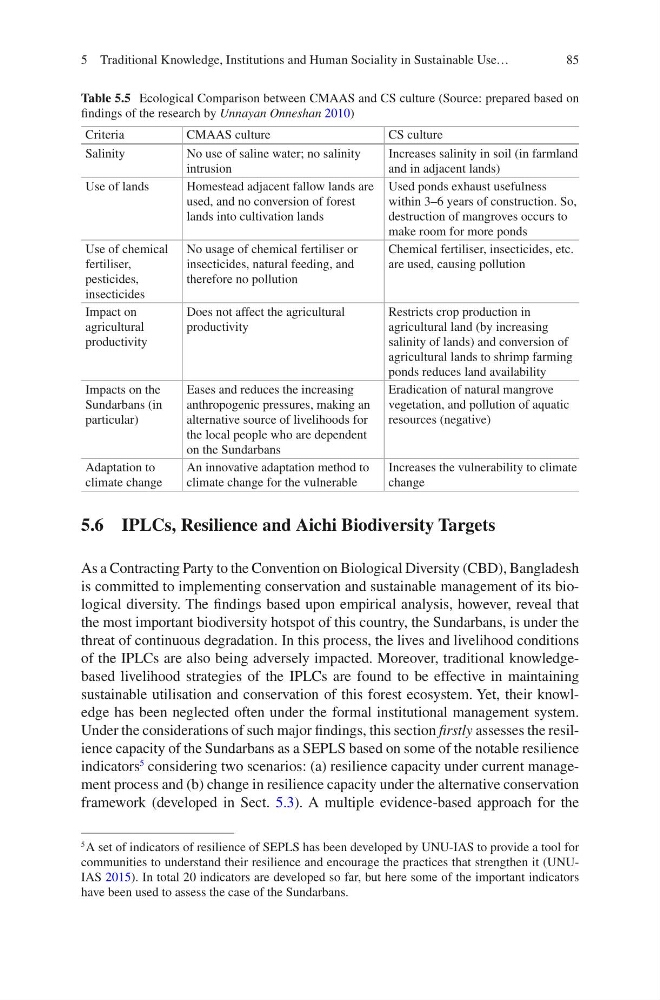
Table 5.5 Ecological Comparison between CMAAS and CS culture (Source: prepared based on
findings of the research by Unnayan Onneshan 2010)
Criteria
CMAAS culture
CS culture
Salinity
No use of saline water; no salinity
intrusion
Increases salinity in soil (in farmland
and in adjacent lands)
Use of lands
Homestead adjacent fallow lands are
used, and no conversion of forest
lands into cultivation lands
Used ponds exhaust usefulness
within 3–6 years of construction. So,
destruction of mangroves occurs to
make room for more ponds
Use of chemical
fertiliser,
pesticides,
insecticides
No usage of chemical fertiliser or
insecticides, natural feeding, and
therefore no pollution
Chemical fertiliser, insecticides, etc.
are used, causing pollution
Impact on
agricultural
productivity
Does not affect the agricultural
productivity
Restricts crop production in
agricultural land (by increasing
salinity of lands) and conversion of
agricultural lands to shrimp farming
ponds reduces land availability
Impacts on the
Sundarbans (in
particular)
Eases and reduces the increasing
anthropogenic pressures, making an
alternative source of livelihoods for
the local people who are dependent
on the Sundarbans
Eradication of natural mangrove
vegetation, and pollution of aquatic
resources (negative)
Adaptation to
climate change
An innovative adaptation method to
climate change for the vulnerable
Increases the vulnerability to climate
change
5 Traditional Knowledge, Institutions and Human Sociality in Sustainable Use…
5.6 IPLCs, Resilience and Aichi Biodiversity Targets
As a Contracting Party to the Convention on Biological Diversity (CBD), Bangladesh
is committed to implementing conservation and sustainable management of its biological diversity. The findings based upon empirical analysis, however, reveal that
the most important biodiversity hotspot of this country, the Sundarbans, is under the
threat of continuous degradation. In this process, the lives and livelihood conditions
of the IPLCs are also being adversely impacted. Moreover, traditional knowledgebased livelihood strategies of the IPLCs are found to be effective in maintaining
sustainable utilisation and conservation of this forest ecosystem. Yet, their knowledge has been neglected often under the formal institutional management system.
Under the considerations of such major findings, this section firstly assesses the resilience capacity of the Sundarbans as a SEPLS based on some of the notable resilience
indicators
5
considering two scenarios: (a) resilience capacity under current management process and (b) change in resilience capacity under the alternative conservation
framework (developed in Sect. 5.3). A multiple evidence-based approach for the
5 A set of indicators of resilience of SEPLS has been developed by UNU-IAS to provide a tool for
communities to understand their resilience and encourage the practices that strengthen it (UNUIAS 2015). In total 20 indicators are developed so far, but here some of the important indicators
have been used to assess the case of the Sundarbans.
Table 5.5 Ecological Comparison between CMAAS and CS culture (Source: prepared based on
findings of the research by Unnayan Onneshan 2010)
Criteria
CMAAS culture
CS culture
Salinity
No use of saline water; no salinity
intrusion
Increases salinity in soil (in farmland
and in adjacent lands)
Use of lands
Homestead adjacent fallow lands are
used, and no conversion of forest
lands into cultivation lands
Used ponds exhaust usefulness
within 3–6 years of construction. So,
destruction of mangroves occurs to
make room for more ponds
Use of chemical
fertiliser,
pesticides,
insecticides
No usage of chemical fertiliser or
insecticides, natural feeding, and
therefore no pollution
Chemical fertiliser, insecticides, etc.
are used, causing pollution
Impact on
agricultural
productivity
Does not affect the agricultural
productivity
Restricts crop production in
agricultural land (by increasing
salinity of lands) and conversion of
agricultural lands to shrimp farming
ponds reduces land availability
Impacts on the
Sundarbans (in
particular)
Eases and reduces the increasing
anthropogenic pressures, making an
alternative source of livelihoods for
the local people who are dependent
on the Sundarbans
Eradication of natural mangrove
vegetation, and pollution of aquatic
resources (negative)
Adaptation to
climate change
An innovative adaptation method to
climate change for the vulnerable
Increases the vulnerability to climate
change
5 Traditional Knowledge, Institutions and Human Sociality in Sustainable Use…