

35
A distributed questionnaire of six pages was used for the CE valuation exercise.
Respondents were asked to choose their preferred option from alternative tour scenarios with different combinations of tour options.
In CE studies, it is important to select attributes and levels to create hypothetical
scenarios. Based on current tours and discussions with managers on the Amami
Oshima Island, this study selected the following attributes and levels to design profiles and choice sets: Carp Removal option, Tour Time, Pick-up option, and Tour
Fee. Carp Removal option refers to catching carp using fishing nets before and/or
after the canoe tour. Pick-up option refers to picking up tourists at their accommodations and taking them to recreation sites. In the island, recreational sites are located
far from towns and the airport. Thus, tourists have to drive themselves to recreational areas or use a bus service, which only operates every few hours. These four
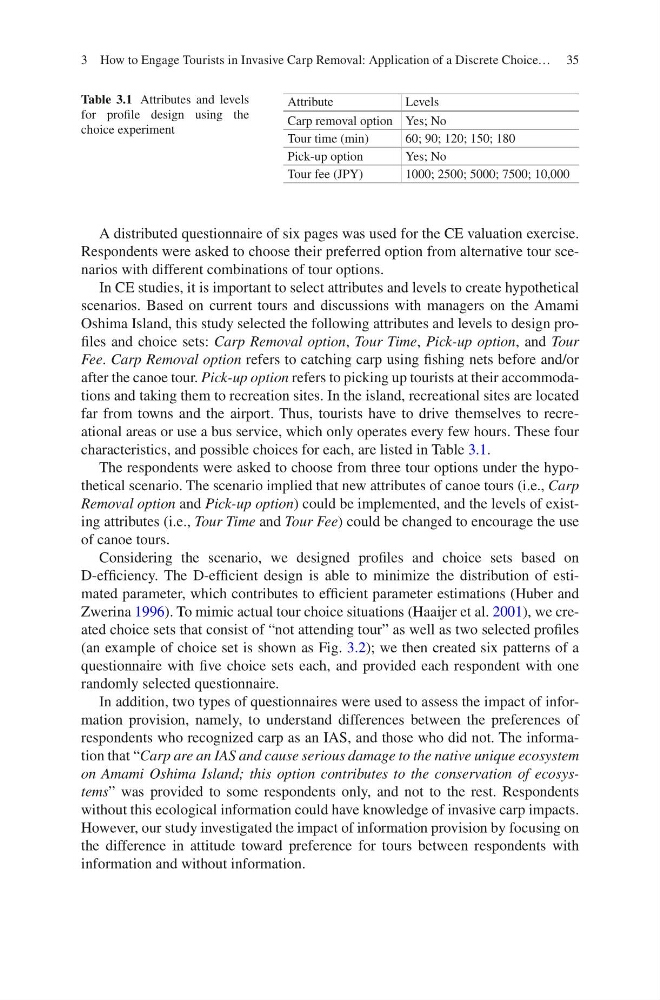
characteristics, and possible choices for each, are listed in Table 3.1.
The respondents were asked to choose from three tour options under the hypothetical scenario. The scenario implied that new attributes of canoe tours (i.e., Carp
Removal option and Pick-up option) could be implemented, and the levels of existing attributes (i.e., Tour Time and Tour Fee) could be changed to encourage the use
of canoe tours.
Considering the scenario, we designed profiles and choice sets based on
D-efficiency. The D-efficient design is able to minimize the distribution of estimated parameter, which contributes to efficient parameter estimations (Huber and
Zwerina 1996). To mimic actual tour choice situations (Haaijer et al. 2001), we created choice sets that consist of “not attending tour” as well as two selected profiles
(an example of choice set is shown as Fig. 3.2); we then created six patterns of a
questionnaire with five choice sets each, and provided each respondent with one
randomly selected questionnaire.
In addition, two types of questionnaires were used to assess the impact of information provision, namely, to understand differences between the preferences of
respondents who recognized carp as an IAS, and those who did not. The information that “Carp are an IAS and cause serious damage to the native unique ecosystem
on Amami Oshima Island; this option contributes to the conservation of ecosystems” was provided to some respondents only, and not to the rest. Respondents
without this ecological information could have knowledge of invasive carp impacts.
However, our study investigated the impact of information provision by focusing on
the difference in attitude toward preference for tours between respondents with
information and without information.
Table 3.1 Attributes and levels
for profile design using the
choice experiment
Attribute
Levels
Carp removal option Yes; No
Tour time (min)
60; 90; 120; 150; 180
Pick-up option
Yes; No
Tour fee (JPY)
1000; 2500; 5000; 7500; 10,000
3 How to Engage Tourists in Invasive Carp Removal: Application of a Discrete Choice…
A distributed questionnaire of six pages was used for the CE valuation exercise.
Respondents were asked to choose their preferred option from alternative tour scenarios with different combinations of tour options.
In CE studies, it is important to select attributes and levels to create hypothetical
scenarios. Based on current tours and discussions with managers on the Amami
Oshima Island, this study selected the following attributes and levels to design profiles and choice sets: Carp Removal option, Tour Time, Pick-up option, and Tour
Fee. Carp Removal option refers to catching carp using fishing nets before and/or
after the canoe tour. Pick-up option refers to picking up tourists at their accommodations and taking them to recreation sites. In the island, recreational sites are located
far from towns and the airport. Thus, tourists have to drive themselves to recreational areas or use a bus service, which only operates every few hours. These four
characteristics, and possible choices for each, are listed in Table 3.1.
The respondents were asked to choose from three tour options under the hypothetical scenario. The scenario implied that new attributes of canoe tours (i.e., Carp
Removal option and Pick-up option) could be implemented, and the levels of existing attributes (i.e., Tour Time and Tour Fee) could be changed to encourage the use
of canoe tours.
Considering the scenario, we designed profiles and choice sets based on
D-efficiency. The D-efficient design is able to minimize the distribution of estimated parameter, which contributes to efficient parameter estimations (Huber and
Zwerina 1996). To mimic actual tour choice situations (Haaijer et al. 2001), we created choice sets that consist of “not attending tour” as well as two selected profiles
(an example of choice set is shown as Fig. 3.2); we then created six patterns of a
questionnaire with five choice sets each, and provided each respondent with one
randomly selected questionnaire.
In addition, two types of questionnaires were used to assess the impact of information provision, namely, to understand differences between the preferences of
respondents who recognized carp as an IAS, and those who did not. The information that “Carp are an IAS and cause serious damage to the native unique ecosystem
on Amami Oshima Island; this option contributes to the conservation of ecosystems” was provided to some respondents only, and not to the rest. Respondents
without this ecological information could have knowledge of invasive carp impacts.
However, our study investigated the impact of information provision by focusing on
the difference in attitude toward preference for tours between respondents with
information and without information.
Table 3.1 Attributes and levels
for profile design using the
choice experiment
Attribute
Levels
Carp removal option Yes; No
Tour time (min)
60; 90; 120; 150; 180
Pick-up option
Yes; No
Tour fee (JPY)
1000; 2500; 5000; 7500; 10,000
3 How to Engage Tourists in Invasive Carp Removal: Application of a Discrete Choice…