

13
interrelationships among the sectoral policy interventions by each ministry, and on
the comprehensive design or the effectiveness of the integrated ocean policy as a
whole (for example, Cicin-Sain and Knecht 1998; Guneroglu 2015). Also, marine
ecosystems have high uncertainties and fluctuations with very limited scientific
knowledge. And because the objective of the ecosystem conservation are “the matter of societal choices” (Principle 1 of the Ecosystem Approach of the Convention
on Biological Diversity), the expected effects by policy interventions to the stakeholders are important information for the social agreement and the effective coimplementation of the policy interventions (Ban et al. 2013; Ehler 2014; Kittinger
et al. 2014; Schultz et al. 2015; Bodin 2017). Therefore, using a case of the Sekisei
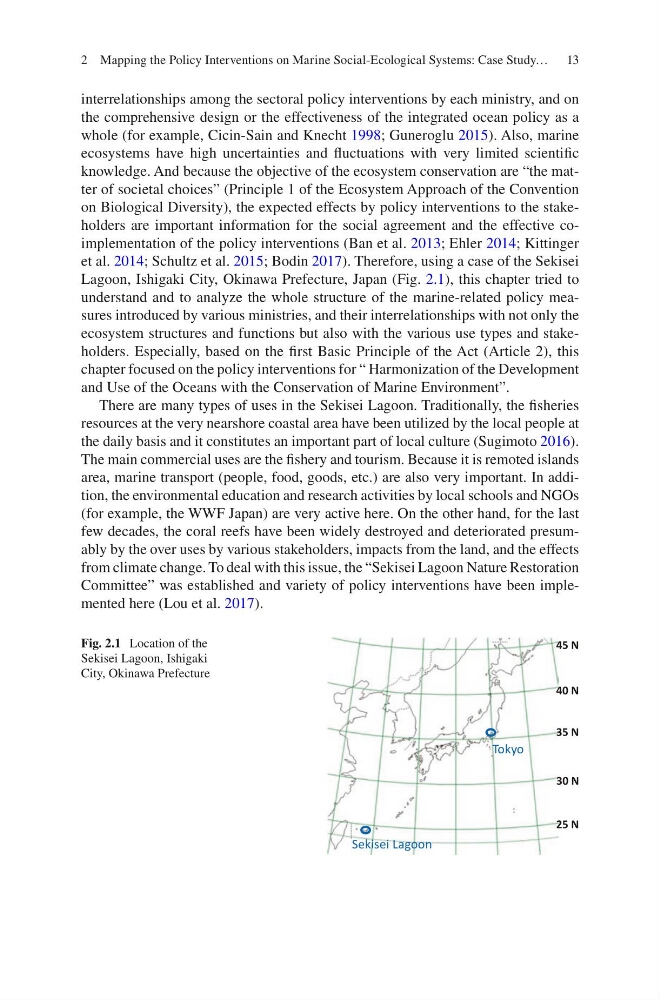
Lagoon, Ishigaki City, Okinawa Prefecture, Japan (Fig. 2.1), this chapter tried to
understand and to analyze the whole structure of the marine-related policy measures introduced by various ministries, and their interrelationships with not only the
ecosystem structures and functions but also with the various use types and stakeholders. Especially, based on the first Basic Principle of the Act (Article 2), this
chapter focused on the policy interventions for “ Harmonization of the Development
and Use of the Oceans with the Conservation of Marine Environment”.
There are many types of uses in the Sekisei Lagoon. Traditionally, the fisheries
resources at the very nearshore coastal area have been utilized by the local people at
the daily basis and it constitutes an important part of local culture (Sugimoto 2016).
The main commercial uses are the fishery and tourism. Because it is remoted islands
area, marine transport (people, food, goods, etc.) are also very important. In addition, the environmental education and research activities by local schools and NGOs
(for example, the WWF Japan) are very active here. On the other hand, for the last
few decades, the coral reefs have been widely destroyed and deteriorated presumably by the over uses by various stakeholders, impacts from the land, and the effects
from climate change. To deal with this issue, the “Sekisei Lagoon Nature Restoration
Committee” was established and variety of policy interventions have been implemented here (Lou et al. 2017).
Sekisei Lagoon
40 N
35 N
45 N
25 N
30 N
Tokyo
Fig. 2.1 Location of the
Sekisei Lagoon, Ishigaki
City, Okinawa Prefecture
2 Mapping the Policy Interventions on Marine Social-Ecological Systems: Case Study…
interrelationships among the sectoral policy interventions by each ministry, and on
the comprehensive design or the effectiveness of the integrated ocean policy as a
whole (for example, Cicin-Sain and Knecht 1998; Guneroglu 2015). Also, marine
ecosystems have high uncertainties and fluctuations with very limited scientific
knowledge. And because the objective of the ecosystem conservation are “the matter of societal choices” (Principle 1 of the Ecosystem Approach of the Convention
on Biological Diversity), the expected effects by policy interventions to the stakeholders are important information for the social agreement and the effective coimplementation of the policy interventions (Ban et al. 2013; Ehler 2014; Kittinger
et al. 2014; Schultz et al. 2015; Bodin 2017). Therefore, using a case of the Sekisei
Lagoon, Ishigaki City, Okinawa Prefecture, Japan (Fig. 2.1), this chapter tried to
understand and to analyze the whole structure of the marine-related policy measures introduced by various ministries, and their interrelationships with not only the
ecosystem structures and functions but also with the various use types and stakeholders. Especially, based on the first Basic Principle of the Act (Article 2), this
chapter focused on the policy interventions for “ Harmonization of the Development
and Use of the Oceans with the Conservation of Marine Environment”.
There are many types of uses in the Sekisei Lagoon. Traditionally, the fisheries
resources at the very nearshore coastal area have been utilized by the local people at
the daily basis and it constitutes an important part of local culture (Sugimoto 2016).
The main commercial uses are the fishery and tourism. Because it is remoted islands
area, marine transport (people, food, goods, etc.) are also very important. In addition, the environmental education and research activities by local schools and NGOs
(for example, the WWF Japan) are very active here. On the other hand, for the last
few decades, the coral reefs have been widely destroyed and deteriorated presumably by the over uses by various stakeholders, impacts from the land, and the effects
from climate change. To deal with this issue, the “Sekisei Lagoon Nature Restoration
Committee” was established and variety of policy interventions have been implemented here (Lou et al. 2017).
Sekisei Lagoon
40 N
35 N
45 N
25 N
30 N
Tokyo
Fig. 2.1 Location of the
Sekisei Lagoon, Ishigaki
City, Okinawa Prefecture
2 Mapping the Policy Interventions on Marine Social-Ecological Systems: Case Study…