

157
Many SPI studies (29) mentioned participation as a key challenge of SPI structure. Capacity building (18 studies) and trust building (16 studies) were also
described as key challenges. Table 8.2 summarizes the common challenges and possible solutions identified in the reviewed papers.
Outcomes
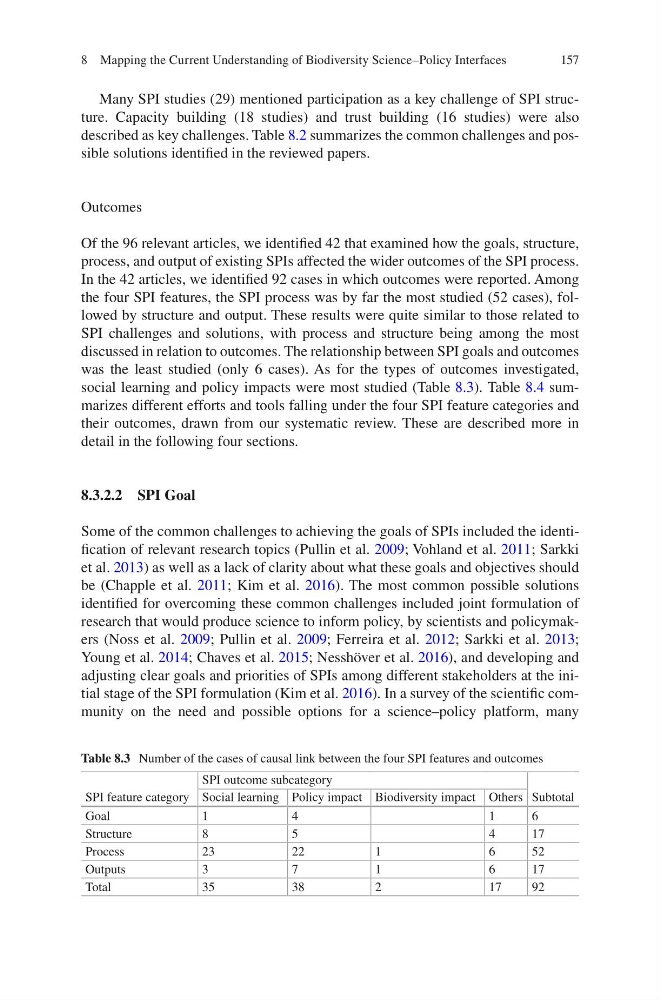
Of the 96 relevant articles, we identified 42 that examined how the goals, structure,
process, and output of existing SPIs affected the wider outcomes of the SPI process.
In the 42 articles, we identified 92 cases in which outcomes were reported. Among
the four SPI features, the SPI process was by far the most studied (52 cases), followed by structure and output. These results were quite similar to those related to
SPI challenges and solutions, with process and structure being among the most
discussed in relation to outcomes. The relationship between SPI goals and outcomes
was the least studied (only 6 cases). As for the types of outcomes investigated,
social learning and policy impacts were most studied (Table 8.3). Table 8.4 summarizes different efforts and tools falling under the four SPI feature categories and
their outcomes, drawn from our systematic review. These are described more in
detail in the following four sections.
8.3.2.2 SPI Goal
Some of the common challenges to achieving the goals of SPIs included the identification of relevant research topics (Pullin et al. 2009; Vohland et al. 2011; Sarkki
et al. 2013) as well as a lack of clarity about what these goals and objectives should
be (Chapple et al. 2011; Kim et al. 2016). The most common possible solutions
identified for overcoming these common challenges included joint formulation of
research that would produce science to inform policy, by scientists and policymakers (Noss et al. 2009; Pullin et al. 2009; Ferreira et al. 2012; Sarkki et al. 2013;
Young et al. 2014; Chaves et al. 2015; Nesshöver et al. 2016), and developing and
adjusting clear goals and priorities of SPIs among different stakeholders at the initial stage of the SPI formulation (Kim et al. 2016). In a survey of the scientific community on the need and possible options for a science–policy platform, many
Table 8.3 Number of the cases of causal link between the four SPI features and outcomes
SPI feature category
SPI outcome subcategory
Subtotal
Social learning Policy impact Biodiversity impact Others
Goal
1
4
1
6
Structure
8
5
4
17
Process
23
22
1
6
52
Outputs
3
7
1
6
17
Total
35
38
2
17
92
8 Mapping the Current Understanding of Biodiversity Science–Policy Interfaces
Many SPI studies (29) mentioned participation as a key challenge of SPI structure. Capacity building (18 studies) and trust building (16 studies) were also
described as key challenges. Table 8.2 summarizes the common challenges and possible solutions identified in the reviewed papers.
Outcomes
Of the 96 relevant articles, we identified 42 that examined how the goals, structure,
process, and output of existing SPIs affected the wider outcomes of the SPI process.
In the 42 articles, we identified 92 cases in which outcomes were reported. Among
the four SPI features, the SPI process was by far the most studied (52 cases), followed by structure and output. These results were quite similar to those related to
SPI challenges and solutions, with process and structure being among the most
discussed in relation to outcomes. The relationship between SPI goals and outcomes
was the least studied (only 6 cases). As for the types of outcomes investigated,
social learning and policy impacts were most studied (Table 8.3). Table 8.4 summarizes different efforts and tools falling under the four SPI feature categories and
their outcomes, drawn from our systematic review. These are described more in
detail in the following four sections.
8.3.2.2 SPI Goal
Some of the common challenges to achieving the goals of SPIs included the identification of relevant research topics (Pullin et al. 2009; Vohland et al. 2011; Sarkki
et al. 2013) as well as a lack of clarity about what these goals and objectives should
be (Chapple et al. 2011; Kim et al. 2016). The most common possible solutions
identified for overcoming these common challenges included joint formulation of
research that would produce science to inform policy, by scientists and policymakers (Noss et al. 2009; Pullin et al. 2009; Ferreira et al. 2012; Sarkki et al. 2013;
Young et al. 2014; Chaves et al. 2015; Nesshöver et al. 2016), and developing and
adjusting clear goals and priorities of SPIs among different stakeholders at the initial stage of the SPI formulation (Kim et al. 2016). In a survey of the scientific community on the need and possible options for a science–policy platform, many
Table 8.3 Number of the cases of causal link between the four SPI features and outcomes
SPI feature category
SPI outcome subcategory
Subtotal
Social learning Policy impact Biodiversity impact Others
Goal
1
4
1
6
Structure
8
5
4
17
Process
23
22
1
6
52
Outputs
3
7
1
6
17
Total
35
38
2
17
92
8 Mapping the Current Understanding of Biodiversity Science–Policy Interfaces