

158
respondents considered decision-making (i.e., policymaking) to be complex, iterative, and often selective in the information used. The authors concluded that joint
formulation of policy would be preferable (Young et al. 2014).
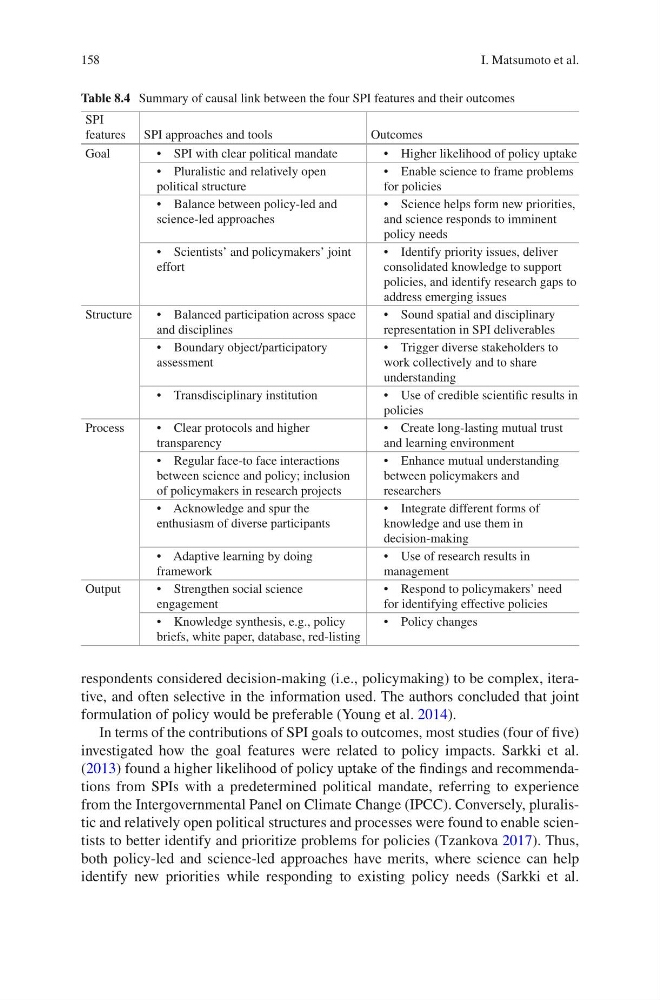
In terms of the contributions of SPI goals to outcomes, most studies (four of five)
investigated how the goal features were related to policy impacts. Sarkki et al.
(2013) found a higher likelihood of policy uptake of the findings and recommendations from SPIs with a predetermined political mandate, referring to experience
from the Intergovernmental Panel on Climate Change (IPCC). Conversely, pluralistic and relatively open political structures and processes were found to enable scientists to better identify and prioritize problems for policies (Tzankova 2017). Thus,
both policy-led and science-led approaches have merits, where science can help
identify new priorities while responding to existing policy needs (Sarkki et al.
Table 8.4 Summary of causal link between the four SPI features and their outcomes
SPI
features SPI approaches and tools
Outcomes
Goal
• SPI with clear political mandate
• Higher likelihood of policy uptake
• Pluralistic and relatively open
political structure
• Enable science to frame problems
for policies
• Balance between policy-led and
science-led approaches
• Science helps form new priorities,
and science responds to imminent
policy needs
• Scientists’ and policymakers’ joint
effort
• Identify priority issues, deliver
consolidated knowledge to support
policies, and identify research gaps to
address emerging issues
Structure
• Balanced participation across space
and disciplines
• Sound spatial and disciplinary
representation in SPI deliverables
• Boundary object/participatory
assessment
• Trigger diverse stakeholders to
work collectively and to share
understanding
• Transdisciplinary institution
• Use of credible scientific results in
policies
Process
• Clear protocols and higher
transparency
• Create long-lasting mutual trust
and learning environment
• Regular face-to face interactions
between science and policy; inclusion
of policymakers in research projects
• Enhance mutual understanding
between policymakers and
researchers
• Acknowledge and spur the
enthusiasm of diverse participants
• Integrate different forms of
knowledge and use them in
decision-making
• Adaptive learning by doing
framework
• Use of research results in
management
Output
• Strengthen social science
engagement
• Respond to policymakers’ need
for identifying effective policies
• Knowledge synthesis, e.g., policy
briefs, white paper, database, red-listing
• Policy changes
I. Matsumoto et al.
respondents considered decision-making (i.e., policymaking) to be complex, iterative, and often selective in the information used. The authors concluded that joint
formulation of policy would be preferable (Young et al. 2014).
In terms of the contributions of SPI goals to outcomes, most studies (four of five)
investigated how the goal features were related to policy impacts. Sarkki et al.
(2013) found a higher likelihood of policy uptake of the findings and recommendations from SPIs with a predetermined political mandate, referring to experience
from the Intergovernmental Panel on Climate Change (IPCC). Conversely, pluralistic and relatively open political structures and processes were found to enable scientists to better identify and prioritize problems for policies (Tzankova 2017). Thus,
both policy-led and science-led approaches have merits, where science can help
identify new priorities while responding to existing policy needs (Sarkki et al.
Table 8.4 Summary of causal link between the four SPI features and their outcomes
SPI
features SPI approaches and tools
Outcomes
Goal
• SPI with clear political mandate
• Higher likelihood of policy uptake
• Pluralistic and relatively open
political structure
• Enable science to frame problems
for policies
• Balance between policy-led and
science-led approaches
• Science helps form new priorities,
and science responds to imminent
policy needs
• Scientists’ and policymakers’ joint
effort
• Identify priority issues, deliver
consolidated knowledge to support
policies, and identify research gaps to
address emerging issues
Structure
• Balanced participation across space
and disciplines
• Sound spatial and disciplinary
representation in SPI deliverables
• Boundary object/participatory
assessment
• Trigger diverse stakeholders to
work collectively and to share
understanding
• Transdisciplinary institution
• Use of credible scientific results in
policies
Process
• Clear protocols and higher
transparency
• Create long-lasting mutual trust
and learning environment
• Regular face-to face interactions
between science and policy; inclusion
of policymakers in research projects
• Enhance mutual understanding
between policymakers and
researchers
• Acknowledge and spur the
enthusiasm of diverse participants
• Integrate different forms of
knowledge and use them in
decision-making
• Adaptive learning by doing
framework
• Use of research results in
management
Output
• Strengthen social science
engagement
• Respond to policymakers’ need
for identifying effective policies
• Knowledge synthesis, e.g., policy
briefs, white paper, database, red-listing
• Policy changes
I. Matsumoto et al.