

152
considered an indication of their effectiveness. SPI outcomes were captured by their
reported impacts, broadly categorized as social learning impacts, policy impacts,
behavioural changes, and biodiversity impacts. The subcategories of SPI features,
as listed in Table 8.1, were used as units to analyse impacts.
8.3 Results and Discussion
We identified 178 peer-reviewed articles, published from 1990 to April 6, 2017,
with titles, keywords, or abstracts containing our search terms. Ninety-six of these
were found to be directly relevant to our review of biodiversity SPIs, which discussed
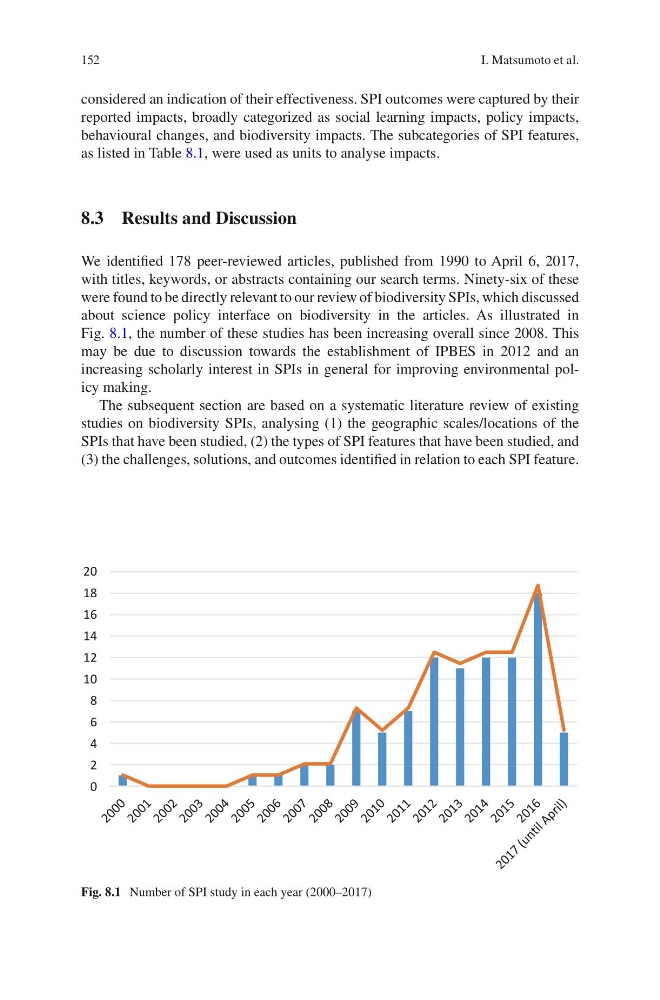
about science policy interface on biodiversity in the articles. As illustrated in
Fig. 8.1, the number of these studies has been increasing overall since 2008. This
may be due to discussion towards the establishment of IPBES in 2012 and an
increasing scholarly interest in SPIs in general for improving environmental policy making.
The subsequent section are based on a systematic literature review of existing
studies on biodiversity SPIs, analysing (1) the geographic scales/locations of the
SPIs that have been studied, (2) the types of SPI features that have been studied, and
(3) the challenges, solutions, and outcomes identified in relation to each SPI feature.
20
18
16
12
14
10
8
6
4
2
0
Fig. 8.1 Number of SPI study in each year (2000–2017)
I. Matsumoto et al.
considered an indication of their effectiveness. SPI outcomes were captured by their
reported impacts, broadly categorized as social learning impacts, policy impacts,
behavioural changes, and biodiversity impacts. The subcategories of SPI features,
as listed in Table 8.1, were used as units to analyse impacts.
8.3 Results and Discussion
We identified 178 peer-reviewed articles, published from 1990 to April 6, 2017,
with titles, keywords, or abstracts containing our search terms. Ninety-six of these
were found to be directly relevant to our review of biodiversity SPIs, which discussed
about science policy interface on biodiversity in the articles. As illustrated in
Fig. 8.1, the number of these studies has been increasing overall since 2008. This
may be due to discussion towards the establishment of IPBES in 2012 and an
increasing scholarly interest in SPIs in general for improving environmental policy making.
The subsequent section are based on a systematic literature review of existing
studies on biodiversity SPIs, analysing (1) the geographic scales/locations of the
SPIs that have been studied, (2) the types of SPI features that have been studied, and
(3) the challenges, solutions, and outcomes identified in relation to each SPI feature.
20
18
16
12
14
10
8
6
4
2
0
Fig. 8.1 Number of SPI study in each year (2000–2017)
I. Matsumoto et al.