

153
8.3.1 Distribution of SPI Studies
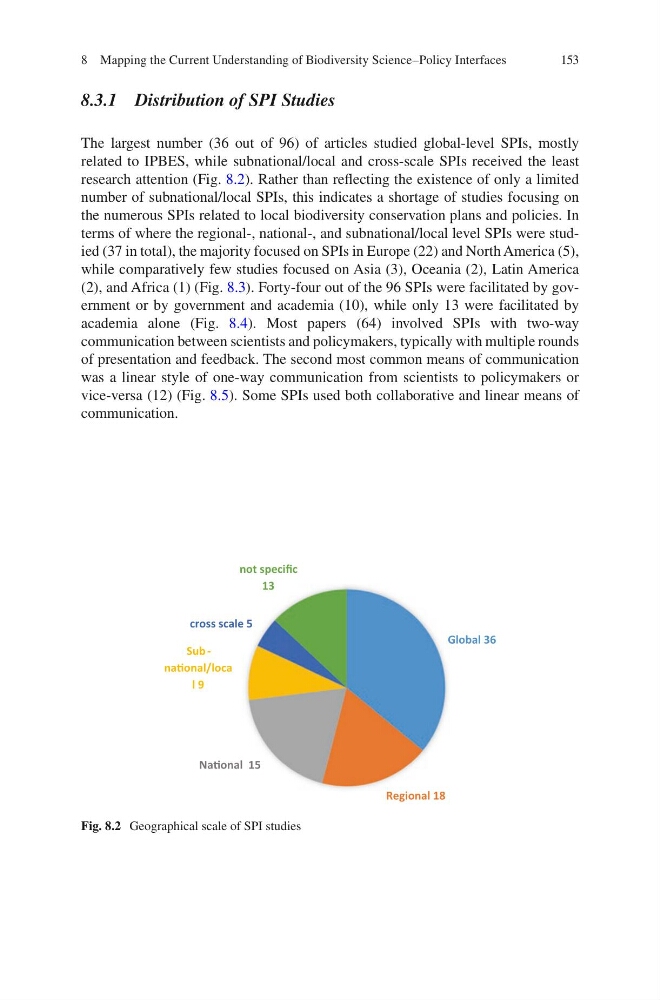
The largest number (36 out of 96) of articles studied global-level SPIs, mostly
related to IPBES, while subnational/local and cross-scale SPIs received the least
research attention (Fig. 8.2). Rather than reflecting the existence of only a limited
number of subnational/local SPIs, this indicates a shortage of studies focusing on
the numerous SPIs related to local biodiversity conservation plans and policies. In
terms of where the regional-, national-, and subnational/local level SPIs were studied (37 in total), the majority focused on SPIs in Europe (22) and North America (5),
while comparatively few studies focused on Asia (3), Oceania (2), Latin America
(2), and Africa (1) (Fig. 8.3). Forty-four out of the 96 SPIs were facilitated by government or by government and academia (10), while only 13 were facilitated by
academia alone (Fig. 8.4). Most papers (64) involved SPIs with two-way
communication between scientists and policymakers, typically with multiple rounds
of presentation and feedback. The second most common means of communication
was a linear style of one-way communication from scientists to policymakers or
vice- versa (12) (Fig. 8.5). Some SPIs used both collaborative and linear means of
communication.
Global 36
Regional 18
NaƟonal 15
Sub -
naƟonal/loca
l 9
cross scale 5
not specific
13
Fig. 8.2 Geographical scale of SPI studies
8 Mapping the Current Understanding of Biodiversity Science–Policy Interfaces
8.3.1 Distribution of SPI Studies
The largest number (36 out of 96) of articles studied global-level SPIs, mostly
related to IPBES, while subnational/local and cross-scale SPIs received the least
research attention (Fig. 8.2). Rather than reflecting the existence of only a limited
number of subnational/local SPIs, this indicates a shortage of studies focusing on
the numerous SPIs related to local biodiversity conservation plans and policies. In
terms of where the regional-, national-, and subnational/local level SPIs were studied (37 in total), the majority focused on SPIs in Europe (22) and North America (5),
while comparatively few studies focused on Asia (3), Oceania (2), Latin America
(2), and Africa (1) (Fig. 8.3). Forty-four out of the 96 SPIs were facilitated by government or by government and academia (10), while only 13 were facilitated by
academia alone (Fig. 8.4). Most papers (64) involved SPIs with two-way
communication between scientists and policymakers, typically with multiple rounds
of presentation and feedback. The second most common means of communication
was a linear style of one-way communication from scientists to policymakers or
vice- versa (12) (Fig. 8.5). Some SPIs used both collaborative and linear means of
communication.
Global 36
Regional 18
NaƟonal 15
Sub -
naƟonal/loca
l 9
cross scale 5
not specific
13
Fig. 8.2 Geographical scale of SPI studies
8 Mapping the Current Understanding of Biodiversity Science–Policy Interfaces