

128
solution sub-types at the local level in all three sub-regions (Fig. 7.2). These solutions target an increase in the number of categories of actors that hold benefit rights
or that are included in decision-making processes.
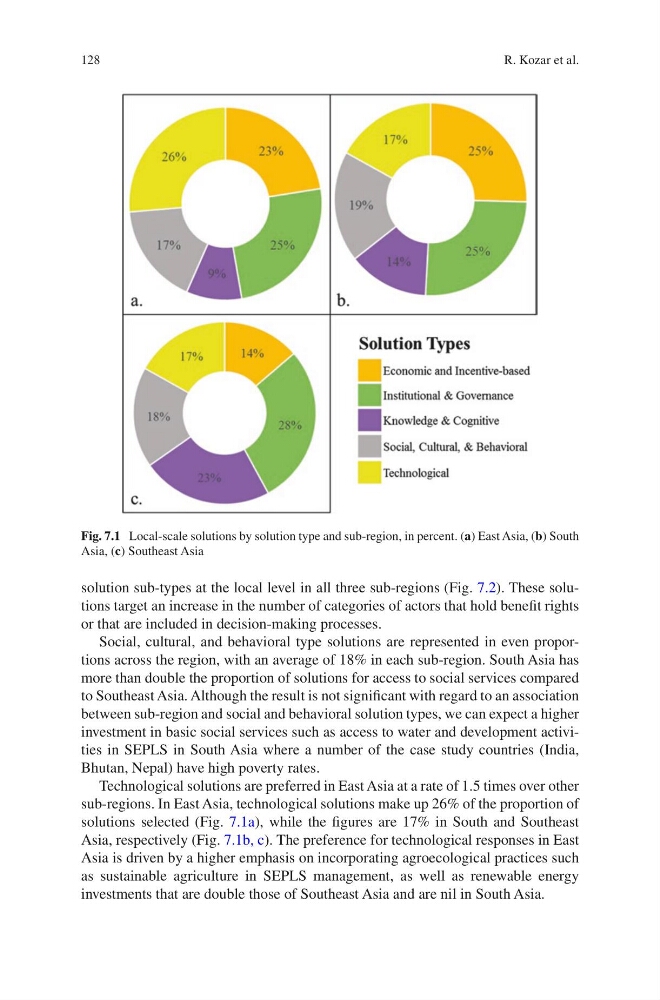
Social, cultural, and behavioral type solutions are represented in even proportions across the region, with an average of 18% in each sub-region. South Asia has
more than double the proportion of solutions for access to social services compared
to Southeast Asia. Although the result is not significant with regard to an association
between sub-region and social and behavioral solution types, we can expect a higher
investment in basic social services such as access to water and development activities in SEPLS in South Asia where a number of the case study countries (India,
Bhutan, Nepal) have high poverty rates.
Technological solutions are preferred in East Asia at a rate of 1.5 times over other
sub-regions. In East Asia, technological solutions make up 26% of the proportion of
solutions selected (Fig. 7.1a), while the figures are 17% in South and Southeast
Asia, respectively (Fig. 7.1b, c). The preference for technological responses in East
Asia is driven by a higher emphasis on incorporating agroecological practices such
as sustainable agriculture in SEPLS management, as well as renewable energy
investments that are double those of Southeast Asia and are nil in South Asia.
Fig. 7.1 Local-scale solutions by solution type and sub-region, in percent. (a) East Asia, (b) South
Asia, (c) Southeast Asia
R. Kozar et al.
solution sub-types at the local level in all three sub-regions (Fig. 7.2). These solutions target an increase in the number of categories of actors that hold benefit rights
or that are included in decision-making processes.
Social, cultural, and behavioral type solutions are represented in even proportions across the region, with an average of 18% in each sub-region. South Asia has
more than double the proportion of solutions for access to social services compared
to Southeast Asia. Although the result is not significant with regard to an association
between sub-region and social and behavioral solution types, we can expect a higher
investment in basic social services such as access to water and development activities in SEPLS in South Asia where a number of the case study countries (India,
Bhutan, Nepal) have high poverty rates.
Technological solutions are preferred in East Asia at a rate of 1.5 times over other
sub-regions. In East Asia, technological solutions make up 26% of the proportion of
solutions selected (Fig. 7.1a), while the figures are 17% in South and Southeast
Asia, respectively (Fig. 7.1b, c). The preference for technological responses in East
Asia is driven by a higher emphasis on incorporating agroecological practices such
as sustainable agriculture in SEPLS management, as well as renewable energy
investments that are double those of Southeast Asia and are nil in South Asia.
Fig. 7.1 Local-scale solutions by solution type and sub-region, in percent. (a) East Asia, (b) South
Asia, (c) Southeast Asia
R. Kozar et al.