

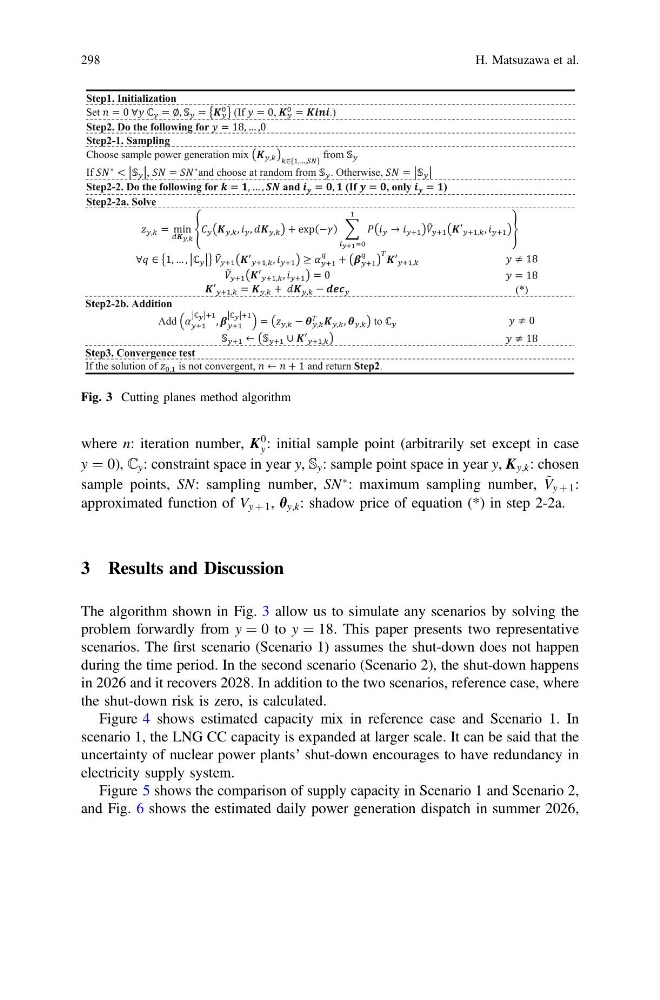
where n: iteration number, K
0
y : initial sample point (arbitrarily set except in case
y ¼ 0), C y : constraint space in year y, S y : sample point space in year y, K y;k : chosen
sample points, SN: sampling number, SN
à : maximum sampling number, ~
V y þ 1 :
approximated function of V y þ 1 , h y;k : shadow price of equation (*) in step 2-2a.
3 Results and Discussion
The algorithm shown in Fig. 3 allow us to simulate any scenarios by solving the
problem forwardly from y ¼ 0 to y ¼ 18. This paper presents two representative
scenarios. The first scenario (Scenario 1) assumes the shut-down does not happen
during the time period. In the second scenario (Scenario 2), the shut-down happens
in 2026 and it recovers 2028. In addition to the two scenarios, reference case, where
the shut-down risk is zero, is calculated.
Figure 4 shows estimated capacity mix in reference case and Scenario 1. In
scenario 1, the LNG CC capacity is expanded at larger scale. It can be said that the
uncertainty of nuclear power plants’ shut-down encourages to have redundancy in
electricity supply system.
Figure 5 shows the comparison of supply capacity in Scenario 1 and Scenario 2,
and Fig. 6 shows the estimated daily power generation dispatch in summer 2026,
Fig. 3 Cutting planes method algorithm
298
H. Matsuzawa et al.
0
y : initial sample point (arbitrarily set except in case
y ¼ 0), C y : constraint space in year y, S y : sample point space in year y, K y;k : chosen
sample points, SN: sampling number, SN
à : maximum sampling number, ~
V y þ 1 :
approximated function of V y þ 1 , h y;k : shadow price of equation (*) in step 2-2a.
3 Results and Discussion
The algorithm shown in Fig. 3 allow us to simulate any scenarios by solving the
problem forwardly from y ¼ 0 to y ¼ 18. This paper presents two representative
scenarios. The first scenario (Scenario 1) assumes the shut-down does not happen
during the time period. In the second scenario (Scenario 2), the shut-down happens
in 2026 and it recovers 2028. In addition to the two scenarios, reference case, where
the shut-down risk is zero, is calculated.
Figure 4 shows estimated capacity mix in reference case and Scenario 1. In
scenario 1, the LNG CC capacity is expanded at larger scale. It can be said that the
uncertainty of nuclear power plants’ shut-down encourages to have redundancy in
electricity supply system.
Figure 5 shows the comparison of supply capacity in Scenario 1 and Scenario 2,
and Fig. 6 shows the estimated daily power generation dispatch in summer 2026,
Fig. 3 Cutting planes method algorithm
298
H. Matsuzawa et al.