

MTTR ¼
1
l
ð26Þ
P 0 ! 1
ð
Þ¼1 À exp À1=MTTR
ð
Þ
ð 27Þ
P 1 ! 0
ð
Þ¼1 À exp À1=MTBD
ð
Þ
ð 28Þ
where k: disruption rate, R: the reliability of nuclear power plants’ availability, f y
ð Þ:
disruption density function, MTBD: mean time between disruptions (year), MTTR:
mean time to recovery (year).
2.3 Calculation Algorithm
To solve strictly this model formulated using stochastic dynamic programming
needs a lot of computations because of the high dimensionality of K y , and calculation is difficult due to computational constraints. This problem is called “the curse
of dimensionality”. Therefore, as an approximate solution method to stochastic
dynamic programming, cutting planes method [6] is adopted in this paper. This
method uses the convexity of V y K y ; i y
À
Á
, which characteristic is due to the linear
programming technique employed in Eqs. (1)–(28), and V y K y ; i y
À
Á
is approximated
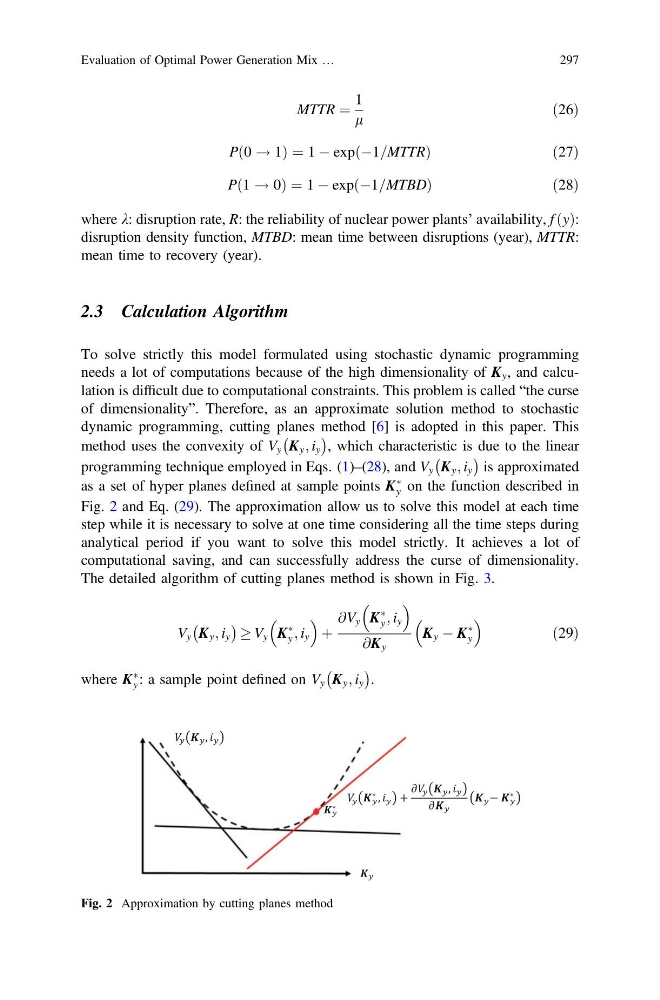
as a set of hyper planes defined at sample points K
Ã
y on the function described in
Fig. 2 and Eq. (29). The approximation allow us to solve this model at each time
step while it is necessary to solve at one time considering all the time steps during
analytical period if you want to solve this model strictly. It achieves a lot of
computational saving, and can successfully address the curse of dimensionality.
The detailed algorithm of cutting planes method is shown in Fig. 3.
V y K y ; i y
À
Á ! V y K
Ã
y ; i y
þ
@V y K
Ã
y ; i y
@K y
K y À K
Ã
y
ð29Þ
where K
Ã
y : a sample point defined on V y K y ; i y
À
Á
.
Fig. 2 Approximation by cutting planes method
Evaluation of Optimal Power Generation Mix …
297
1
l
ð26Þ
P 0 ! 1
ð
Þ¼1 À exp À1=MTTR
ð
Þ
ð 27Þ
P 1 ! 0
ð
Þ¼1 À exp À1=MTBD
ð
Þ
ð 28Þ
where k: disruption rate, R: the reliability of nuclear power plants’ availability, f y
ð Þ:
disruption density function, MTBD: mean time between disruptions (year), MTTR:
mean time to recovery (year).
2.3 Calculation Algorithm
To solve strictly this model formulated using stochastic dynamic programming
needs a lot of computations because of the high dimensionality of K y , and calculation is difficult due to computational constraints. This problem is called “the curse
of dimensionality”. Therefore, as an approximate solution method to stochastic
dynamic programming, cutting planes method [6] is adopted in this paper. This
method uses the convexity of V y K y ; i y
À
Á
, which characteristic is due to the linear
programming technique employed in Eqs. (1)–(28), and V y K y ; i y
À
Á
is approximated
as a set of hyper planes defined at sample points K
Ã
y on the function described in
Fig. 2 and Eq. (29). The approximation allow us to solve this model at each time
step while it is necessary to solve at one time considering all the time steps during
analytical period if you want to solve this model strictly. It achieves a lot of
computational saving, and can successfully address the curse of dimensionality.
The detailed algorithm of cutting planes method is shown in Fig. 3.
V y K y ; i y
À
Á ! V y K
Ã
y ; i y
þ
@V y K
Ã
y ; i y
@K y
K y À K
Ã
y
ð29Þ
where K
Ã
y : a sample point defined on V y K y ; i y
À
Á
.
Fig. 2 Approximation by cutting planes method
Evaluation of Optimal Power Generation Mix …
297