

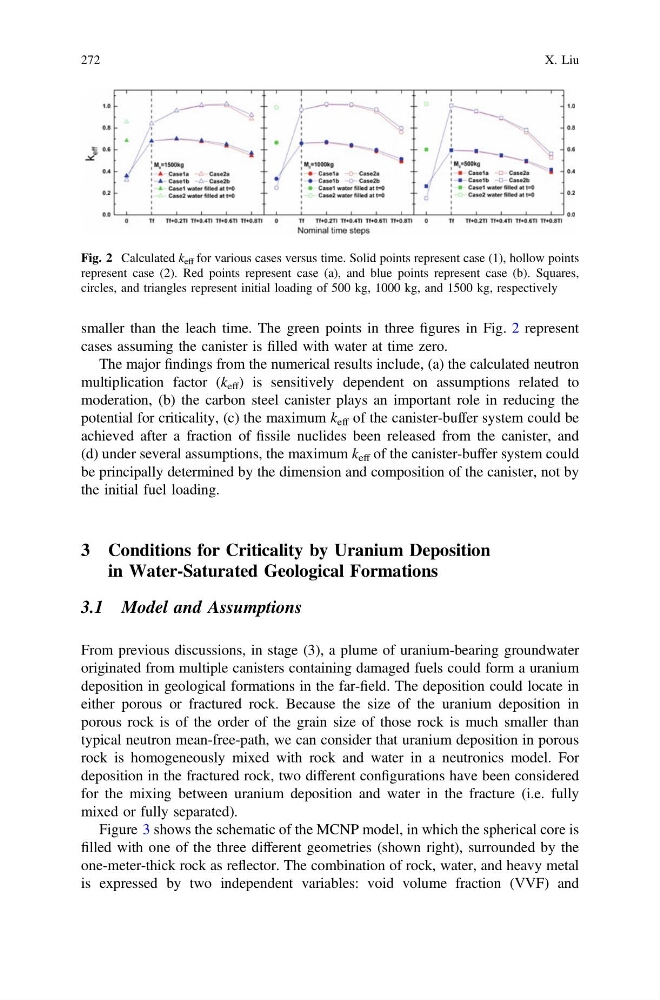
smaller than the leach time. The green points in three figures in Fig. 2 represent
cases assuming the canister is filled with water at time zero.
The major findings from the numerical results include, (a) the calculated neutron
multiplication factor (k eff ) is sensitively dependent on assumptions related to
moderation, (b) the carbon steel canister plays an important role in reducing the
potential for criticality, (c) the maximum k eff of the canister-buffer system could be
achieved after a fraction of fissile nuclides been released from the canister, and
(d) under several assumptions, the maximum k eff of the canister-buffer system could
be principally determined by the dimension and composition of the canister, not by
the initial fuel loading.
3 Conditions for Criticality by Uranium Deposition
in Water-Saturated Geological Formations
3.1 Model and Assumptions
From previous discussions, in stage (3), a plume of uranium-bearing groundwater
originated from multiple canisters containing damaged fuels could form a uranium
deposition in geological formations in the far-field. The deposition could locate in
either porous or fractured rock. Because the size of the uranium deposition in
porous rock is of the order of the grain size of those rock is much smaller than
typical neutron mean-free-path, we can consider that uranium deposition in porous
rock is homogeneously mixed with rock and water in a neutronics model. For
deposition in the fractured rock, two different configurations have been considered
for the mixing between uranium deposition and water in the fracture (i.e. fully
mixed or fully separated).
Figure 3 shows the schematic of the MCNP model, in which the spherical core is
filled with one of the three different geometries (shown right), surrounded by the
one-meter-thick rock as reflector. The combination of rock, water, and heavy metal
is expressed by two independent variables: void volume fraction (VVF) and
Fig. 2 Calculated k eff for various cases versus time. Solid points represent case (1), hollow points
represent case (2). Red points represent case (a), and blue points represent case (b). Squares,
circles, and triangles represent initial loading of 500 kg, 1000 kg, and 1500 kg, respectively
272
X. Liu
cases assuming the canister is filled with water at time zero.
The major findings from the numerical results include, (a) the calculated neutron
multiplication factor (k eff ) is sensitively dependent on assumptions related to
moderation, (b) the carbon steel canister plays an important role in reducing the
potential for criticality, (c) the maximum k eff of the canister-buffer system could be
achieved after a fraction of fissile nuclides been released from the canister, and
(d) under several assumptions, the maximum k eff of the canister-buffer system could
be principally determined by the dimension and composition of the canister, not by
the initial fuel loading.
3 Conditions for Criticality by Uranium Deposition
in Water-Saturated Geological Formations
3.1 Model and Assumptions
From previous discussions, in stage (3), a plume of uranium-bearing groundwater
originated from multiple canisters containing damaged fuels could form a uranium
deposition in geological formations in the far-field. The deposition could locate in
either porous or fractured rock. Because the size of the uranium deposition in
porous rock is of the order of the grain size of those rock is much smaller than
typical neutron mean-free-path, we can consider that uranium deposition in porous
rock is homogeneously mixed with rock and water in a neutronics model. For
deposition in the fractured rock, two different configurations have been considered
for the mixing between uranium deposition and water in the fracture (i.e. fully
mixed or fully separated).
Figure 3 shows the schematic of the MCNP model, in which the spherical core is
filled with one of the three different geometries (shown right), surrounded by the
one-meter-thick rock as reflector. The combination of rock, water, and heavy metal
is expressed by two independent variables: void volume fraction (VVF) and
Fig. 2 Calculated k eff for various cases versus time. Solid points represent case (1), hollow points
represent case (2). Red points represent case (a), and blue points represent case (b). Squares,
circles, and triangles represent initial loading of 500 kg, 1000 kg, and 1500 kg, respectively
272
X. Liu