

(T f ) of the carbon steel canister is assumed to be 1000 years. After canister failure,
water fills the canister, and the canister is modeled as a porous medium with
porosity of 0.3. The geometry of neutronics model for the damaged fuel debris at
different time steps have been built based on our literature review on defueling
process for the Three Mile Island (TMI) accident [6]. A hexagonal lattice of
spherical fuel particles is assumed. The pitch distance between particles is assumed
to be either (1) make particles contact each other or (2) make the particles lattice
fully fill the canister. In the leaching steps, the released materials from the damaged
fuel particles is assumed to be either (a) removed from the canister-buffer system, or
(b) be homogeneously mixed with the corroded canister. Combinations of the above
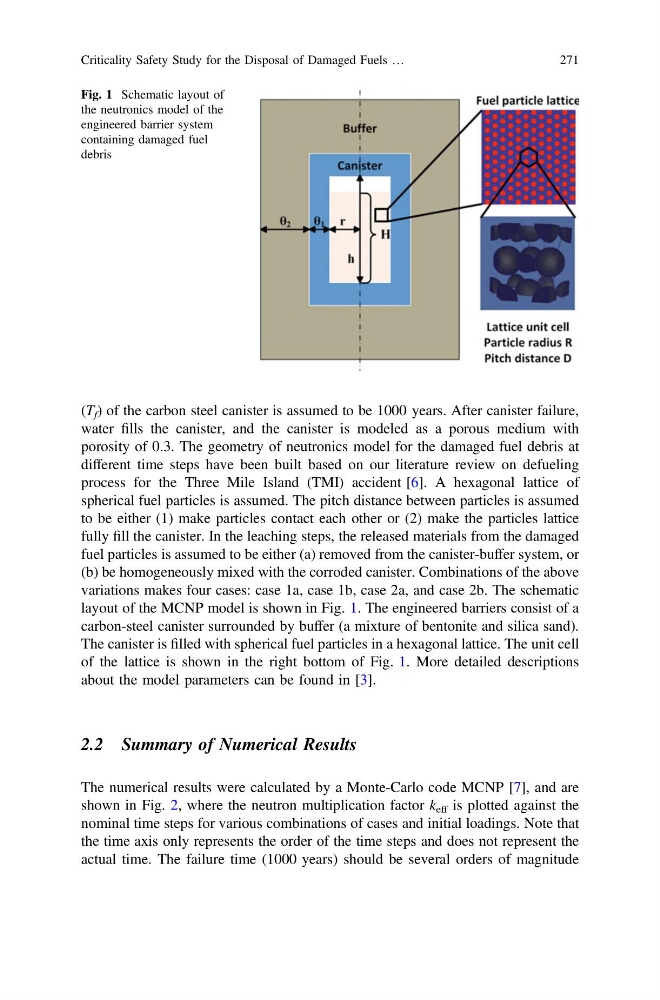
variations makes four cases: case 1a, case 1b, case 2a, and case 2b. The schematic
layout of the MCNP model is shown in Fig. 1. The engineered barriers consist of a
carbon-steel canister surrounded by buffer (a mixture of bentonite and silica sand).
The canister is filled with spherical fuel particles in a hexagonal lattice. The unit cell
of the lattice is shown in the right bottom of Fig. 1. More detailed descriptions
about the model parameters can be found in [3].
2.2 Summary of Numerical Results
The numerical results were calculated by a Monte-Carlo code MCNP [7], and are
shown in Fig. 2, where the neutron multiplication factor k eff is plotted against the
nominal time steps for various combinations of cases and initial loadings. Note that
the time axis only represents the order of the time steps and does not represent the
actual time. The failure time (1000 years) should be several orders of magnitude
Fig. 1 Schematic layout of
the neutronics model of the
engineered barrier system
containing damaged fuel
debris
Criticality Safety Study for the Disposal of Damaged Fuels …
271
water fills the canister, and the canister is modeled as a porous medium with
porosity of 0.3. The geometry of neutronics model for the damaged fuel debris at
different time steps have been built based on our literature review on defueling
process for the Three Mile Island (TMI) accident [6]. A hexagonal lattice of
spherical fuel particles is assumed. The pitch distance between particles is assumed
to be either (1) make particles contact each other or (2) make the particles lattice
fully fill the canister. In the leaching steps, the released materials from the damaged
fuel particles is assumed to be either (a) removed from the canister-buffer system, or
(b) be homogeneously mixed with the corroded canister. Combinations of the above
variations makes four cases: case 1a, case 1b, case 2a, and case 2b. The schematic
layout of the MCNP model is shown in Fig. 1. The engineered barriers consist of a
carbon-steel canister surrounded by buffer (a mixture of bentonite and silica sand).
The canister is filled with spherical fuel particles in a hexagonal lattice. The unit cell
of the lattice is shown in the right bottom of Fig. 1. More detailed descriptions
about the model parameters can be found in [3].
2.2 Summary of Numerical Results
The numerical results were calculated by a Monte-Carlo code MCNP [7], and are
shown in Fig. 2, where the neutron multiplication factor k eff is plotted against the
nominal time steps for various combinations of cases and initial loadings. Note that
the time axis only represents the order of the time steps and does not represent the
actual time. The failure time (1000 years) should be several orders of magnitude
Fig. 1 Schematic layout of
the neutronics model of the
engineered barrier system
containing damaged fuel
debris
Criticality Safety Study for the Disposal of Damaged Fuels …
271