

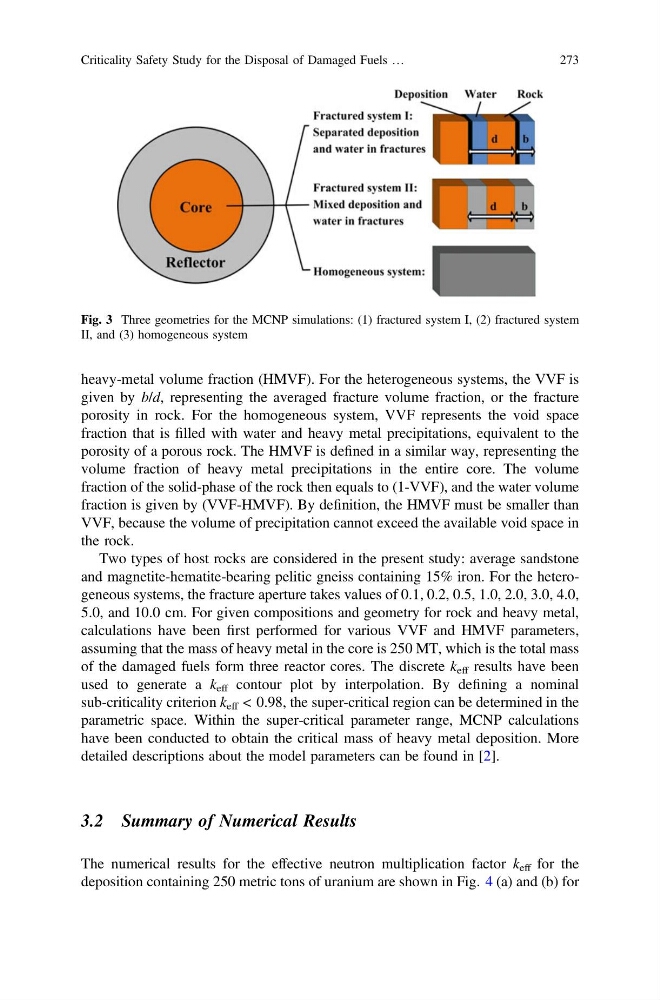
heavy-metal volume fraction (HMVF). For the heterogeneous systems, the VVF is
given by b/d, representing the averaged fracture volume fraction, or the fracture
porosity in rock. For the homogeneous system, VVF represents the void space
fraction that is filled with water and heavy metal precipitations, equivalent to the
porosity of a porous rock. The HMVF is defined in a similar way, representing the
volume fraction of heavy metal precipitations in the entire core. The volume
fraction of the solid-phase of the rock then equals to (1-VVF), and the water volume
fraction is given by (VVF-HMVF). By definition, the HMVF must be smaller than
VVF, because the volume of precipitation cannot exceed the available void space in
the rock.
Two types of host rocks are considered in the present study: average sandstone
and magnetite-hematite-bearing pelitic gneiss containing 15% iron. For the heterogeneous systems, the fracture aperture takes values of 0.1, 0.2, 0.5, 1.0, 2.0, 3.0, 4.0,
5.0, and 10.0 cm. For given compositions and geometry for rock and heavy metal,
calculations have been first performed for various VVF and HMVF parameters,
assuming that the mass of heavy metal in the core is 250 MT, which is the total mass
of the damaged fuels form three reactor cores. The discrete k eff results have been
used to generate a k eff contour plot by interpolation. By defining a nominal
sub-criticality criterion k eff < 0.98, the super-critical region can be determined in the
parametric space. Within the super-critical parameter range, MCNP calculations
have been conducted to obtain the critical mass of heavy metal deposition. More
detailed descriptions about the model parameters can be found in [2].
3.2 Summary of Numerical Results
The numerical results for the effective neutron multiplication factor k eff for the
deposition containing 250 metric tons of uranium are shown in Fig. 4 (a) and (b) for
Fig. 3 Three geometries for the MCNP simulations: (1) fractured system I, (2) fractured system
II, and (3) homogeneous system
Criticality Safety Study for the Disposal of Damaged Fuels …
273
given by b/d, representing the averaged fracture volume fraction, or the fracture
porosity in rock. For the homogeneous system, VVF represents the void space
fraction that is filled with water and heavy metal precipitations, equivalent to the
porosity of a porous rock. The HMVF is defined in a similar way, representing the
volume fraction of heavy metal precipitations in the entire core. The volume
fraction of the solid-phase of the rock then equals to (1-VVF), and the water volume
fraction is given by (VVF-HMVF). By definition, the HMVF must be smaller than
VVF, because the volume of precipitation cannot exceed the available void space in
the rock.
Two types of host rocks are considered in the present study: average sandstone
and magnetite-hematite-bearing pelitic gneiss containing 15% iron. For the heterogeneous systems, the fracture aperture takes values of 0.1, 0.2, 0.5, 1.0, 2.0, 3.0, 4.0,
5.0, and 10.0 cm. For given compositions and geometry for rock and heavy metal,
calculations have been first performed for various VVF and HMVF parameters,
assuming that the mass of heavy metal in the core is 250 MT, which is the total mass
of the damaged fuels form three reactor cores. The discrete k eff results have been
used to generate a k eff contour plot by interpolation. By defining a nominal
sub-criticality criterion k eff < 0.98, the super-critical region can be determined in the
parametric space. Within the super-critical parameter range, MCNP calculations
have been conducted to obtain the critical mass of heavy metal deposition. More
detailed descriptions about the model parameters can be found in [2].
3.2 Summary of Numerical Results
The numerical results for the effective neutron multiplication factor k eff for the
deposition containing 250 metric tons of uranium are shown in Fig. 4 (a) and (b) for
Fig. 3 Three geometries for the MCNP simulations: (1) fractured system I, (2) fractured system
II, and (3) homogeneous system
Criticality Safety Study for the Disposal of Damaged Fuels …
273