

plan, the new outlook sets the desired fraction of nuclear in 2030 as 20–22%, a level
below that in the plan before Fukushima (more than 50%). Regarding the appropriate fraction of nuclear (20–22%), the possibility of supplying power at that
designated ratio by nuclear needs to be cautiously discussed. Because the existing
capacity of nuclear power plants will decline by half to 2030, if the regulation of
40-year operational lifetime is assigned on all the existing plants [17]. However, the
20–22% nuclear fraction could be realized if a 20-year lifetime extension is
endorsed by NRA through the additional investment to comply with the new safety
standards. Other challenge for maintaining nuclear at the fraction is electricity
market reform in Japan to 2020 where new investment for nuclear becomes difficult
because nuclear faces competition to other alternative power resources. The new
outlook describes that the desired fraction of nuclear energy could play an indispensable role to satisfy the requirement of 3Es in Japan, although multiple challenges remain to maintain the status of nuclear in the future power supply portfolio.
The plan also suggests to maximize the ratio of renewables at a level higher than
the one pursued in the previous plan. In the new outlook, renewables will account
for 22–24% of total power generation in 2030 (Fig. 8). A special consideration was
conducted concerning the cost of purchasing renewable energy under the FIT
system which was introduced in 2012. FIT has played a crucial role to increase the
installation of renewable energy in Japan, while the financial burden of purchasing
renewable energy at a specific rate from 10 to 20 years is regarded as one of the
challenge in energy policy of Japan like Germany. The new outlook forecasts that
annual purchasing cost of renewable will increase from 0.5 trillion yen in 2013 to
3.7–4.0 trillion yen in 2030. However, the outlook estimates that total electricity
costs in 2030 will decrease by 3–5% from 9.7 trillion yen in 2013, since renewables, nuclear and energy efficiency reduce the consumption of fossil fuels, even if
the purchasing cost for renewables will grow significantly.
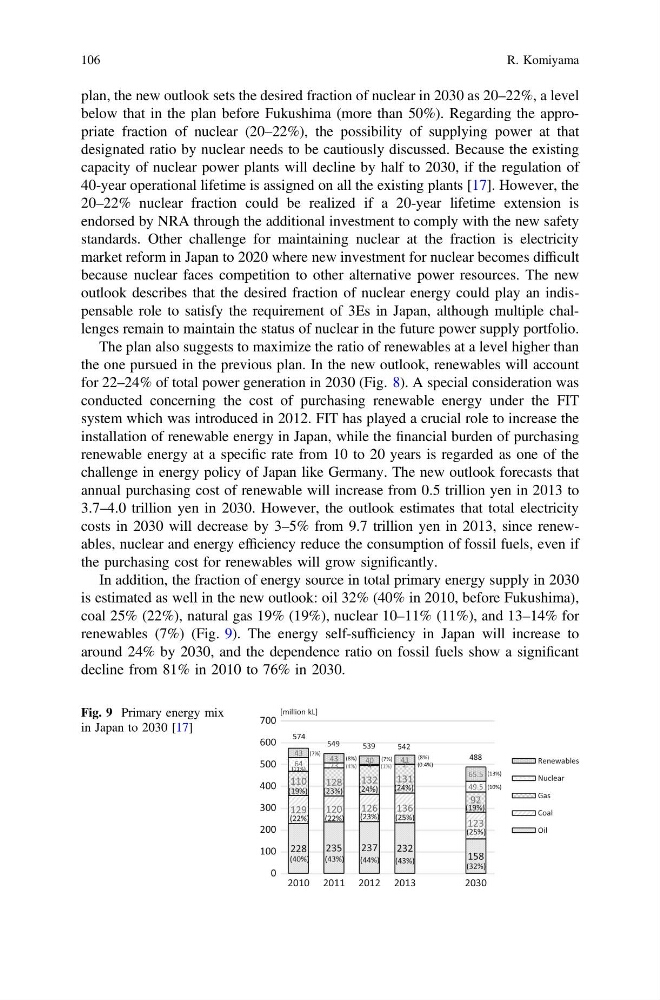
In addition, the fraction of energy source in total primary energy supply in 2030
is estimated as well in the new outlook: oil 32% (40% in 2010, before Fukushima),
coal 25% (22%), natural gas 19% (19%), nuclear 10–11% (11%), and 13–14% for
renewables (7%) (Fig. 9). The energy self-sufficiency in Japan will increase to
around 24% by 2030, and the dependence ratio on fossil fuels show a significant
decline from 81% in 2010 to 76% in 2030.
228
235
237
232
158
129
120
126
136
123
110
128
132
131
92
64
23
4
2
49.5
43
43
40
41
65.5
0
100
200
300
400
500
600
700
2010 2011 2012 2013
2030
Renewables
Nuclear
Gas
Coal
Oil
(40%)
(43%)
(44%)
(43%)
(32%)
(22%)
(22%)
(23%)
(25%)
(25%)
(19%)
(23%)
(24%)
(24%)
(19%)
(11%)
(4%)
(1%)
(0.4%)
(10%)
(7%)
(8%)
(7%)
(8%)
(13%)
[million kL]
574
549
539
542
488
Fig. 9 Primary energy mix
in Japan to 2030 [17]
106
R. Komiyama
below that in the plan before Fukushima (more than 50%). Regarding the appropriate fraction of nuclear (20–22%), the possibility of supplying power at that
designated ratio by nuclear needs to be cautiously discussed. Because the existing
capacity of nuclear power plants will decline by half to 2030, if the regulation of
40-year operational lifetime is assigned on all the existing plants [17]. However, the
20–22% nuclear fraction could be realized if a 20-year lifetime extension is
endorsed by NRA through the additional investment to comply with the new safety
standards. Other challenge for maintaining nuclear at the fraction is electricity
market reform in Japan to 2020 where new investment for nuclear becomes difficult
because nuclear faces competition to other alternative power resources. The new
outlook describes that the desired fraction of nuclear energy could play an indispensable role to satisfy the requirement of 3Es in Japan, although multiple challenges remain to maintain the status of nuclear in the future power supply portfolio.
The plan also suggests to maximize the ratio of renewables at a level higher than
the one pursued in the previous plan. In the new outlook, renewables will account
for 22–24% of total power generation in 2030 (Fig. 8). A special consideration was
conducted concerning the cost of purchasing renewable energy under the FIT
system which was introduced in 2012. FIT has played a crucial role to increase the
installation of renewable energy in Japan, while the financial burden of purchasing
renewable energy at a specific rate from 10 to 20 years is regarded as one of the
challenge in energy policy of Japan like Germany. The new outlook forecasts that
annual purchasing cost of renewable will increase from 0.5 trillion yen in 2013 to
3.7–4.0 trillion yen in 2030. However, the outlook estimates that total electricity
costs in 2030 will decrease by 3–5% from 9.7 trillion yen in 2013, since renewables, nuclear and energy efficiency reduce the consumption of fossil fuels, even if
the purchasing cost for renewables will grow significantly.
In addition, the fraction of energy source in total primary energy supply in 2030
is estimated as well in the new outlook: oil 32% (40% in 2010, before Fukushima),
coal 25% (22%), natural gas 19% (19%), nuclear 10–11% (11%), and 13–14% for
renewables (7%) (Fig. 9). The energy self-sufficiency in Japan will increase to
around 24% by 2030, and the dependence ratio on fossil fuels show a significant
decline from 81% in 2010 to 76% in 2030.
228
235
237
232
158
129
120
126
136
123
110
128
132
131
92
64
23
4
2
49.5
43
43
40
41
65.5
0
100
200
300
400
500
600
700
2010 2011 2012 2013
2030
Renewables
Nuclear
Gas
Coal
Oil
(40%)
(43%)
(44%)
(43%)
(32%)
(22%)
(22%)
(23%)
(25%)
(25%)
(19%)
(23%)
(24%)
(24%)
(19%)
(11%)
(4%)
(1%)
(0.4%)
(10%)
(7%)
(8%)
(7%)
(8%)
(13%)
[million kL]
574
549
539
542
488
Fig. 9 Primary energy mix
in Japan to 2030 [17]
106
R. Komiyama