

3.6 Social Forces Between Pedestrians
43
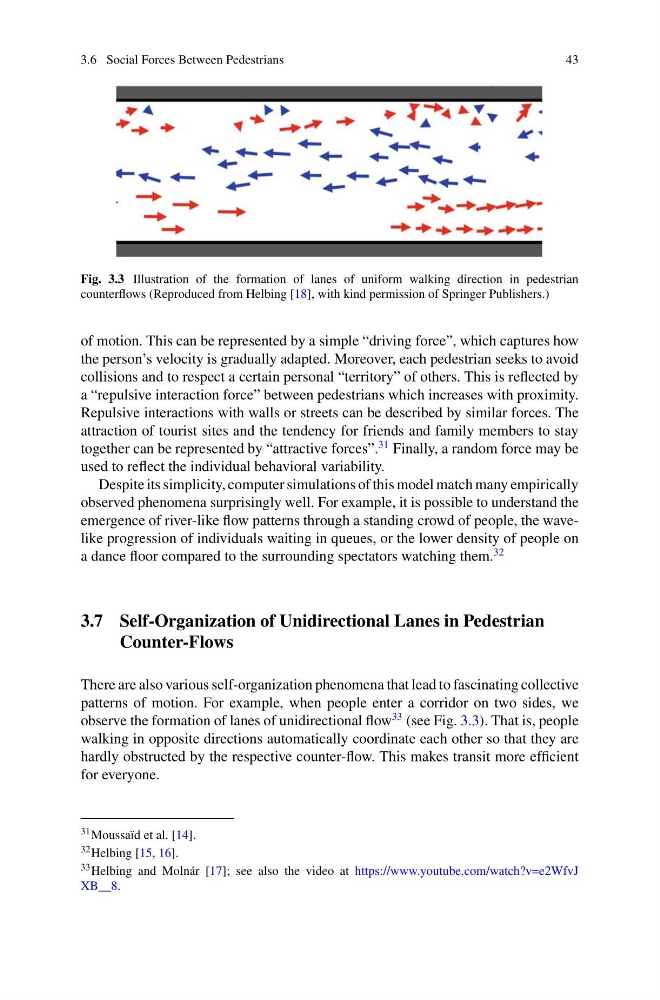
Fig. 3.3 Illustration of the formation of lanes of uniform walking direction in pedestrian
counterflows (Reproduced from Helbing [18], with kind permission of Springer Publishers.)
of motion. This can be represented by a simple “driving force”, which captures how
the person’s velocity is gradually adapted. Moreover, each pedestrian seeks to avoid
collisions and to respect a certain personal “territory” of others. This is reflected by
a “repulsive interaction force” between pedestrians which increases with proximity.
Repulsive interactions with walls or streets can be described by similar forces. The
attraction of tourist sites and the tendency for friends and family members to stay
together can be represented by “attractive forces”.
31 Finally, a random force may be
used to reflect the individual behavioral variability.
Despite its simplicity, computer simulations of this model match many empirically
observed phenomena surprisingly well. For example, it is possible to understand the
emergence of river-like flow patterns through a standing crowd of people, the wavelike progression of individuals waiting in queues, or the lower density of people on
a dance floor compared to the surrounding spectators watching them.
32
3.7 Self-Organization of Unidirectional Lanes in Pedestrian
Counter-Flows
There are also various self-organization phenomena that lead to fascinating collective
patterns of motion. For example, when people enter a corridor on two sides, we
observe the formation of lanes of unidirectional flow
33 (see Fig. 3.3). That is, people
walking in opposite directions automatically coordinate each other so that they are
hardly obstructed by the respective counter-flow. This makes transit more efficient
for everyone.
31 Moussaïd et al. [14].
32 Helbing [15, 16].
33 Helbing and Molnár [17]; see also the video at https://www.youtube.com/watch?v=e2WfvJ
XB__8.
43
Fig. 3.3 Illustration of the formation of lanes of uniform walking direction in pedestrian
counterflows (Reproduced from Helbing [18], with kind permission of Springer Publishers.)
of motion. This can be represented by a simple “driving force”, which captures how
the person’s velocity is gradually adapted. Moreover, each pedestrian seeks to avoid
collisions and to respect a certain personal “territory” of others. This is reflected by
a “repulsive interaction force” between pedestrians which increases with proximity.
Repulsive interactions with walls or streets can be described by similar forces. The
attraction of tourist sites and the tendency for friends and family members to stay
together can be represented by “attractive forces”.
31 Finally, a random force may be
used to reflect the individual behavioral variability.
Despite its simplicity, computer simulations of this model match many empirically
observed phenomena surprisingly well. For example, it is possible to understand the
emergence of river-like flow patterns through a standing crowd of people, the wavelike progression of individuals waiting in queues, or the lower density of people on
a dance floor compared to the surrounding spectators watching them.
32
3.7 Self-Organization of Unidirectional Lanes in Pedestrian
Counter-Flows
There are also various self-organization phenomena that lead to fascinating collective
patterns of motion. For example, when people enter a corridor on two sides, we
observe the formation of lanes of unidirectional flow
33 (see Fig. 3.3). That is, people
walking in opposite directions automatically coordinate each other so that they are
hardly obstructed by the respective counter-flow. This makes transit more efficient
for everyone.
31 Moussaïd et al. [14].
32 Helbing [15, 16].
33 Helbing and Molnár [17]; see also the video at https://www.youtube.com/watch?v=e2WfvJ
XB__8.