

44
3 Social Forces
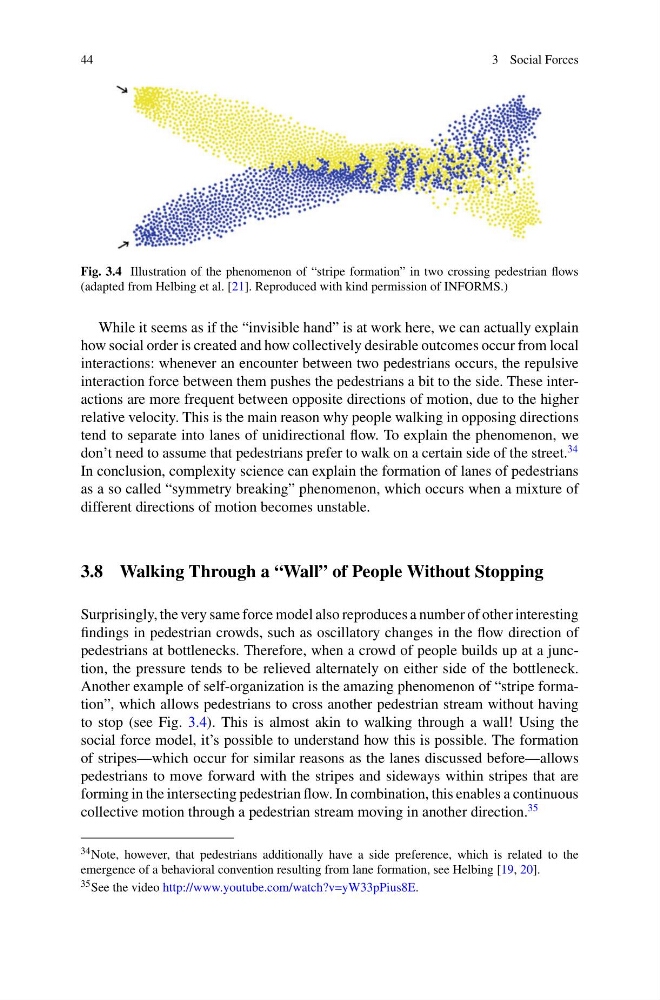
Fig. 3.4 Illustration of the phenomenon of “stripe formation” in two crossing pedestrian flows
(adapted from Helbing et al. [21]. Reproduced with kind permission of INFORMS.)
While it seems as if the “invisible hand” is at work here, we can actually explain
how social order is created and how collectively desirable outcomes occur from local
interactions: whenever an encounter between two pedestrians occurs, the repulsive
interaction force between them pushes the pedestrians a bit to the side. These interactions are more frequent between opposite directions of motion, due to the higher
relative velocity. This is the main reason why people walking in opposing directions
tend to separate into lanes of unidirectional flow. To explain the phenomenon, we
don’t need to assume that pedestrians prefer to walk on a certain side of the street.
34
In conclusion, complexity science can explain the formation of lanes of pedestrians
as a so called “symmetry breaking” phenomenon, which occurs when a mixture of
different directions of motion becomes unstable.
3.8 Walking Through a “Wall” of People Without Stopping
Surprisingly, the very same force model also reproduces a number of other interesting
findings in pedestrian crowds, such as oscillatory changes in the flow direction of
pedestrians at bottlenecks. Therefore, when a crowd of people builds up at a junction, the pressure tends to be relieved alternately on either side of the bottleneck.
Another example of self-organization is the amazing phenomenon of “stripe formation”, which allows pedestrians to cross another pedestrian stream without having
to stop (see Fig. 3.4). This is almost akin to walking through a wall! Using the
social force model, it’s possible to understand how this is possible. The formation
of stripes—which occur for similar reasons as the lanes discussed before—allows
pedestrians to move forward with the stripes and sideways within stripes that are
forming in the intersecting pedestrian flow. In combination, this enables a continuous
collective motion through a pedestrian stream moving in another direction.
35
34 Note, however, that pedestrians additionally have a side preference, which is related to the
emergence of a behavioral convention resulting from lane formation, see Helbing [19, 20].
35 See the video http://www.youtube.com/watch?v=yW33pPius8E.
3 Social Forces
Fig. 3.4 Illustration of the phenomenon of “stripe formation” in two crossing pedestrian flows
(adapted from Helbing et al. [21]. Reproduced with kind permission of INFORMS.)
While it seems as if the “invisible hand” is at work here, we can actually explain
how social order is created and how collectively desirable outcomes occur from local
interactions: whenever an encounter between two pedestrians occurs, the repulsive
interaction force between them pushes the pedestrians a bit to the side. These interactions are more frequent between opposite directions of motion, due to the higher
relative velocity. This is the main reason why people walking in opposing directions
tend to separate into lanes of unidirectional flow. To explain the phenomenon, we
don’t need to assume that pedestrians prefer to walk on a certain side of the street.
34
In conclusion, complexity science can explain the formation of lanes of pedestrians
as a so called “symmetry breaking” phenomenon, which occurs when a mixture of
different directions of motion becomes unstable.
3.8 Walking Through a “Wall” of People Without Stopping
Surprisingly, the very same force model also reproduces a number of other interesting
findings in pedestrian crowds, such as oscillatory changes in the flow direction of
pedestrians at bottlenecks. Therefore, when a crowd of people builds up at a junction, the pressure tends to be relieved alternately on either side of the bottleneck.
Another example of self-organization is the amazing phenomenon of “stripe formation”, which allows pedestrians to cross another pedestrian stream without having
to stop (see Fig. 3.4). This is almost akin to walking through a wall! Using the
social force model, it’s possible to understand how this is possible. The formation
of stripes—which occur for similar reasons as the lanes discussed before—allows
pedestrians to move forward with the stripes and sideways within stripes that are
forming in the intersecting pedestrian flow. In combination, this enables a continuous
collective motion through a pedestrian stream moving in another direction.
35
34 Note, however, that pedestrians additionally have a side preference, which is related to the
emergence of a behavioral convention resulting from lane formation, see Helbing [19, 20].
35 See the video http://www.youtube.com/watch?v=yW33pPius8E.