

42
3 Social Forces
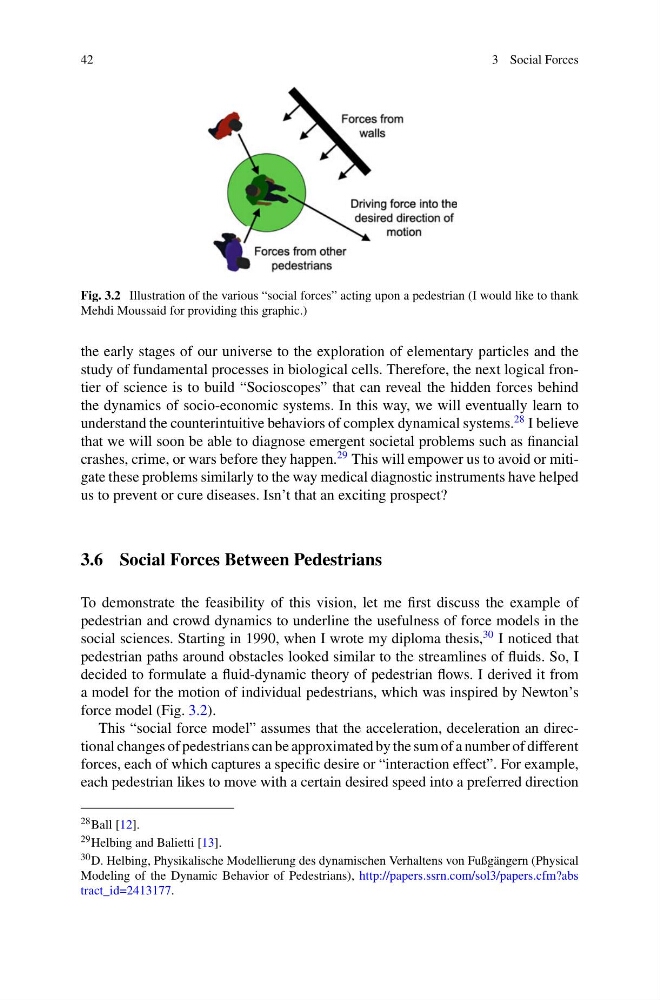
Fig. 3.2 Illustration of the various “social forces” acting upon a pedestrian (I would like to thank
Mehdi Moussaid for providing this graphic.)
the early stages of our universe to the exploration of elementary particles and the
study of fundamental processes in biological cells. Therefore, the next logical frontier of science is to build “Socioscopes” that can reveal the hidden forces behind
the dynamics of socio-economic systems. In this way, we will eventually learn to
understand the counterintuitive behaviors of complex dynamical systems.
28 I believe
that we will soon be able to diagnose emergent societal problems such as financial
crashes, crime, or wars before they happen.
29 This will empower us to avoid or mitigate these problems similarly to the way medical diagnostic instruments have helped
us to prevent or cure diseases. Isn’t that an exciting prospect?
3.6 Social Forces Between Pedestrians
To demonstrate the feasibility of this vision, let me first discuss the example of
pedestrian and crowd dynamics to underline the usefulness of force models in the
social sciences. Starting in 1990, when I wrote my diploma thesis,
30 I noticed that
pedestrian paths around obstacles looked similar to the streamlines of fluids. So, I
decided to formulate a fluid-dynamic theory of pedestrian flows. I derived it from
a model for the motion of individual pedestrians, which was inspired by Newton’s
force model (Fig. 3.2).
This “social force model” assumes that the acceleration, deceleration an directional changes of pedestrians can be approximated by the sum of a number of different
forces, each of which captures a specific desire or “interaction effect”. For example,
each pedestrian likes to move with a certain desired speed into a preferred direction
28 Ball [12].
29 Helbing and Balietti [13].
30 D. Helbing, Physikalische Modellierung des dynamischen Verhaltens von Fußgängern (Physical
Modeling of the Dynamic Behavior of Pedestrians), http://papers.ssrn.com/sol3/papers.cfm?abs
tract_id=2413177.
3 Social Forces
Fig. 3.2 Illustration of the various “social forces” acting upon a pedestrian (I would like to thank
Mehdi Moussaid for providing this graphic.)
the early stages of our universe to the exploration of elementary particles and the
study of fundamental processes in biological cells. Therefore, the next logical frontier of science is to build “Socioscopes” that can reveal the hidden forces behind
the dynamics of socio-economic systems. In this way, we will eventually learn to
understand the counterintuitive behaviors of complex dynamical systems.
28 I believe
that we will soon be able to diagnose emergent societal problems such as financial
crashes, crime, or wars before they happen.
29 This will empower us to avoid or mitigate these problems similarly to the way medical diagnostic instruments have helped
us to prevent or cure diseases. Isn’t that an exciting prospect?
3.6 Social Forces Between Pedestrians
To demonstrate the feasibility of this vision, let me first discuss the example of
pedestrian and crowd dynamics to underline the usefulness of force models in the
social sciences. Starting in 1990, when I wrote my diploma thesis,
30 I noticed that
pedestrian paths around obstacles looked similar to the streamlines of fluids. So, I
decided to formulate a fluid-dynamic theory of pedestrian flows. I derived it from
a model for the motion of individual pedestrians, which was inspired by Newton’s
force model (Fig. 3.2).
This “social force model” assumes that the acceleration, deceleration an directional changes of pedestrians can be approximated by the sum of a number of different
forces, each of which captures a specific desire or “interaction effect”. For example,
each pedestrian likes to move with a certain desired speed into a preferred direction
28 Ball [12].
29 Helbing and Balietti [13].
30 D. Helbing, Physikalische Modellierung des dynamischen Verhaltens von Fußgängern (Physical
Modeling of the Dynamic Behavior of Pedestrians), http://papers.ssrn.com/sol3/papers.cfm?abs
tract_id=2413177.