

46
B. Pietras and A. Daffertshofer
0
0.2
0.4
0.6
0.8
I
k
0
500
1000
1500
2000
0
0.5
1
R
0
0.2
0.4
0.6
0.8
I
k
0
500
1000
1500
2000
0
0.5
1
R
E k
0
I
k
0
500
1000
1500
2000
Time t
0
0.5
1
R
0.2
0.4
0.6
0.8
I
k
Phase plane
0
500
1000
1500
2000
0
0.5
1
R
Order parameter
0
0.2
0.4
0.6
I
k
0
500
1000
1500
2000
0
0.5
1
R
0.4
0.6
0.8
E k
0
0.2
0.4
I
k
0
500
1000
1500
2000
Time t
0
0.5
1
R
Phase histogram
-
0
0
0.5
1
P
-
0
0
0.2
0.4
0.6
P
-
0
k
0
0.2
0.4
0.6
P
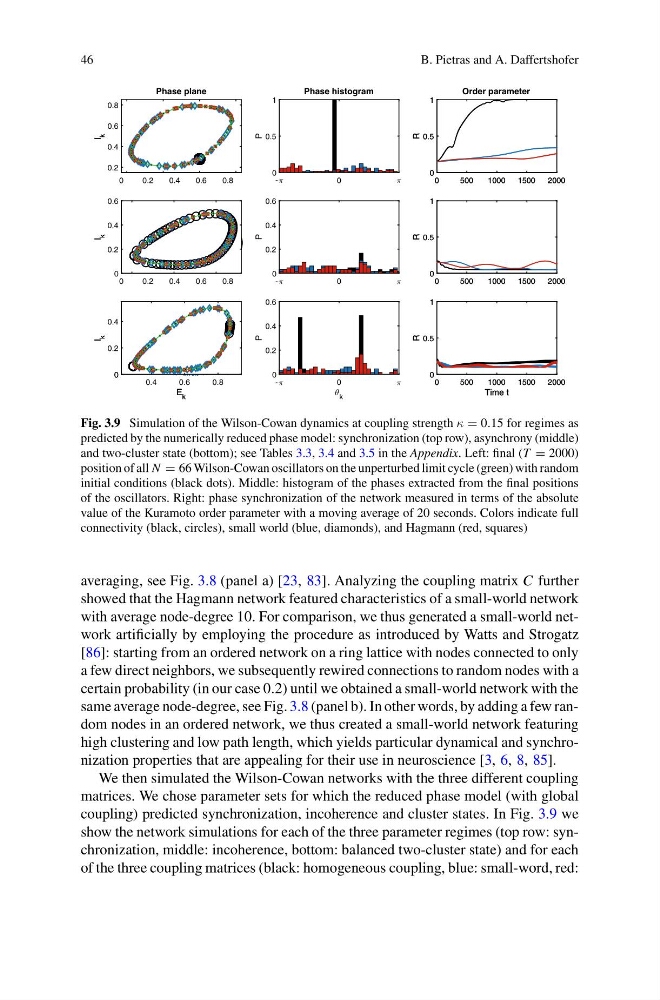
Fig. 3.9 Simulation of the Wilson-Cowan dynamics at coupling strength κ = 0.15 for regimes as
predicted by the numerically reduced phase model: synchronization (top row), asynchrony (middle)
and two-cluster state (bottom); see Tables 3.3, 3.4 and 3.5 in the Appendix. Left: final (T = 2000)
position of all N = 66 Wilson-Cowan oscillators on the unperturbed limit cycle (green) with random
initial conditions (black dots). Middle: histogram of the phases extracted from the final positions
of the oscillators. Right: phase synchronization of the network measured in terms of the absolute
value of the Kuramoto order parameter with a moving average of 20 seconds. Colors indicate full
connectivity (black, circles), small world (blue, diamonds), and Hagmann (red, squares)
averaging, see Fig. 3.8 (panel a) [23, 83]. Analyzing the coupling matrix C further
showed that the Hagmann network featured characteristics of a small-world network
with average node-degree 10. For comparison, we thus generated a small-world network artificially by employing the procedure as introduced by Watts and Strogatz
[86]: starting from an ordered network on a ring lattice with nodes connected to only
a few direct neighbors, we subsequently rewired connections to random nodes with a
certain probability (in our case 0.2) until we obtained a small-world network with the
same average node-degree, see Fig. 3.8 (panel b). In other words, by adding a few random nodes in an ordered network, we thus created a small-world network featuring
high clustering and low path length, which yields particular dynamical and synchronization properties that are appealing for their use in neuroscience [3, 6, 8, 85].
We then simulated the Wilson-Cowan networks with the three different coupling
matrices. We chose parameter sets for which the reduced phase model (with global
coupling) predicted synchronization, incoherence and cluster states. In Fig. 3.9 we
show the network simulations for each of the three parameter regimes (top row: synchronization, middle: incoherence, bottom: balanced two-cluster state) and for each
of the three coupling matrices (black: homogeneous coupling, blue: small-word, red:
B. Pietras and A. Daffertshofer
0
0.2
0.4
0.6
0.8
I
k
0
500
1000
1500
2000
0
0.5
1
R
0
0.2
0.4
0.6
0.8
I
k
0
500
1000
1500
2000
0
0.5
1
R
E k
0
I
k
0
500
1000
1500
2000
Time t
0
0.5
1
R
0.2
0.4
0.6
0.8
I
k
Phase plane
0
500
1000
1500
2000
0
0.5
1
R
Order parameter
0
0.2
0.4
0.6
I
k
0
500
1000
1500
2000
0
0.5
1
R
0.4
0.6
0.8
E k
0
0.2
0.4
I
k
0
500
1000
1500
2000
Time t
0
0.5
1
R
Phase histogram
-
0
0
0.5
1
P
-
0
0
0.2
0.4
0.6
P
-
0
k
0
0.2
0.4
0.6
P
Fig. 3.9 Simulation of the Wilson-Cowan dynamics at coupling strength κ = 0.15 for regimes as
predicted by the numerically reduced phase model: synchronization (top row), asynchrony (middle)
and two-cluster state (bottom); see Tables 3.3, 3.4 and 3.5 in the Appendix. Left: final (T = 2000)
position of all N = 66 Wilson-Cowan oscillators on the unperturbed limit cycle (green) with random
initial conditions (black dots). Middle: histogram of the phases extracted from the final positions
of the oscillators. Right: phase synchronization of the network measured in terms of the absolute
value of the Kuramoto order parameter with a moving average of 20 seconds. Colors indicate full
connectivity (black, circles), small world (blue, diamonds), and Hagmann (red, squares)
averaging, see Fig. 3.8 (panel a) [23, 83]. Analyzing the coupling matrix C further
showed that the Hagmann network featured characteristics of a small-world network
with average node-degree 10. For comparison, we thus generated a small-world network artificially by employing the procedure as introduced by Watts and Strogatz
[86]: starting from an ordered network on a ring lattice with nodes connected to only
a few direct neighbors, we subsequently rewired connections to random nodes with a
certain probability (in our case 0.2) until we obtained a small-world network with the
same average node-degree, see Fig. 3.8 (panel b). In other words, by adding a few random nodes in an ordered network, we thus created a small-world network featuring
high clustering and low path length, which yields particular dynamical and synchronization properties that are appealing for their use in neuroscience [3, 6, 8, 85].
We then simulated the Wilson-Cowan networks with the three different coupling
matrices. We chose parameter sets for which the reduced phase model (with global
coupling) predicted synchronization, incoherence and cluster states. In Fig. 3.9 we
show the network simulations for each of the three parameter regimes (top row: synchronization, middle: incoherence, bottom: balanced two-cluster state) and for each
of the three coupling matrices (black: homogeneous coupling, blue: small-word, red: