

3 Reduced Phase Models of Oscillatory Neural Networks
45
structure in neural networks can have significant consequences for the collective
dynamics, see, e.g., [1–3, 7, 11, 12, 27, 38, 61, 62, 68, 71, 72, 81]. A network
topology, i.e. how the nodes of the network are connected, that deviates from global,
all-to-all coupling, may render many results about predicted network behavior no
longer valid. In some cases, the reduced phase interaction function in combination with the connectivity matrix can still provide important information about the
collective dynamics of a realistically connected network, e.g., about (remote) synchronization, see [25, 34, 58, 63, 69]. The Kuramoto model of phase oscillators
where = sin(ψ) has been extensively studied on complex networks, see, e.g.,
the review by Rodrigues et al. [70]. More recently, it could also be shown how time
delays shape the phase relationships in oscillatory networks with realistic connectivity structure [65, 66]. Some questions, however, still remain unanswered, e.g., how
structure shapes function, what the constituents for synchrony are, or what drives a
network into a chaotic state.
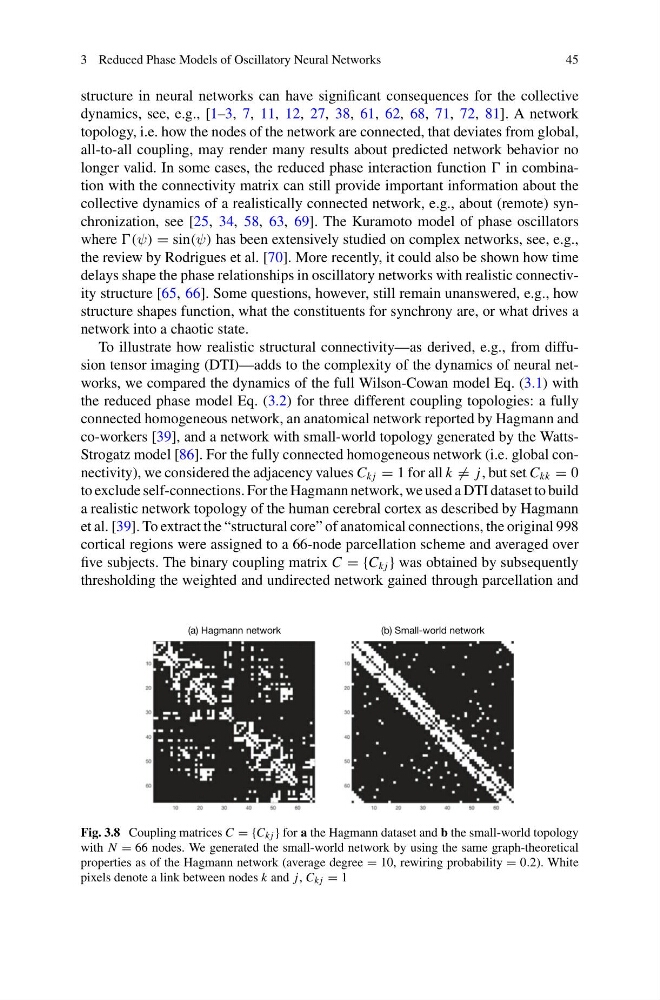
To illustrate how realistic structural connectivity—as derived, e.g., from diffusion tensor imaging (DTI)—adds to the complexity of the dynamics of neural networks, we compared the dynamics of the full Wilson-Cowan model Eq. (3.1) with
the reduced phase model Eq. (3.2) for three different coupling topologies: a fully
connected homogeneous network, an anatomical network reported by Hagmann and
co-workers [39], and a network with small-world topology generated by the WattsStrogatz model [86]. For the fully connected homogeneous network (i.e. global connectivity), we considered the adjacency values C k j = 1 for all k = j, but set C kk = 0
to exclude self-connections. For the Hagmann network, we used a DTI dataset to build
a realistic network topology of the human cerebral cortex as described by Hagmann
et al. [39]. To extract the “structural core” of anatomical connections, the original 998
cortical regions were assigned to a 66-node parcellation scheme and averaged over
five subjects. The binary coupling matrix C = {C k j } was obtained by subsequently
thresholding the weighted and undirected network gained through parcellation and
(a) Hagmann network
(b) Small-world network
Fig. 3.8 Coupling matrices C = {C k j } for a the Hagmann dataset and b the small-world topology
with N = 66 nodes. We generated the small-world network by using the same graph-theoretical
properties as of the Hagmann network (average degree = 10, rewiring probability = 0.2). White
pixels denote a link between nodes k and j, C k j = 1
45
structure in neural networks can have significant consequences for the collective
dynamics, see, e.g., [1–3, 7, 11, 12, 27, 38, 61, 62, 68, 71, 72, 81]. A network
topology, i.e. how the nodes of the network are connected, that deviates from global,
all-to-all coupling, may render many results about predicted network behavior no
longer valid. In some cases, the reduced phase interaction function in combination with the connectivity matrix can still provide important information about the
collective dynamics of a realistically connected network, e.g., about (remote) synchronization, see [25, 34, 58, 63, 69]. The Kuramoto model of phase oscillators
where = sin(ψ) has been extensively studied on complex networks, see, e.g.,
the review by Rodrigues et al. [70]. More recently, it could also be shown how time
delays shape the phase relationships in oscillatory networks with realistic connectivity structure [65, 66]. Some questions, however, still remain unanswered, e.g., how
structure shapes function, what the constituents for synchrony are, or what drives a
network into a chaotic state.
To illustrate how realistic structural connectivity—as derived, e.g., from diffusion tensor imaging (DTI)—adds to the complexity of the dynamics of neural networks, we compared the dynamics of the full Wilson-Cowan model Eq. (3.1) with
the reduced phase model Eq. (3.2) for three different coupling topologies: a fully
connected homogeneous network, an anatomical network reported by Hagmann and
co-workers [39], and a network with small-world topology generated by the WattsStrogatz model [86]. For the fully connected homogeneous network (i.e. global connectivity), we considered the adjacency values C k j = 1 for all k = j, but set C kk = 0
to exclude self-connections. For the Hagmann network, we used a DTI dataset to build
a realistic network topology of the human cerebral cortex as described by Hagmann
et al. [39]. To extract the “structural core” of anatomical connections, the original 998
cortical regions were assigned to a 66-node parcellation scheme and averaged over
five subjects. The binary coupling matrix C = {C k j } was obtained by subsequently
thresholding the weighted and undirected network gained through parcellation and
(a) Hagmann network
(b) Small-world network
Fig. 3.8 Coupling matrices C = {C k j } for a the Hagmann dataset and b the small-world topology
with N = 66 nodes. We generated the small-world network by using the same graph-theoretical
properties as of the Hagmann network (average degree = 10, rewiring probability = 0.2). White
pixels denote a link between nodes k and j, C k j = 1