

44
B. Pietras and A. Daffertshofer
0
0.5
1
0
0.5
1
I
k
4985
4990
4995
5000
-2
0
2
k
= 0.15
0
1000 2000 3000 4000 5000
0
0.5
1
R
0
0.5
1
0
0.5
1
I
k
4985
4990
4995
5000
-2
0
2
k
= 0.75
0
1000 2000 3000 4000 5000
0
0.5
1
R
0
0.5
1
E k
0
0.5
1
I
k
4985
4990
4995
5000
Time t
-2
0
2
k
= 0.81
0
1000 2000 3000 4000 5000
Time t
0
0.5
1
R
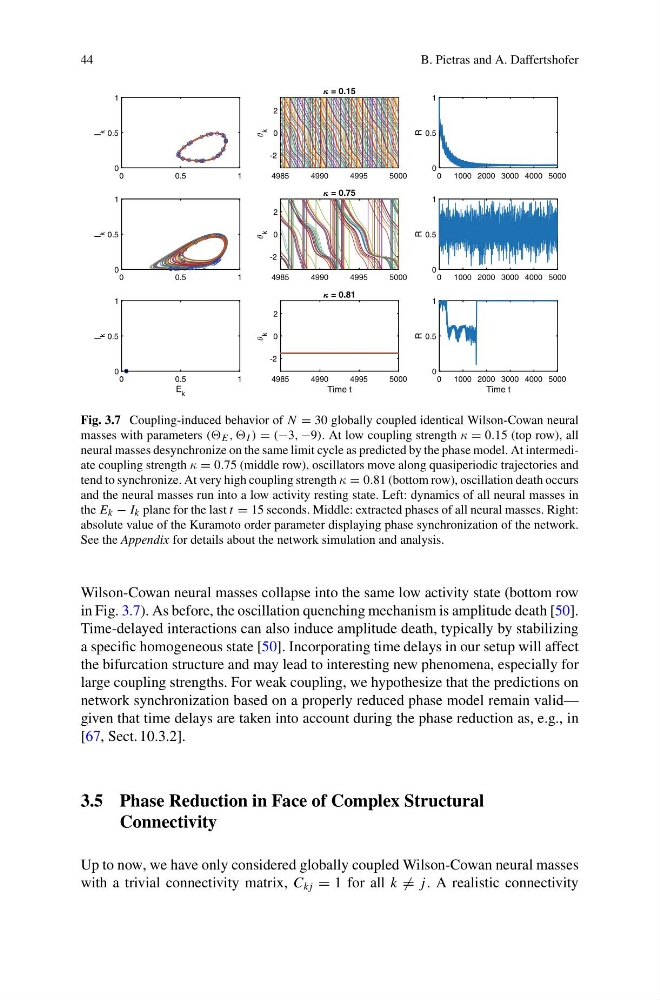
Fig. 3.7 Coupling-induced behavior of N = 30 globally coupled identical Wilson-Cowan neural
masses with parameters (( E , , I ) = (−3, −9). At low coupling strength κ = 0.15 (top row), all
neural masses desynchronize on the same limit cycle as predicted by the phase model. At intermediate coupling strength κ = 0.75 (middle row), oscillators move along quasiperiodic trajectories and
tend to synchronize. At very high coupling strength κ = 0.81 (bottom row), oscillation death occurs
and the neural masses run into a low activity resting state. Left: dynamics of all neural masses in
the E k − I k plane for the last t = 15 seconds. Middle: extracted phases of all neural masses. Right:
absolute value of the Kuramoto order parameter displaying phase synchronization of the network.
See the Appendix for details about the network simulation and analysis.
Wilson-Cowan neural masses collapse into the same low activity state (bottom row
in Fig. 3.7). As before, the oscillation quenching mechanism is amplitude death [50].
Time-delayed interactions can also induce amplitude death, typically by stabilizing
a specific homogeneous state [50]. Incorporating time delays in our setup will affect
the bifurcation structure and may lead to interesting new phenomena, especially for
large coupling strengths. For weak coupling, we hypothesize that the predictions on
network synchronization based on a properly reduced phase model remain valid—
given that time delays are taken into account during the phase reduction as, e.g., in
[67, Sect. 10.3.2].
3.5 Phase Reduction in Face of Complex Structural
Connectivity
Up to now, we have only considered globally coupled Wilson-Cowan neural masses
with a trivial connectivity matrix, C k j = 1 for all k = j. A realistic connectivity
B. Pietras and A. Daffertshofer
0
0.5
1
0
0.5
1
I
k
4985
4990
4995
5000
-2
0
2
k
= 0.15
0
1000 2000 3000 4000 5000
0
0.5
1
R
0
0.5
1
0
0.5
1
I
k
4985
4990
4995
5000
-2
0
2
k
= 0.75
0
1000 2000 3000 4000 5000
0
0.5
1
R
0
0.5
1
E k
0
0.5
1
I
k
4985
4990
4995
5000
Time t
-2
0
2
k
= 0.81
0
1000 2000 3000 4000 5000
Time t
0
0.5
1
R
Fig. 3.7 Coupling-induced behavior of N = 30 globally coupled identical Wilson-Cowan neural
masses with parameters (( E , , I ) = (−3, −9). At low coupling strength κ = 0.15 (top row), all
neural masses desynchronize on the same limit cycle as predicted by the phase model. At intermediate coupling strength κ = 0.75 (middle row), oscillators move along quasiperiodic trajectories and
tend to synchronize. At very high coupling strength κ = 0.81 (bottom row), oscillation death occurs
and the neural masses run into a low activity resting state. Left: dynamics of all neural masses in
the E k − I k plane for the last t = 15 seconds. Middle: extracted phases of all neural masses. Right:
absolute value of the Kuramoto order parameter displaying phase synchronization of the network.
See the Appendix for details about the network simulation and analysis.
Wilson-Cowan neural masses collapse into the same low activity state (bottom row
in Fig. 3.7). As before, the oscillation quenching mechanism is amplitude death [50].
Time-delayed interactions can also induce amplitude death, typically by stabilizing
a specific homogeneous state [50]. Incorporating time delays in our setup will affect
the bifurcation structure and may lead to interesting new phenomena, especially for
large coupling strengths. For weak coupling, we hypothesize that the predictions on
network synchronization based on a properly reduced phase model remain valid—
given that time delays are taken into account during the phase reduction as, e.g., in
[67, Sect. 10.3.2].
3.5 Phase Reduction in Face of Complex Structural
Connectivity
Up to now, we have only considered globally coupled Wilson-Cowan neural masses
with a trivial connectivity matrix, C k j = 1 for all k = j. A realistic connectivity