

42
B. Pietras and A. Daffertshofer
0.79
0.8
0.81
0.82
0.83
0.34
0.36
0.38
I
k
4985
4990
4995
5000
-2
0
2
k
= 0
0
1000 2000 3000 4000 5000
0
0.5
1
R
0.79
0.8
0.81
0.82
0.83
0.34
0.36
0.38
I
k
4985
4990
4995
5000
-2
0
2
k
= 0.05
0
1000 2000 3000 4000 5000
0
0.5
1
R
0.7
0.75
0.8
0.85
E k
0.2
0.3
0.4
0.5
I
k
4985
4990
4995
5000
Time t
-2
0
2
k
= 0.81
4850
4900
4950
5000
Time t
0
0.5
1
R
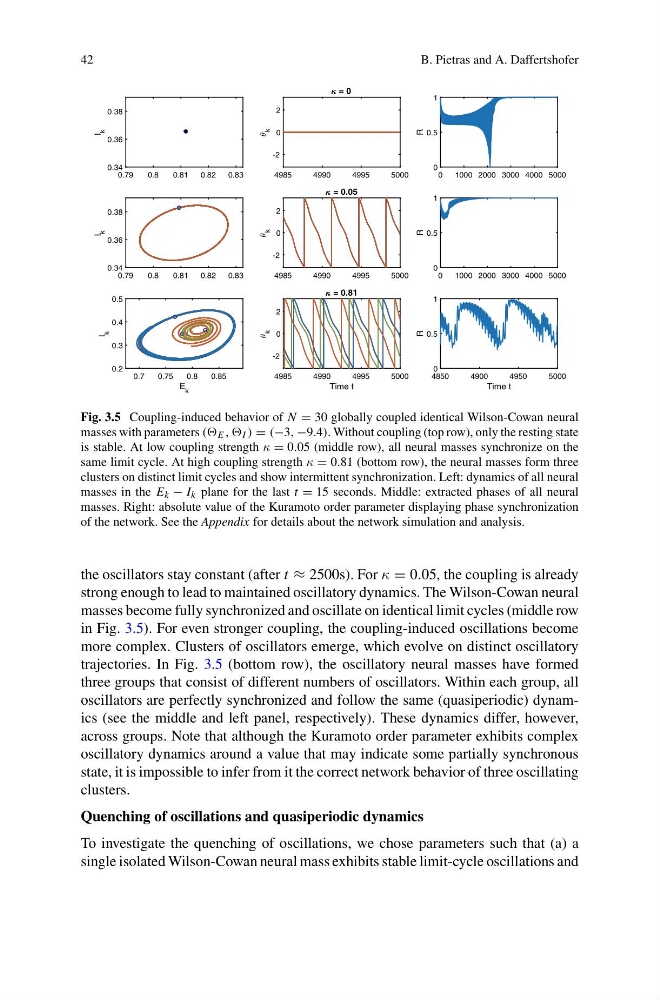
Fig. 3.5 Coupling-induced behavior of N = 30 globally coupled identical Wilson-Cowan neural
masses with parameters (( E , , I ) = (−3, −9.4). Without coupling (top row), only the resting state
is stable. At low coupling strength κ = 0.05 (middle row), all neural masses synchronize on the
same limit cycle. At high coupling strength κ = 0.81 (bottom row), the neural masses form three
clusters on distinct limit cycles and show intermittent synchronization. Left: dynamics of all neural
masses in the E k − I k plane for the last t = 15 seconds. Middle: extracted phases of all neural
masses. Right: absolute value of the Kuramoto order parameter displaying phase synchronization
of the network. See the Appendix for details about the network simulation and analysis.
the oscillators stay constant (after t ≈ 2500s). For κ = 0.05, the coupling is already
strong enough to lead to maintained oscillatory dynamics. The Wilson-Cowan neural
masses become fully synchronized and oscillate on identical limit cycles (middle row
in Fig. 3.5). For even stronger coupling, the coupling-induced oscillations become
more complex. Clusters of oscillators emerge, which evolve on distinct oscillatory
trajectories. In Fig. 3.5 (bottom row), the oscillatory neural masses have formed
three groups that consist of different numbers of oscillators. Within each group, all
oscillators are perfectly synchronized and follow the same (quasiperiodic) dynamics (see the middle and left panel, respectively). These dynamics differ, however,
across groups. Note that although the Kuramoto order parameter exhibits complex
oscillatory dynamics around a value that may indicate some partially synchronous
state, it is impossible to infer from it the correct network behavior of three oscillating
clusters.
Quenching of oscillations and quasiperiodic dynamics
To investigate the quenching of oscillations, we chose parameters such that (a) a
single isolated Wilson-Cowan neural mass exhibits stable limit-cycle oscillations and
B. Pietras and A. Daffertshofer
0.79
0.8
0.81
0.82
0.83
0.34
0.36
0.38
I
k
4985
4990
4995
5000
-2
0
2
k
= 0
0
1000 2000 3000 4000 5000
0
0.5
1
R
0.79
0.8
0.81
0.82
0.83
0.34
0.36
0.38
I
k
4985
4990
4995
5000
-2
0
2
k
= 0.05
0
1000 2000 3000 4000 5000
0
0.5
1
R
0.7
0.75
0.8
0.85
E k
0.2
0.3
0.4
0.5
I
k
4985
4990
4995
5000
Time t
-2
0
2
k
= 0.81
4850
4900
4950
5000
Time t
0
0.5
1
R
Fig. 3.5 Coupling-induced behavior of N = 30 globally coupled identical Wilson-Cowan neural
masses with parameters (( E , , I ) = (−3, −9.4). Without coupling (top row), only the resting state
is stable. At low coupling strength κ = 0.05 (middle row), all neural masses synchronize on the
same limit cycle. At high coupling strength κ = 0.81 (bottom row), the neural masses form three
clusters on distinct limit cycles and show intermittent synchronization. Left: dynamics of all neural
masses in the E k − I k plane for the last t = 15 seconds. Middle: extracted phases of all neural
masses. Right: absolute value of the Kuramoto order parameter displaying phase synchronization
of the network. See the Appendix for details about the network simulation and analysis.
the oscillators stay constant (after t ≈ 2500s). For κ = 0.05, the coupling is already
strong enough to lead to maintained oscillatory dynamics. The Wilson-Cowan neural
masses become fully synchronized and oscillate on identical limit cycles (middle row
in Fig. 3.5). For even stronger coupling, the coupling-induced oscillations become
more complex. Clusters of oscillators emerge, which evolve on distinct oscillatory
trajectories. In Fig. 3.5 (bottom row), the oscillatory neural masses have formed
three groups that consist of different numbers of oscillators. Within each group, all
oscillators are perfectly synchronized and follow the same (quasiperiodic) dynamics (see the middle and left panel, respectively). These dynamics differ, however,
across groups. Note that although the Kuramoto order parameter exhibits complex
oscillatory dynamics around a value that may indicate some partially synchronous
state, it is impossible to infer from it the correct network behavior of three oscillating
clusters.
Quenching of oscillations and quasiperiodic dynamics
To investigate the quenching of oscillations, we chose parameters such that (a) a
single isolated Wilson-Cowan neural mass exhibits stable limit-cycle oscillations and