

38
B. Pietras and A. Daffertshofer
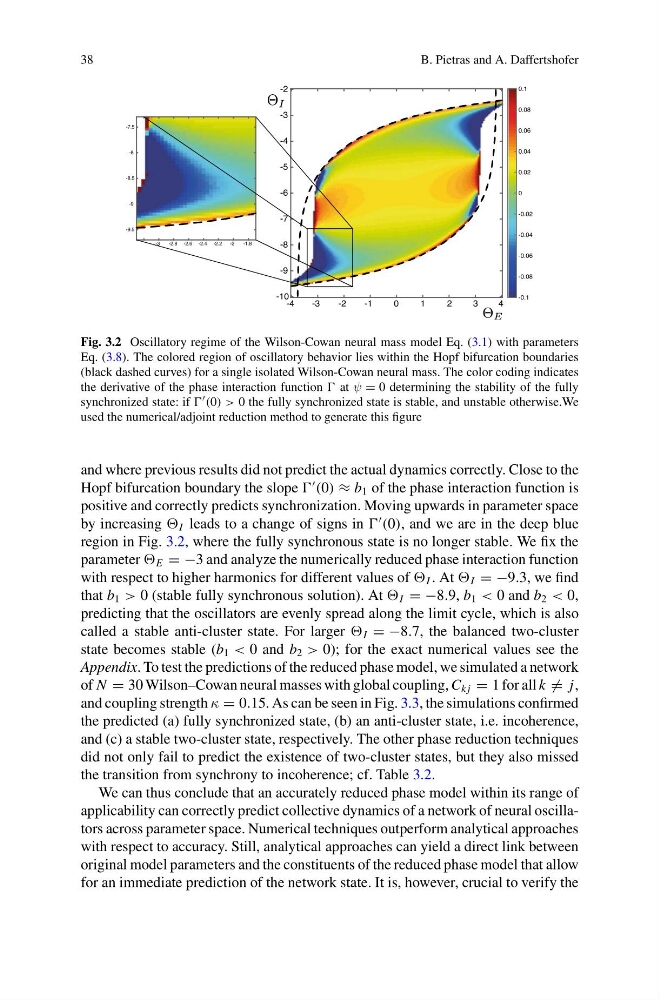
Fig. 3.2 Oscillatory regime of the Wilson-Cowan neural mass model Eq. (3.1) with parameters
Eq. (3.8). The colored region of oscillatory behavior lies within the Hopf bifurcation boundaries
(black dashed curves) for a single isolated Wilson-Cowan neural mass. The color coding indicates
the derivative of the phase interaction function at ψ = 0 determining the stability of the fully
synchronized state: if (0) > 0 the fully synchronized state is stable, and unstable otherwise.We
used the numerical/adjoint reduction method to generate this figure
and where previous results did not predict the actual dynamics correctly. Close to the
Hopf bifurcation boundary the slope
(0) ≈ b 1 of the phase interaction function is
positive and correctly predicts synchronization. Moving upwards in parameter space
by increasing I leads to a change of signs in
(0), and we are in the deep blue
region in Fig. 3.2, where the fully synchronous state is no longer stable. We fix the
parameter E = −3 and analyze the numerically reduced phase interaction function
with respect to higher harmonics for different values of I . At I = −9.3, we find
that b 1 > 0 (stable fully synchronous solution). At I = −8.9, b 1 < 0 and b 2 < 0,
predicting that the oscillators are evenly spread along the limit cycle, which is also
called a stable anti-cluster state. For larger I = −8.7, the balanced two-cluster
state becomes stable (b 1 < 0 and b 2 > 0); for the exact numerical values see the
Appendix. To test the predictions of the reduced phase model, we simulated a network
of N = 30 Wilson–Cowan neural masses with global coupling, C k j = 1 for all k = j,
and coupling strength κ = 0.15. As can be seen in Fig. 3.3, the simulations confirmed
the predicted (a) fully synchronized state, (b) an anti-cluster state, i.e. incoherence,
and (c) a stable two-cluster state, respectively. The other phase reduction techniques
did not only fail to predict the existence of two-cluster states, but they also missed
the transition from synchrony to incoherence; cf. Table 3.2.
We can thus conclude that an accurately reduced phase model within its range of
applicability can correctly predict collective dynamics of a network of neural oscillators across parameter space. Numerical techniques outperform analytical approaches
with respect to accuracy. Still, analytical approaches can yield a direct link between
original model parameters and the constituents of the reduced phase model that allow
for an immediate prediction of the network state. It is, however, crucial to verify the
B. Pietras and A. Daffertshofer
Fig. 3.2 Oscillatory regime of the Wilson-Cowan neural mass model Eq. (3.1) with parameters
Eq. (3.8). The colored region of oscillatory behavior lies within the Hopf bifurcation boundaries
(black dashed curves) for a single isolated Wilson-Cowan neural mass. The color coding indicates
the derivative of the phase interaction function at ψ = 0 determining the stability of the fully
synchronized state: if (0) > 0 the fully synchronized state is stable, and unstable otherwise.We
used the numerical/adjoint reduction method to generate this figure
and where previous results did not predict the actual dynamics correctly. Close to the
Hopf bifurcation boundary the slope
(0) ≈ b 1 of the phase interaction function is
positive and correctly predicts synchronization. Moving upwards in parameter space
by increasing I leads to a change of signs in
(0), and we are in the deep blue
region in Fig. 3.2, where the fully synchronous state is no longer stable. We fix the
parameter E = −3 and analyze the numerically reduced phase interaction function
with respect to higher harmonics for different values of I . At I = −9.3, we find
that b 1 > 0 (stable fully synchronous solution). At I = −8.9, b 1 < 0 and b 2 < 0,
predicting that the oscillators are evenly spread along the limit cycle, which is also
called a stable anti-cluster state. For larger I = −8.7, the balanced two-cluster
state becomes stable (b 1 < 0 and b 2 > 0); for the exact numerical values see the
Appendix. To test the predictions of the reduced phase model, we simulated a network
of N = 30 Wilson–Cowan neural masses with global coupling, C k j = 1 for all k = j,
and coupling strength κ = 0.15. As can be seen in Fig. 3.3, the simulations confirmed
the predicted (a) fully synchronized state, (b) an anti-cluster state, i.e. incoherence,
and (c) a stable two-cluster state, respectively. The other phase reduction techniques
did not only fail to predict the existence of two-cluster states, but they also missed
the transition from synchrony to incoherence; cf. Table 3.2.
We can thus conclude that an accurately reduced phase model within its range of
applicability can correctly predict collective dynamics of a network of neural oscillators across parameter space. Numerical techniques outperform analytical approaches
with respect to accuracy. Still, analytical approaches can yield a direct link between
original model parameters and the constituents of the reduced phase model that allow
for an immediate prediction of the network state. It is, however, crucial to verify the