

3 Reduced Phase Models of Oscillatory Neural Networks
39
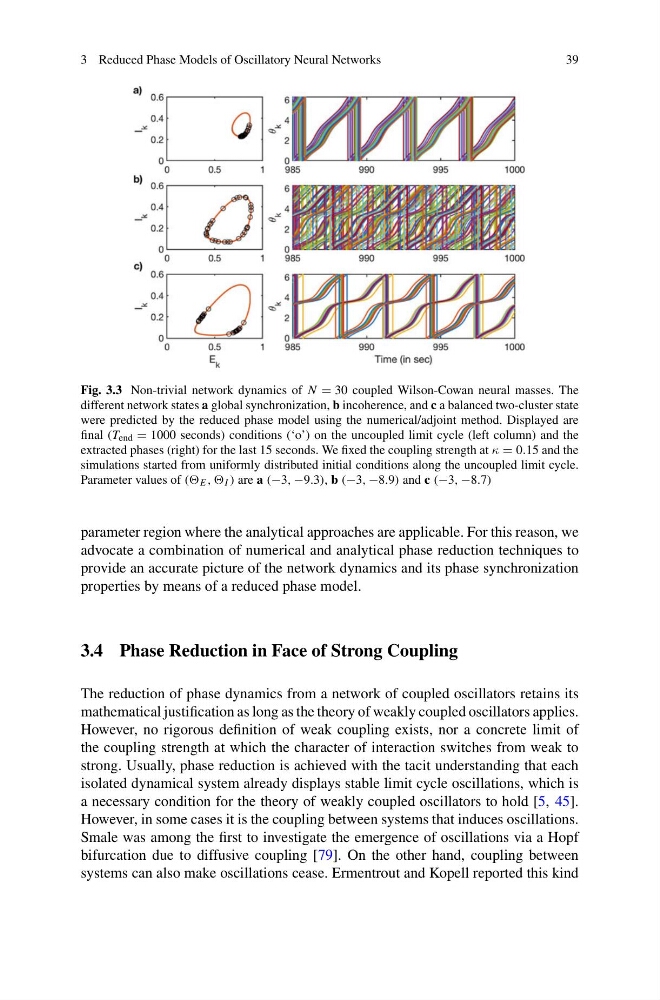
Fig. 3.3 Non-trivial network dynamics of N = 30 coupled Wilson-Cowan neural masses. The
different network states a global synchronization, b incoherence, and c a balanced two-cluster state
were predicted by the reduced phase model using the numerical/adjoint method. Displayed are
final (T end = 1000 seconds) conditions (‘o’) on the uncoupled limit cycle (left column) and the
extracted phases (right) for the last 15 seconds. We fixed the coupling strength at κ = 0.15 and the
simulations started from uniformly distributed initial conditions along the uncoupled limit cycle.
Parameter values of (( E , , I ) are a (−3, −9.3), b (−3, −8.9) and c (−3, −8.7)
parameter region where the analytical approaches are applicable. For this reason, we
advocate a combination of numerical and analytical phase reduction techniques to
provide an accurate picture of the network dynamics and its phase synchronization
properties by means of a reduced phase model.
3.4 Phase Reduction in Face of Strong Coupling
The reduction of phase dynamics from a network of coupled oscillators retains its
mathematical justification as long as the theory of weakly coupled oscillators applies.
However, no rigorous definition of weak coupling exists, nor a concrete limit of
the coupling strength at which the character of interaction switches from weak to
strong. Usually, phase reduction is achieved with the tacit understanding that each
isolated dynamical system already displays stable limit cycle oscillations, which is
a necessary condition for the theory of weakly coupled oscillators to hold [5, 45].
However, in some cases it is the coupling between systems that induces oscillations.
Smale was among the first to investigate the emergence of oscillations via a Hopf
bifurcation due to diffusive coupling [79]. On the other hand, coupling between
systems can also make oscillations cease. Ermentrout and Kopell reported this kind
39
Fig. 3.3 Non-trivial network dynamics of N = 30 coupled Wilson-Cowan neural masses. The
different network states a global synchronization, b incoherence, and c a balanced two-cluster state
were predicted by the reduced phase model using the numerical/adjoint method. Displayed are
final (T end = 1000 seconds) conditions (‘o’) on the uncoupled limit cycle (left column) and the
extracted phases (right) for the last 15 seconds. We fixed the coupling strength at κ = 0.15 and the
simulations started from uniformly distributed initial conditions along the uncoupled limit cycle.
Parameter values of (( E , , I ) are a (−3, −9.3), b (−3, −8.9) and c (−3, −8.7)
parameter region where the analytical approaches are applicable. For this reason, we
advocate a combination of numerical and analytical phase reduction techniques to
provide an accurate picture of the network dynamics and its phase synchronization
properties by means of a reduced phase model.
3.4 Phase Reduction in Face of Strong Coupling
The reduction of phase dynamics from a network of coupled oscillators retains its
mathematical justification as long as the theory of weakly coupled oscillators applies.
However, no rigorous definition of weak coupling exists, nor a concrete limit of
the coupling strength at which the character of interaction switches from weak to
strong. Usually, phase reduction is achieved with the tacit understanding that each
isolated dynamical system already displays stable limit cycle oscillations, which is
a necessary condition for the theory of weakly coupled oscillators to hold [5, 45].
However, in some cases it is the coupling between systems that induces oscillations.
Smale was among the first to investigate the emergence of oscillations via a Hopf
bifurcation due to diffusive coupling [79]. On the other hand, coupling between
systems can also make oscillations cease. Ermentrout and Kopell reported this kind