

2 Phase and Amplitude Description of Complex Oscillatory Patterns …
19
ODE case. Figures 2.3 and 2.4 show the phase and amplitude sensitivity functions
of the oscillating-spot solution of the FHN model, respectively (see Sect. 2.5 for
details).
Thus, by defining the phase and amplitude functionals, we can reduce the weakly
perturbed RD system, Eq. (2.11), to a set of ODEs (2.12) and (2.13) for the phase
and amplitude. The reduced phase-amplitude equations are much simpler than the
original RD system and facilitate detailed analysis of the oscillatory patterns. In
Ref. [25], the phase equation has been used to analyze synchronization between a pair
of mutually coupled RD systems. In the next section, we analyze optimal entrainment
with feedback stabilization of RD systems using the phase and amplitude equations.
2.4 Optimal Entrainment of Oscillatory Patterns with
Feedback
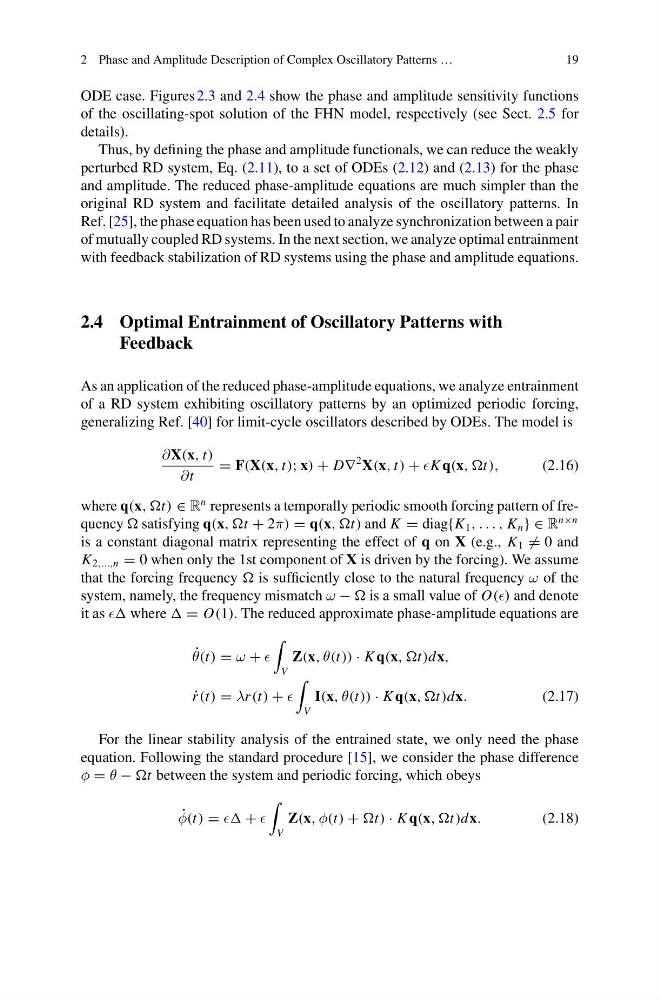
As an application of the reduced phase-amplitude equations, we analyze entrainment
of a RD system exhibiting oscillatory patterns by an optimized periodic forcing,
generalizing Ref. [40] for limit-cycle oscillators described by ODEs. The model is
∂X(x, t)
∂t
= F(X(x, t); x) + D∇
2 X(x, t) + K q(x, ,t),
(2.16)
where q(x, ,t) ∈ R
n represents a temporally periodic smooth forcing pattern of frequency satisfying q(x, ,t + 2π) = q(x, ,t) and K = diag{K 1 , . . . , K n } ∈ R
n×n
is a constant diagonal matrix representing the effect of q on X (e.g., K 1 = 0 and
K 2,...,n = 0 when only the 1st component of X is driven by the forcing). We assume
that the forcing frequency is sufficiently close to the natural frequency ω of the
system, namely, the frequency mismatch ω − is a small value of O() and denote
it as where = O(1). The reduced approximate phase-amplitude equations are
˙
θ(t) = ω +
V
Z(x, θ(t)) · K q(x, ,t)dx,
˙
r (t) = λr (t) +
V
I(x, θ(t)) · K q(x, ,t)dx.
(2.17)
For the linear stability analysis of the entrained state, we only need the phase
equation. Following the standard procedure [15], we consider the phase difference
φ = θ − t between the system and periodic forcing, which obeys
˙
φ(t) = +
V
Z(x, φ(t) + t) · K q(x, ,t)dx.
(2.18)
19
ODE case. Figures 2.3 and 2.4 show the phase and amplitude sensitivity functions
of the oscillating-spot solution of the FHN model, respectively (see Sect. 2.5 for
details).
Thus, by defining the phase and amplitude functionals, we can reduce the weakly
perturbed RD system, Eq. (2.11), to a set of ODEs (2.12) and (2.13) for the phase
and amplitude. The reduced phase-amplitude equations are much simpler than the
original RD system and facilitate detailed analysis of the oscillatory patterns. In
Ref. [25], the phase equation has been used to analyze synchronization between a pair
of mutually coupled RD systems. In the next section, we analyze optimal entrainment
with feedback stabilization of RD systems using the phase and amplitude equations.
2.4 Optimal Entrainment of Oscillatory Patterns with
Feedback
As an application of the reduced phase-amplitude equations, we analyze entrainment
of a RD system exhibiting oscillatory patterns by an optimized periodic forcing,
generalizing Ref. [40] for limit-cycle oscillators described by ODEs. The model is
∂X(x, t)
∂t
= F(X(x, t); x) + D∇
2 X(x, t) + K q(x, ,t),
(2.16)
where q(x, ,t) ∈ R
n represents a temporally periodic smooth forcing pattern of frequency satisfying q(x, ,t + 2π) = q(x, ,t) and K = diag{K 1 , . . . , K n } ∈ R
n×n
is a constant diagonal matrix representing the effect of q on X (e.g., K 1 = 0 and
K 2,...,n = 0 when only the 1st component of X is driven by the forcing). We assume
that the forcing frequency is sufficiently close to the natural frequency ω of the
system, namely, the frequency mismatch ω − is a small value of O() and denote
it as where = O(1). The reduced approximate phase-amplitude equations are
˙
θ(t) = ω +
V
Z(x, θ(t)) · K q(x, ,t)dx,
˙
r (t) = λr (t) +
V
I(x, θ(t)) · K q(x, ,t)dx.
(2.17)
For the linear stability analysis of the entrained state, we only need the phase
equation. Following the standard procedure [15], we consider the phase difference
φ = θ − t between the system and periodic forcing, which obeys
˙
φ(t) = +
V
Z(x, φ(t) + t) · K q(x, ,t)dx.
(2.18)