

314
T. Penzel et al.
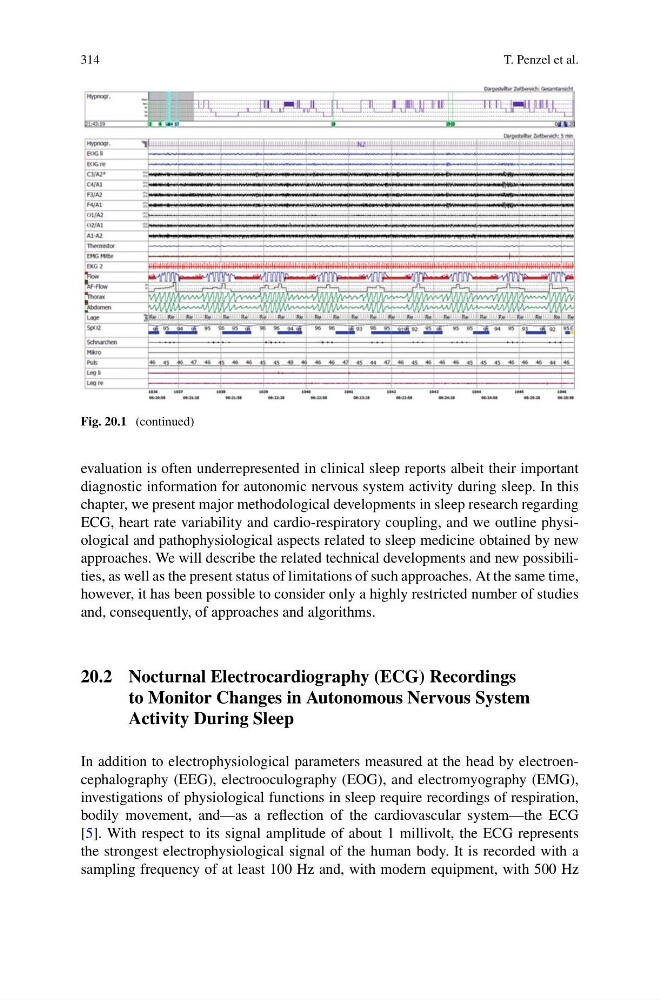
Fig. 20.1 (continued)
evaluation is often underrepresented in clinical sleep reports albeit their important
diagnostic information for autonomic nervous system activity during sleep. In this
chapter, we present major methodological developments in sleep research regarding
ECG, heart rate variability and cardio-respiratory coupling, and we outline physiological and pathophysiological aspects related to sleep medicine obtained by new
approaches. We will describe the related technical developments and new possibilities, as well as the present status of limitations of such approaches. At the same time,
however, it has been possible to consider only a highly restricted number of studies
and, consequently, of approaches and algorithms.
20.2 Nocturnal Electrocardiography (ECG) Recordings
to Monitor Changes in Autonomous Nervous System
Activity During Sleep
In addition to electrophysiological parameters measured at the head by electroencephalography (EEG), electrooculography (EOG), and electromyography (EMG),
investigations of physiological functions in sleep require recordings of respiration,
bodily movement, and—as a reflection of the cardiovascular system—the ECG
[5]. With respect to its signal amplitude of about 1 millivolt, the ECG represents
the strongest electrophysiological signal of the human body. It is recorded with a
sampling frequency of at least 100 Hz and, with modern equipment, with 500 Hz
T. Penzel et al.
Fig. 20.1 (continued)
evaluation is often underrepresented in clinical sleep reports albeit their important
diagnostic information for autonomic nervous system activity during sleep. In this
chapter, we present major methodological developments in sleep research regarding
ECG, heart rate variability and cardio-respiratory coupling, and we outline physiological and pathophysiological aspects related to sleep medicine obtained by new
approaches. We will describe the related technical developments and new possibilities, as well as the present status of limitations of such approaches. At the same time,
however, it has been possible to consider only a highly restricted number of studies
and, consequently, of approaches and algorithms.
20.2 Nocturnal Electrocardiography (ECG) Recordings
to Monitor Changes in Autonomous Nervous System
Activity During Sleep
In addition to electrophysiological parameters measured at the head by electroencephalography (EEG), electrooculography (EOG), and electromyography (EMG),
investigations of physiological functions in sleep require recordings of respiration,
bodily movement, and—as a reflection of the cardiovascular system—the ECG
[5]. With respect to its signal amplitude of about 1 millivolt, the ECG represents
the strongest electrophysiological signal of the human body. It is recorded with a
sampling frequency of at least 100 Hz and, with modern equipment, with 500 Hz