

10 Useful Transformations from Non-autonomous to Autonomous Systems
171
[θ, z] = [0, 0] or [θ, z] = [π, 0] the vertical movement around these points will be
sustained even for large a. However, for other initial conditions, our result predicts
that, for very small a, the vertical oscillations around θ = 0 will be stable but the
vertical oscillations around θ = π will be unstable. This result, has been found using
other methods for the forced damped pendulum [9, 10] and for other forced oscillators
[2, 15]. The idea for the transformation presented here was first introduced in [2].
It was also used there to conclude that if x ∈ R, the oscillations in steady state will
always have the period of the forcing even if a is large, provided f (x) is not periodic
(see [2] for a proof).
10.3.2 Transformation of a Non-autonomous Boolean
Network
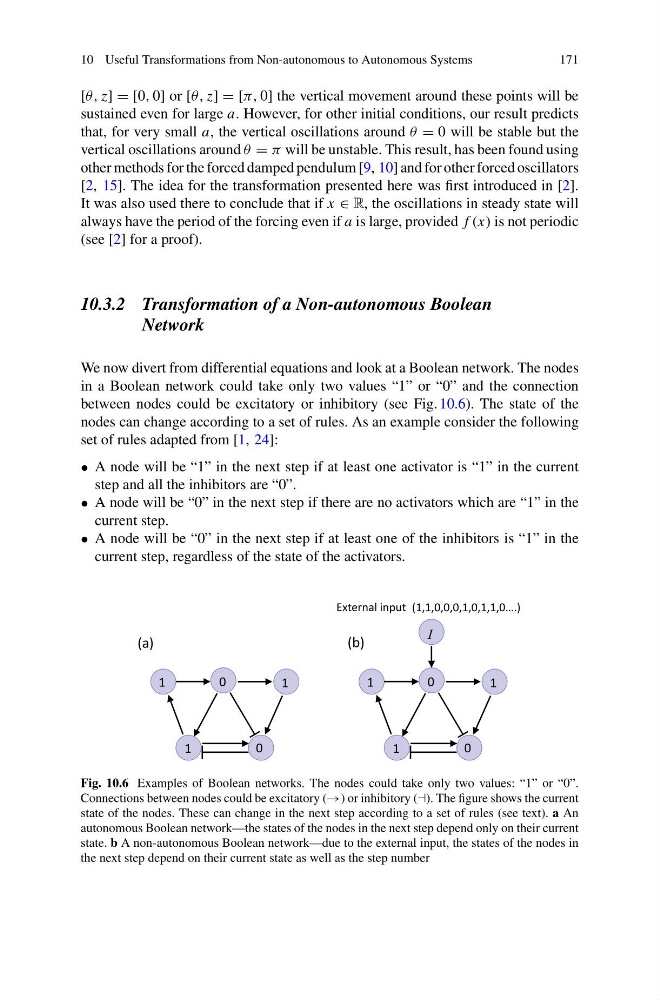
We now divert from differential equations and look at a Boolean network. The nodes
in a Boolean network could take only two values “1” or “0” and the connection
between nodes could be excitatory or inhibitory (see Fig. 10.6). The state of the
nodes can change according to a set of rules. As an example consider the following
set of rules adapted from [1, 24]:
• A node will be “1” in the next step if at least one activator is “1” in the current
step and all the inhibitors are “0”.
• A node will be “0” in the next step if there are no activators which are “1” in the
current step.
• A node will be “0” in the next step if at least one of the inhibitors is “1” in the
current step, regardless of the state of the activators.
1
0
1
0
1
External input (1,1,0,0,0,1,0,1,1,0….)
1
0
1
0
1
I
(a)
(b)
Fig. 10.6 Examples of Boolean networks. The nodes could take only two values: “1” or “0”.
Connections between nodes could be excitatory (→) or inhibitory (). The figure shows the current
state of the nodes. These can change in the next step according to a set of rules (see text). a An
autonomous Boolean network—the states of the nodes in the next step depend only on their current
state. b A non-autonomous Boolean network—due to the external input, the states of the nodes in
the next step depend on their current state as well as the step number
171
[θ, z] = [0, 0] or [θ, z] = [π, 0] the vertical movement around these points will be
sustained even for large a. However, for other initial conditions, our result predicts
that, for very small a, the vertical oscillations around θ = 0 will be stable but the
vertical oscillations around θ = π will be unstable. This result, has been found using
other methods for the forced damped pendulum [9, 10] and for other forced oscillators
[2, 15]. The idea for the transformation presented here was first introduced in [2].
It was also used there to conclude that if x ∈ R, the oscillations in steady state will
always have the period of the forcing even if a is large, provided f (x) is not periodic
(see [2] for a proof).
10.3.2 Transformation of a Non-autonomous Boolean
Network
We now divert from differential equations and look at a Boolean network. The nodes
in a Boolean network could take only two values “1” or “0” and the connection
between nodes could be excitatory or inhibitory (see Fig. 10.6). The state of the
nodes can change according to a set of rules. As an example consider the following
set of rules adapted from [1, 24]:
• A node will be “1” in the next step if at least one activator is “1” in the current
step and all the inhibitors are “0”.
• A node will be “0” in the next step if there are no activators which are “1” in the
current step.
• A node will be “0” in the next step if at least one of the inhibitors is “1” in the
current step, regardless of the state of the activators.
1
0
1
0
1
External input (1,1,0,0,0,1,0,1,1,0….)
1
0
1
0
1
I
(a)
(b)
Fig. 10.6 Examples of Boolean networks. The nodes could take only two values: “1” or “0”.
Connections between nodes could be excitatory (→) or inhibitory (). The figure shows the current
state of the nodes. These can change in the next step according to a set of rules (see text). a An
autonomous Boolean network—the states of the nodes in the next step depend only on their current
state. b A non-autonomous Boolean network—due to the external input, the states of the nodes in
the next step depend on their current state as well as the step number