

172
A. Ben-Tal
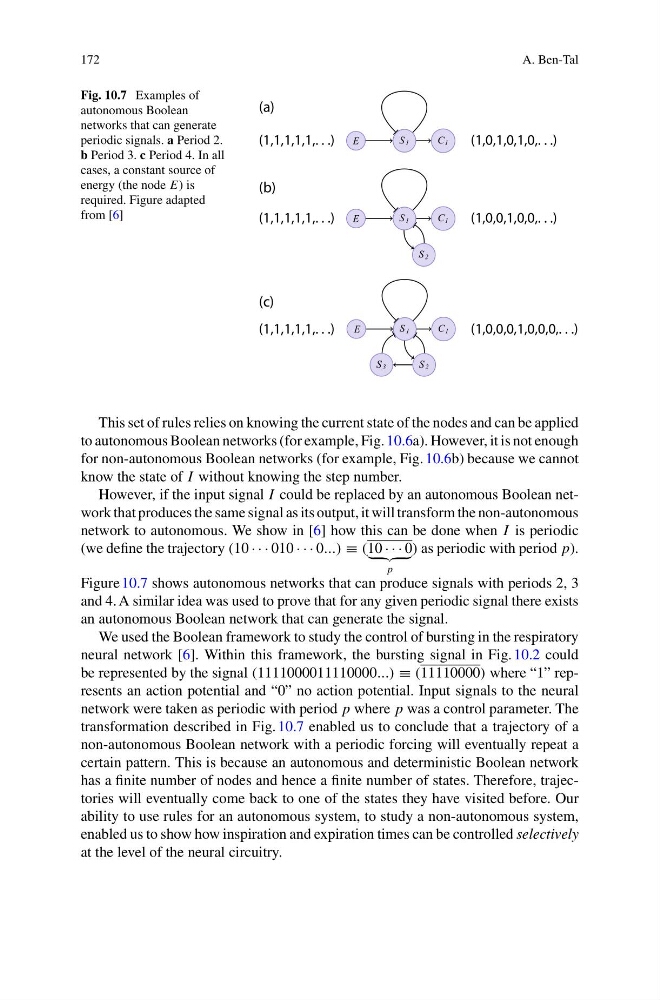
Fig. 10.7 Examples of
autonomous Boolean
networks that can generate
periodic signals. a Period 2.
b Period 3. c Period 4. In all
cases, a constant source of
energy (the node E) is
required. Figure adapted
from [6]
S 1
C 1
E
S 1
C 1
S 2
E
S 1
C 1
S 2
S 3
E
(1,0,1,0,1,0,. . .)
(1,0,0,1,0,0,. . .)
(1,0,0,0,1,0,0,0,. . .)
(1,1,1,1,1,. . .)
(1,1,1,1,1,. . .)
(1,1,1,1,1,. . .)
(a)
(b)
(c)
This set of rules relies on knowing the current state of the nodes and can be applied
to autonomous Boolean networks (for example, Fig. 10.6a). However, it is not enough
for non-autonomous Boolean networks (for example, Fig. 10.6b) because we cannot
know the state of I without knowing the step number.
However, if the input signal I could be replaced by an autonomous Boolean network that produces the same signal as its output, it will transform the non-autonomous
network to autonomous. We show in [6] how this can be done when I is periodic
(we define the trajectory (10 · · · 010 · · · 0...) ≡ (10 · · · 0
p
) as periodic with period p).
Figure 10.7 shows autonomous networks that can produce signals with periods 2, 3
and 4. A similar idea was used to prove that for any given periodic signal there exists
an autonomous Boolean network that can generate the signal.
We used the Boolean framework to study the control of bursting in the respiratory
neural network [6]. Within this framework, the bursting signal in Fig. 10.2 could
be represented by the signal (1111000011110000...) ≡ (11110000) where “1” represents an action potential and “0” no action potential. Input signals to the neural
network were taken as periodic with period p where p was a control parameter. The
transformation described in Fig. 10.7 enabled us to conclude that a trajectory of a
non-autonomous Boolean network with a periodic forcing will eventually repeat a
certain pattern. This is because an autonomous and deterministic Boolean network
has a finite number of nodes and hence a finite number of states. Therefore, trajectories will eventually come back to one of the states they have visited before. Our
ability to use rules for an autonomous system, to study a non-autonomous system,
enabled us to show how inspiration and expiration times can be controlled selectively
at the level of the neural circuitry.
A. Ben-Tal
Fig. 10.7 Examples of
autonomous Boolean
networks that can generate
periodic signals. a Period 2.
b Period 3. c Period 4. In all
cases, a constant source of
energy (the node E) is
required. Figure adapted
from [6]
S 1
C 1
E
S 1
C 1
S 2
E
S 1
C 1
S 2
S 3
E
(1,0,1,0,1,0,. . .)
(1,0,0,1,0,0,. . .)
(1,0,0,0,1,0,0,0,. . .)
(1,1,1,1,1,. . .)
(1,1,1,1,1,. . .)
(1,1,1,1,1,. . .)
(a)
(b)
(c)
This set of rules relies on knowing the current state of the nodes and can be applied
to autonomous Boolean networks (for example, Fig. 10.6a). However, it is not enough
for non-autonomous Boolean networks (for example, Fig. 10.6b) because we cannot
know the state of I without knowing the step number.
However, if the input signal I could be replaced by an autonomous Boolean network that produces the same signal as its output, it will transform the non-autonomous
network to autonomous. We show in [6] how this can be done when I is periodic
(we define the trajectory (10 · · · 010 · · · 0...) ≡ (10 · · · 0
p
) as periodic with period p).
Figure 10.7 shows autonomous networks that can produce signals with periods 2, 3
and 4. A similar idea was used to prove that for any given periodic signal there exists
an autonomous Boolean network that can generate the signal.
We used the Boolean framework to study the control of bursting in the respiratory
neural network [6]. Within this framework, the bursting signal in Fig. 10.2 could
be represented by the signal (1111000011110000...) ≡ (11110000) where “1” represents an action potential and “0” no action potential. Input signals to the neural
network were taken as periodic with period p where p was a control parameter. The
transformation described in Fig. 10.7 enabled us to conclude that a trajectory of a
non-autonomous Boolean network with a periodic forcing will eventually repeat a
certain pattern. This is because an autonomous and deterministic Boolean network
has a finite number of nodes and hence a finite number of states. Therefore, trajectories will eventually come back to one of the states they have visited before. Our
ability to use rules for an autonomous system, to study a non-autonomous system,
enabled us to show how inspiration and expiration times can be controlled selectively
at the level of the neural circuitry.