

158
I. Kovacic et al.
Two penultimate frequencies (VI and VII) become close to each other for higher κ.
Note that for certain κ, frequencies III, IV can become equal to V.
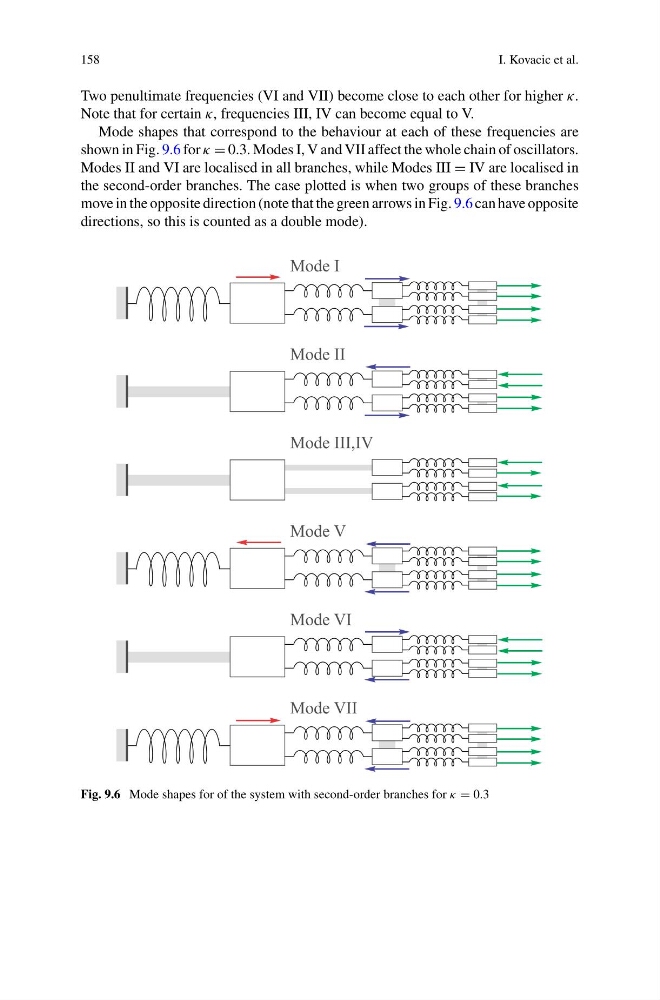
Mode shapes that correspond to the behaviour at each of these frequencies are
shown in Fig. 9.6 for κ = 0.3. Modes I, V and VII affect the whole chain of oscillators.
Modes II and VI are localised in all branches, while Modes III = IV are localised in
the second-order branches. The case plotted is when two groups of these branches
move in the opposite direction (note that the green arrows in Fig. 9.6 can have opposite
directions, so this is counted as a double mode).
Fig. 9.6 Mode shapes for of the system with second-order branches for κ = 0.3
I. Kovacic et al.
Two penultimate frequencies (VI and VII) become close to each other for higher κ.
Note that for certain κ, frequencies III, IV can become equal to V.
Mode shapes that correspond to the behaviour at each of these frequencies are
shown in Fig. 9.6 for κ = 0.3. Modes I, V and VII affect the whole chain of oscillators.
Modes II and VI are localised in all branches, while Modes III = IV are localised in
the second-order branches. The case plotted is when two groups of these branches
move in the opposite direction (note that the green arrows in Fig. 9.6 can have opposite
directions, so this is counted as a double mode).
Fig. 9.6 Mode shapes for of the system with second-order branches for κ = 0.3