

9 On Localised Modes in Bio-inspired Hierarchically Organised …
159
9.4 Model with a Chain of Arbitrary Order of Hierarchy
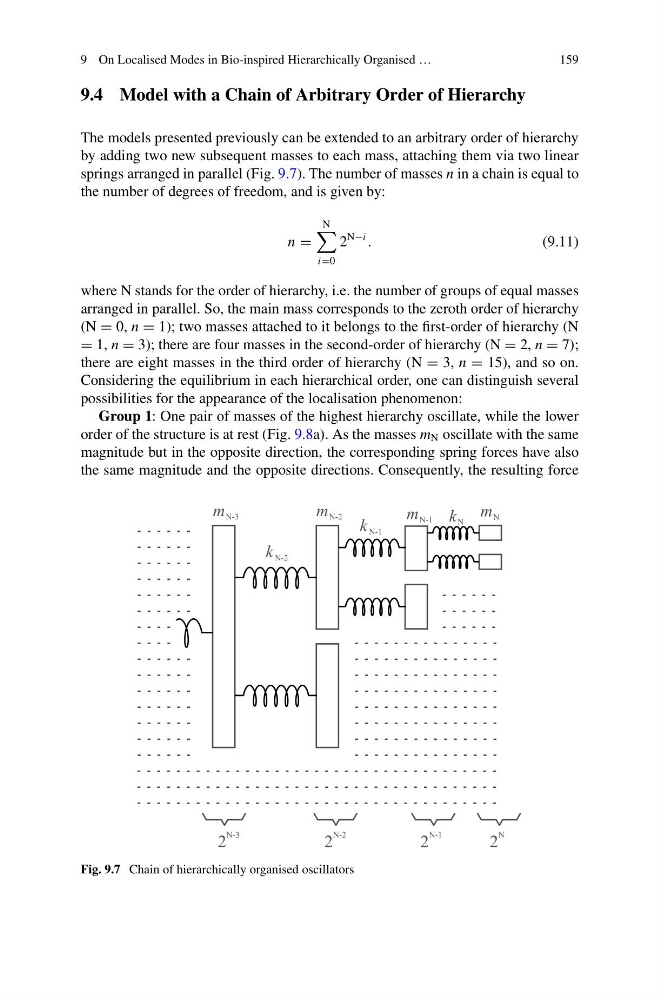
The models presented previously can be extended to an arbitrary order of hierarchy
by adding two new subsequent masses to each mass, attaching them via two linear
springs arranged in parallel (Fig. 9.7). The number of masses n in a chain is equal to
the number of degrees of freedom, and is given by:
n =
N
i=0
2
N−i
.
(9.11)
where N stands for the order of hierarchy, i.e. the number of groups of equal masses
arranged in parallel. So, the main mass corresponds to the zeroth order of hierarchy
(N = 0, n = 1); two masses attached to it belongs to the first-order of hierarchy (N
= 1, n = 3); there are four masses in the second-order of hierarchy (N = 2, n = 7);
there are eight masses in the third order of hierarchy (N = 3, n = 15), and so on.
Considering the equilibrium in each hierarchical order, one can distinguish several
possibilities for the appearance of the localisation phenomenon:
Group 1: One pair of masses of the highest hierarchy oscillate, while the lower
order of the structure is at rest (Fig. 9.8a). As the masses m N oscillate with the same
magnitude but in the opposite direction, the corresponding spring forces have also
the same magnitude and the opposite directions. Consequently, the resulting force
Fig. 9.7 Chain of hierarchically organised oscillators
159
9.4 Model with a Chain of Arbitrary Order of Hierarchy
The models presented previously can be extended to an arbitrary order of hierarchy
by adding two new subsequent masses to each mass, attaching them via two linear
springs arranged in parallel (Fig. 9.7). The number of masses n in a chain is equal to
the number of degrees of freedom, and is given by:
n =
N
i=0
2
N−i
.
(9.11)
where N stands for the order of hierarchy, i.e. the number of groups of equal masses
arranged in parallel. So, the main mass corresponds to the zeroth order of hierarchy
(N = 0, n = 1); two masses attached to it belongs to the first-order of hierarchy (N
= 1, n = 3); there are four masses in the second-order of hierarchy (N = 2, n = 7);
there are eight masses in the third order of hierarchy (N = 3, n = 15), and so on.
Considering the equilibrium in each hierarchical order, one can distinguish several
possibilities for the appearance of the localisation phenomenon:
Group 1: One pair of masses of the highest hierarchy oscillate, while the lower
order of the structure is at rest (Fig. 9.8a). As the masses m N oscillate with the same
magnitude but in the opposite direction, the corresponding spring forces have also
the same magnitude and the opposite directions. Consequently, the resulting force
Fig. 9.7 Chain of hierarchically organised oscillators