

156
I. Kovacic et al.
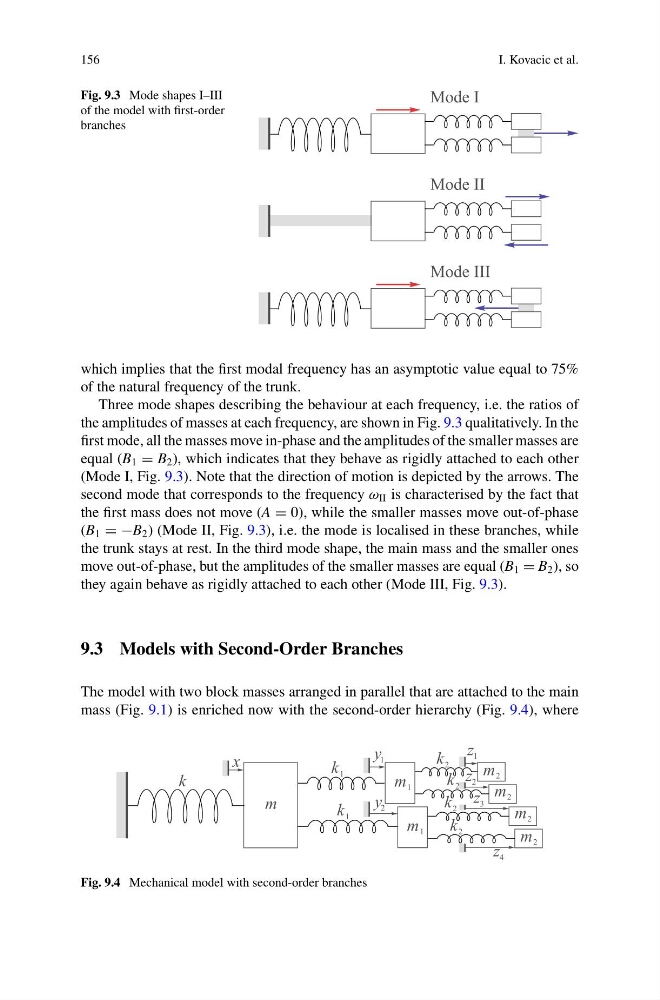
Fig. 9.3 Mode shapes I–III
of the model with first-order
branches
which implies that the first modal frequency has an asymptotic value equal to 75%
of the natural frequency of the trunk.
Three mode shapes describing the behaviour at each frequency, i.e. the ratios of
the amplitudes of masses at each frequency, are shown in Fig. 9.3 qualitatively. In the
first mode, all the masses move in-phase and the amplitudes of the smaller masses are
equal (B 1 = B 2 ), which indicates that they behave as rigidly attached to each other
(Mode I, Fig. 9.3). Note that the direction of motion is depicted by the arrows. The
second mode that corresponds to the frequency ω II is characterised by the fact that
the first mass does not move (A = 0), while the smaller masses move out-of-phase
(B 1 = −B 2 ) (Mode II, Fig. 9.3), i.e. the mode is localised in these branches, while
the trunk stays at rest. In the third mode shape, the main mass and the smaller ones
move out-of-phase, but the amplitudes of the smaller masses are equal (B 1 = B 2 ), so
they again behave as rigidly attached to each other (Mode III, Fig. 9.3).
9.3 Models with Second-Order Branches
The model with two block masses arranged in parallel that are attached to the main
mass (Fig. 9.1) is enriched now with the second-order hierarchy (Fig. 9.4), where
Fig. 9.4 Mechanical model with second-order branches
I. Kovacic et al.
Fig. 9.3 Mode shapes I–III
of the model with first-order
branches
which implies that the first modal frequency has an asymptotic value equal to 75%
of the natural frequency of the trunk.
Three mode shapes describing the behaviour at each frequency, i.e. the ratios of
the amplitudes of masses at each frequency, are shown in Fig. 9.3 qualitatively. In the
first mode, all the masses move in-phase and the amplitudes of the smaller masses are
equal (B 1 = B 2 ), which indicates that they behave as rigidly attached to each other
(Mode I, Fig. 9.3). Note that the direction of motion is depicted by the arrows. The
second mode that corresponds to the frequency ω II is characterised by the fact that
the first mass does not move (A = 0), while the smaller masses move out-of-phase
(B 1 = −B 2 ) (Mode II, Fig. 9.3), i.e. the mode is localised in these branches, while
the trunk stays at rest. In the third mode shape, the main mass and the smaller ones
move out-of-phase, but the amplitudes of the smaller masses are equal (B 1 = B 2 ), so
they again behave as rigidly attached to each other (Mode III, Fig. 9.3).
9.3 Models with Second-Order Branches
The model with two block masses arranged in parallel that are attached to the main
mass (Fig. 9.1) is enriched now with the second-order hierarchy (Fig. 9.4), where
Fig. 9.4 Mechanical model with second-order branches