

nutrients are higher now, so the productivity of the ecosystem seems to be enhanced
(Fig. 14.7) and we can speak of a change in the trophic status of the Pyrenean lakes
towards a relative (in terms of these low-productive waters) “eutrophication”.
Phosphorus comes largely from South, accompanying the dust outbreaks
reaching the Pyrenees from Northern Africa and the Iberian Peninsula (Camarero
and Catalan 2012). There is a certain correlation between the North Atlantic
Oscillation (NAO) index and the production of dust in Northern Africa and subsequent transport towards the Mediterranean (Moulin et al. 1997). Positive NAO
values entail dryer meteorological conditions and therefore higher dust inputs to the
atmosphere. Changes in the dust and phosphorus inputs may therefore be linked to
natural meteorological variations. But in the context of climate change, it can be
also argued that human action is contributing indirectly to enlarge the atmospheric
dust fluxes as well (Mahowald et al. 2010). The data set presented here could be
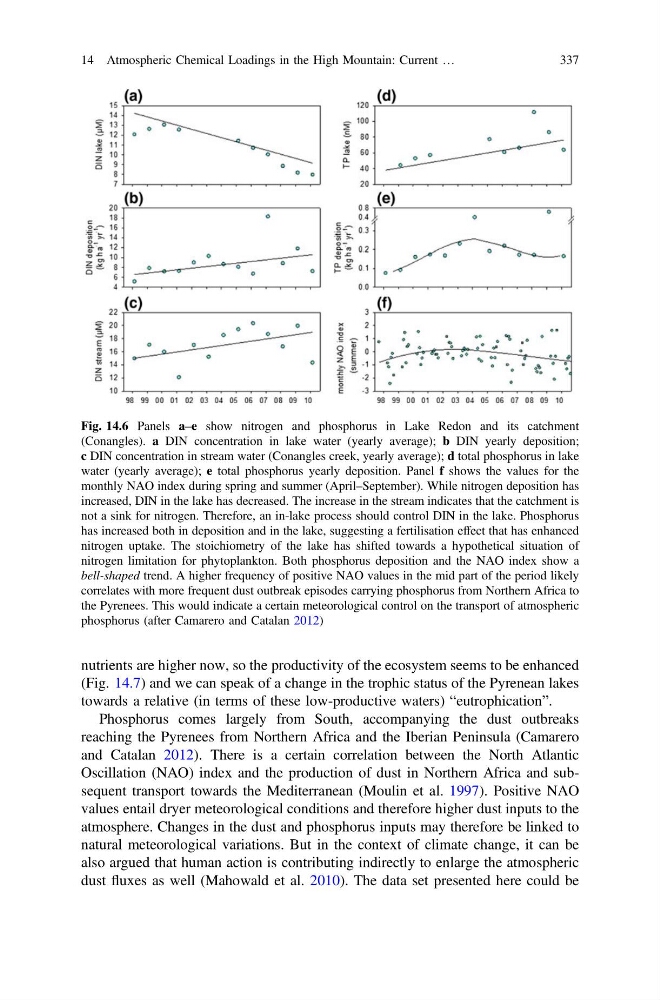
Fig. 14.6 Panels a–e show nitrogen and phosphorus in Lake Redon and its catchment
(Conangles). a DIN concentration in lake water (yearly average); b DIN yearly deposition;
c DIN concentration in stream water (Conangles creek, yearly average); d total phosphorus in lake
water (yearly average); e total phosphorus yearly deposition. Panel f shows the values for the
monthly NAO index during spring and summer (April–September). While nitrogen deposition has
increased, DIN in the lake has decreased. The increase in the stream indicates that the catchment is
not a sink for nitrogen. Therefore, an in-lake process should control DIN in the lake. Phosphorus
has increased both in deposition and in the lake, suggesting a fertilisation effect that has enhanced
nitrogen uptake. The stoichiometry of the lake has shifted towards a hypothetical situation of
nitrogen limitation for phytoplankton. Both phosphorus deposition and the NAO index show a
bell-shaped trend. A higher frequency of positive NAO values in the mid part of the period likely
correlates with more frequent dust outbreak episodes carrying phosphorus from Northern Africa to
the Pyrenees. This would indicate a certain meteorological control on the transport of atmospheric
phosphorus (after Camarero and Catalan 2012)
14 Atmospheric Chemical Loadings in the High Mountain: Current …
337
(Fig. 14.7) and we can speak of a change in the trophic status of the Pyrenean lakes
towards a relative (in terms of these low-productive waters) “eutrophication”.
Phosphorus comes largely from South, accompanying the dust outbreaks
reaching the Pyrenees from Northern Africa and the Iberian Peninsula (Camarero
and Catalan 2012). There is a certain correlation between the North Atlantic
Oscillation (NAO) index and the production of dust in Northern Africa and subsequent transport towards the Mediterranean (Moulin et al. 1997). Positive NAO
values entail dryer meteorological conditions and therefore higher dust inputs to the
atmosphere. Changes in the dust and phosphorus inputs may therefore be linked to
natural meteorological variations. But in the context of climate change, it can be
also argued that human action is contributing indirectly to enlarge the atmospheric
dust fluxes as well (Mahowald et al. 2010). The data set presented here could be
Fig. 14.6 Panels a–e show nitrogen and phosphorus in Lake Redon and its catchment
(Conangles). a DIN concentration in lake water (yearly average); b DIN yearly deposition;
c DIN concentration in stream water (Conangles creek, yearly average); d total phosphorus in lake
water (yearly average); e total phosphorus yearly deposition. Panel f shows the values for the
monthly NAO index during spring and summer (April–September). While nitrogen deposition has
increased, DIN in the lake has decreased. The increase in the stream indicates that the catchment is
not a sink for nitrogen. Therefore, an in-lake process should control DIN in the lake. Phosphorus
has increased both in deposition and in the lake, suggesting a fertilisation effect that has enhanced
nitrogen uptake. The stoichiometry of the lake has shifted towards a hypothetical situation of
nitrogen limitation for phytoplankton. Both phosphorus deposition and the NAO index show a
bell-shaped trend. A higher frequency of positive NAO values in the mid part of the period likely
correlates with more frequent dust outbreak episodes carrying phosphorus from Northern Africa to
the Pyrenees. This would indicate a certain meteorological control on the transport of atmospheric
phosphorus (after Camarero and Catalan 2012)
14 Atmospheric Chemical Loadings in the High Mountain: Current …
337