

will enhance further hydrological changes. In recent years, a great effort has been
made by hydrological scientists to provide reliable projections of future water
resources availability in a warmer climate by coupling climate and hydrological
models. In this last section, we aim to provide a simple, but feasible, projection of
future changes in streamflow of Pyrenean Rivers through a hydrological modelling
approach, considering climate warming scenarios. The hydrological simulations
were done with SWAT (Soil Water Assessment Tool) model, for the Ésera River,
considering the changes in temperature (delta changes) that the Regional Climate
Models of the ENSEMBLES project (Hewitt and Griggs 2004), predict for the time
window 2035–2065, compared to the control period 1970–2000. We did not
consider changes in precipitation due to the high level of uncertainty related to
precipitation projections for the future. Details on the model calibration and climate
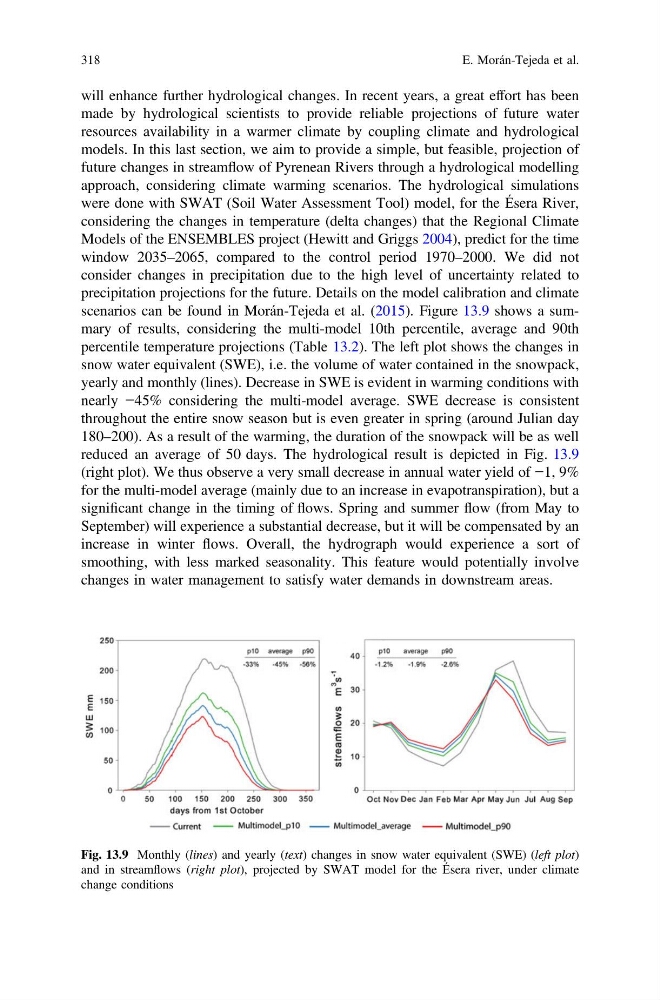
scenarios can be found in Morán-Tejeda et al. (2015). Figure 13.9 shows a summary of results, considering the multi-model 10th percentile, average and 90th
percentile temperature projections (Table 13.2). The left plot shows the changes in
snow water equivalent (SWE), i.e. the volume of water contained in the snowpack,
yearly and monthly (lines). Decrease in SWE is evident in warming conditions with
nearly −45% considering the multi-model average. SWE decrease is consistent
throughout the entire snow season but is even greater in spring (around Julian day
180–200). As a result of the warming, the duration of the snowpack will be as well
reduced an average of 50 days. The hydrological result is depicted in Fig. 13.9
(right plot). We thus observe a very small decrease in annual water yield of −1, 9%
for the multi-model average (mainly due to an increase in evapotranspiration), but a
significant change in the timing of flows. Spring and summer flow (from May to
September) will experience a substantial decrease, but it will be compensated by an
increase in winter flows. Overall, the hydrograph would experience a sort of
smoothing, with less marked seasonality. This feature would potentially involve
changes in water management to satisfy water demands in downstream areas.
Fig. 13.9 Monthly (lines) and yearly (text) changes in snow water equivalent (SWE) (left plot)
and in streamflows (right plot), projected by SWAT model for the Ésera river, under climate
change conditions
318
E. Morán-Tejeda et al.
made by hydrological scientists to provide reliable projections of future water
resources availability in a warmer climate by coupling climate and hydrological
models. In this last section, we aim to provide a simple, but feasible, projection of
future changes in streamflow of Pyrenean Rivers through a hydrological modelling
approach, considering climate warming scenarios. The hydrological simulations
were done with SWAT (Soil Water Assessment Tool) model, for the Ésera River,
considering the changes in temperature (delta changes) that the Regional Climate
Models of the ENSEMBLES project (Hewitt and Griggs 2004), predict for the time
window 2035–2065, compared to the control period 1970–2000. We did not
consider changes in precipitation due to the high level of uncertainty related to
precipitation projections for the future. Details on the model calibration and climate
scenarios can be found in Morán-Tejeda et al. (2015). Figure 13.9 shows a summary of results, considering the multi-model 10th percentile, average and 90th
percentile temperature projections (Table 13.2). The left plot shows the changes in
snow water equivalent (SWE), i.e. the volume of water contained in the snowpack,
yearly and monthly (lines). Decrease in SWE is evident in warming conditions with
nearly −45% considering the multi-model average. SWE decrease is consistent
throughout the entire snow season but is even greater in spring (around Julian day
180–200). As a result of the warming, the duration of the snowpack will be as well
reduced an average of 50 days. The hydrological result is depicted in Fig. 13.9
(right plot). We thus observe a very small decrease in annual water yield of −1, 9%
for the multi-model average (mainly due to an increase in evapotranspiration), but a
significant change in the timing of flows. Spring and summer flow (from May to
September) will experience a substantial decrease, but it will be compensated by an
increase in winter flows. Overall, the hydrograph would experience a sort of
smoothing, with less marked seasonality. This feature would potentially involve
changes in water management to satisfy water demands in downstream areas.
Fig. 13.9 Monthly (lines) and yearly (text) changes in snow water equivalent (SWE) (left plot)
and in streamflows (right plot), projected by SWAT model for the Ésera river, under climate
change conditions
318
E. Morán-Tejeda et al.