

As noted above, many reservoirs store water from Pyrenean rivers to supply
water during the season of lower availability and higher demand (summer). As
observed by López-Moreno et al. (2004), Pyrenean reservoirs have used different
patterns of management (basically two) during the last decades, but in a very
restricted way, not adapted to the inter-annual variability of river flows. We want to
emphasize on the recommendation done by López-Moreno et al. (2004) for a more
dynamic management of Pyrenean reservoirs, given the occurred changes in river
flows and their possible enhancement during next decades.
Although we did not consider changes in future amounts of precipitation, climate
models predict that it is likely to experience a decrease during the 21st century in
the Mediterranean region (Giorgi and Lionello 2008). If such predictions are right,
we would have to add a decline in streamflow amounts to the observed change in
the timing of flows. Another process that was not considered here may involve a
further reduction in water availability. The Pyrenees, as many other Spanish
mountains are experiencing a recovery of natural vegetation, including shrubs and
forests, due to the abandonment of traditional activities that used the mountain
slopes for pastures and cropping (Vicente-Serrano et al. 2004; Lasanta-Martínez
et al. 2005). It has been experimentally demonstrated that forested catchments yield
less amount of water than non-forested ones (e.g. García-Ruiz et al. 2008) due to
rainfall interception and evapotranspiration by forest canopy (Llorens and Domingo
2007). Hydrological modelling also shows that future increase of vegetation cover
in Pyrenean catchments would reduce river flows (López-Moreno et al. 2014). This
aspect involves more complexity and uncertainty for the prediction of future water
resources availability, but also gives us key information for improving the management of water in the Pyrenees in a more integrated fashion.
13.8 Conclusions
We show in this work a comprehensive analysis of the evolution of climate, snow
cover and water resources in the Spanish Pyrenees, during the last four decades, and
the interactions amongst them. This analysis has been possible due to the existence
of quality databases of precipitation, temperature, snow depth and streamflows
developed and managed by different institutions.
Climatically, we focused on the tails of the climate variables distributions, to find
any trend in conditions that could favour/hamper snow accumulation and melting.
We found a decrease in the number of dry-cold and wet-cold days, and an increase
in the number of warm-dry and warm-wet days, meaning that only far-from-mean
temperatures and not precipitation, have experienced significant trends.
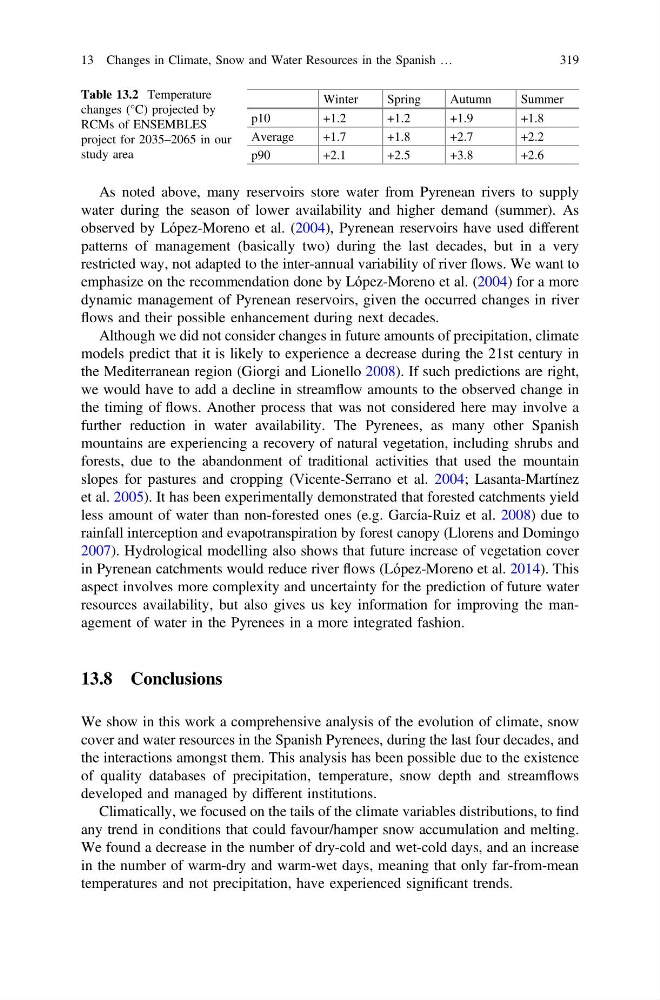
Table 13.2 Temperature
changes (°C) projected by
RCMs of ENSEMBLES
project for 2035–2065 in our
study area
Winter
Spring
Autumn
Summer
p10
+1.2
+1.2
+1.9
+1.8
Average
+1.7
+1.8
+2.7
+2.2
p90
+2.1
+2.5
+3.8
+2.6
13 Changes in Climate, Snow and Water Resources in the Spanish …
319
water during the season of lower availability and higher demand (summer). As
observed by López-Moreno et al. (2004), Pyrenean reservoirs have used different
patterns of management (basically two) during the last decades, but in a very
restricted way, not adapted to the inter-annual variability of river flows. We want to
emphasize on the recommendation done by López-Moreno et al. (2004) for a more
dynamic management of Pyrenean reservoirs, given the occurred changes in river
flows and their possible enhancement during next decades.
Although we did not consider changes in future amounts of precipitation, climate
models predict that it is likely to experience a decrease during the 21st century in
the Mediterranean region (Giorgi and Lionello 2008). If such predictions are right,
we would have to add a decline in streamflow amounts to the observed change in
the timing of flows. Another process that was not considered here may involve a
further reduction in water availability. The Pyrenees, as many other Spanish
mountains are experiencing a recovery of natural vegetation, including shrubs and
forests, due to the abandonment of traditional activities that used the mountain
slopes for pastures and cropping (Vicente-Serrano et al. 2004; Lasanta-Martínez
et al. 2005). It has been experimentally demonstrated that forested catchments yield
less amount of water than non-forested ones (e.g. García-Ruiz et al. 2008) due to
rainfall interception and evapotranspiration by forest canopy (Llorens and Domingo
2007). Hydrological modelling also shows that future increase of vegetation cover
in Pyrenean catchments would reduce river flows (López-Moreno et al. 2014). This
aspect involves more complexity and uncertainty for the prediction of future water
resources availability, but also gives us key information for improving the management of water in the Pyrenees in a more integrated fashion.
13.8 Conclusions
We show in this work a comprehensive analysis of the evolution of climate, snow
cover and water resources in the Spanish Pyrenees, during the last four decades, and
the interactions amongst them. This analysis has been possible due to the existence
of quality databases of precipitation, temperature, snow depth and streamflows
developed and managed by different institutions.
Climatically, we focused on the tails of the climate variables distributions, to find
any trend in conditions that could favour/hamper snow accumulation and melting.
We found a decrease in the number of dry-cold and wet-cold days, and an increase
in the number of warm-dry and warm-wet days, meaning that only far-from-mean
temperatures and not precipitation, have experienced significant trends.
Table 13.2 Temperature
changes (°C) projected by
RCMs of ENSEMBLES
project for 2035–2065 in our
study area
Winter
Spring
Autumn
Summer
p10
+1.2
+1.2
+1.9
+1.8
Average
+1.7
+1.8
+2.7
+2.2
p90
+2.1
+2.5
+3.8
+2.6
13 Changes in Climate, Snow and Water Resources in the Spanish …
319