

13.5 Snow Observations
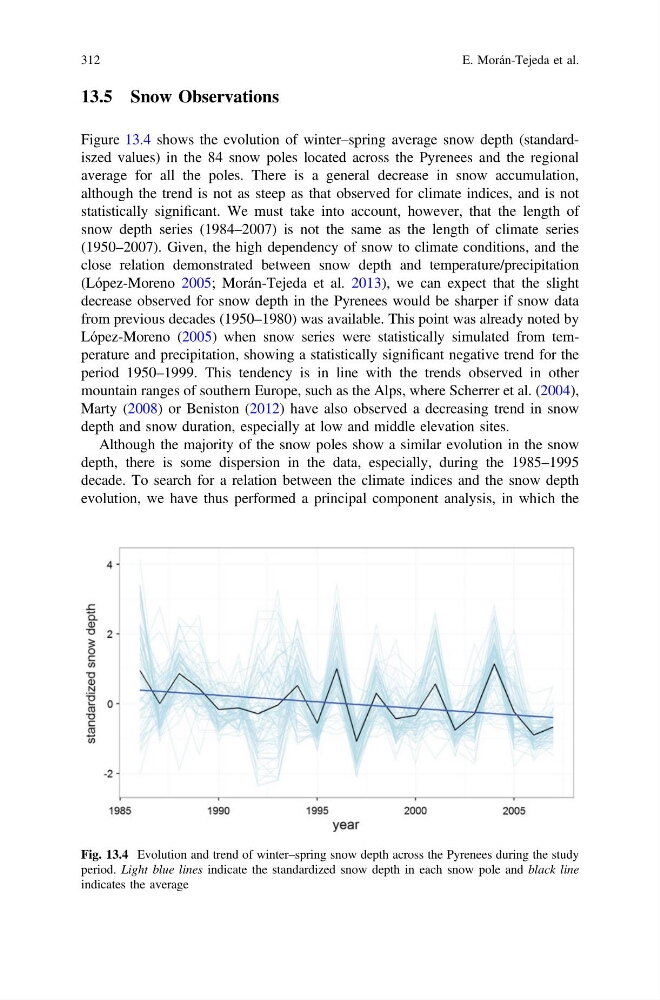
Figure 13.4 shows the evolution of winter–spring average snow depth (standardiszed values) in the 84 snow poles located across the Pyrenees and the regional
average for all the poles. There is a general decrease in snow accumulation,
although the trend is not as steep as that observed for climate indices, and is not
statistically significant. We must take into account, however, that the length of
snow depth series (1984–2007) is not the same as the length of climate series
(1950–2007). Given, the high dependency of snow to climate conditions, and the
close relation demonstrated between snow depth and temperature/precipitation
(López-Moreno 2005; Morán-Tejeda et al. 2013), we can expect that the slight
decrease observed for snow depth in the Pyrenees would be sharper if snow data
from previous decades (1950–1980) was available. This point was already noted by
López-Moreno (2005) when snow series were statistically simulated from temperature and precipitation, showing a statistically significant negative trend for the
period 1950–1999. This tendency is in line with the trends observed in other
mountain ranges of southern Europe, such as the Alps, where Scherrer et al. (2004),
Marty (2008) or Beniston (2012) have also observed a decreasing trend in snow
depth and snow duration, especially at low and middle elevation sites.
Although the majority of the snow poles show a similar evolution in the snow
depth, there is some dispersion in the data, especially, during the 1985–1995
decade. To search for a relation between the climate indices and the snow depth
evolution, we have thus performed a principal component analysis, in which the
Fig. 13.4 Evolution and trend of winter–spring snow depth across the Pyrenees during the study
period. Light blue lines indicate the standardized snow depth in each snow pole and black line
indicates the average
312
E. Morán-Tejeda et al.
Figure 13.4 shows the evolution of winter–spring average snow depth (standardiszed values) in the 84 snow poles located across the Pyrenees and the regional
average for all the poles. There is a general decrease in snow accumulation,
although the trend is not as steep as that observed for climate indices, and is not
statistically significant. We must take into account, however, that the length of
snow depth series (1984–2007) is not the same as the length of climate series
(1950–2007). Given, the high dependency of snow to climate conditions, and the
close relation demonstrated between snow depth and temperature/precipitation
(López-Moreno 2005; Morán-Tejeda et al. 2013), we can expect that the slight
decrease observed for snow depth in the Pyrenees would be sharper if snow data
from previous decades (1950–1980) was available. This point was already noted by
López-Moreno (2005) when snow series were statistically simulated from temperature and precipitation, showing a statistically significant negative trend for the
period 1950–1999. This tendency is in line with the trends observed in other
mountain ranges of southern Europe, such as the Alps, where Scherrer et al. (2004),
Marty (2008) or Beniston (2012) have also observed a decreasing trend in snow
depth and snow duration, especially at low and middle elevation sites.
Although the majority of the snow poles show a similar evolution in the snow
depth, there is some dispersion in the data, especially, during the 1985–1995
decade. To search for a relation between the climate indices and the snow depth
evolution, we have thus performed a principal component analysis, in which the
Fig. 13.4 Evolution and trend of winter–spring snow depth across the Pyrenees during the study
period. Light blue lines indicate the standardized snow depth in each snow pole and black line
indicates the average
312
E. Morán-Tejeda et al.