

variables to extract the components are the snow poles. Four Principal Components
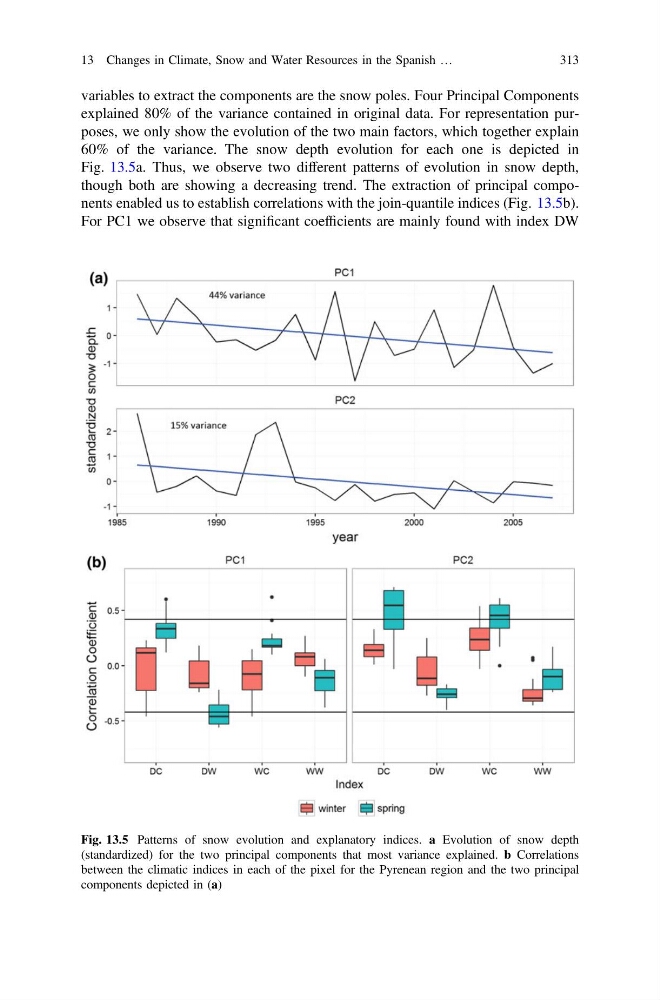
explained 80% of the variance contained in original data. For representation purposes, we only show the evolution of the two main factors, which together explain
60% of the variance. The snow depth evolution for each one is depicted in
Fig. 13.5a. Thus, we observe two different patterns of evolution in snow depth,
though both are showing a decreasing trend. The extraction of principal components enabled us to establish correlations with the join-quantile indices (Fig. 13.5b).
For PC1 we observe that significant coefficients are mainly found with index DW
Fig. 13.5 Patterns of snow evolution and explanatory indices. a Evolution of snow depth
(standardized) for the two principal components that most variance explained. b Correlations
between the climatic indices in each of the pixel for the Pyrenean region and the two principal
components depicted in (a)
13 Changes in Climate, Snow and Water Resources in the Spanish …
313
explained 80% of the variance contained in original data. For representation purposes, we only show the evolution of the two main factors, which together explain
60% of the variance. The snow depth evolution for each one is depicted in
Fig. 13.5a. Thus, we observe two different patterns of evolution in snow depth,
though both are showing a decreasing trend. The extraction of principal components enabled us to establish correlations with the join-quantile indices (Fig. 13.5b).
For PC1 we observe that significant coefficients are mainly found with index DW
Fig. 13.5 Patterns of snow evolution and explanatory indices. a Evolution of snow depth
(standardized) for the two principal components that most variance explained. b Correlations
between the climatic indices in each of the pixel for the Pyrenean region and the two principal
components depicted in (a)
13 Changes in Climate, Snow and Water Resources in the Spanish …
313