

whereas their evolution seems more stationary for winter. The number of dry-cold
and wet-cold days in spring show a steep decrease, and the number of dry-warm
and wet-warm days show a clear increase. In winter, only wet-cold days show a
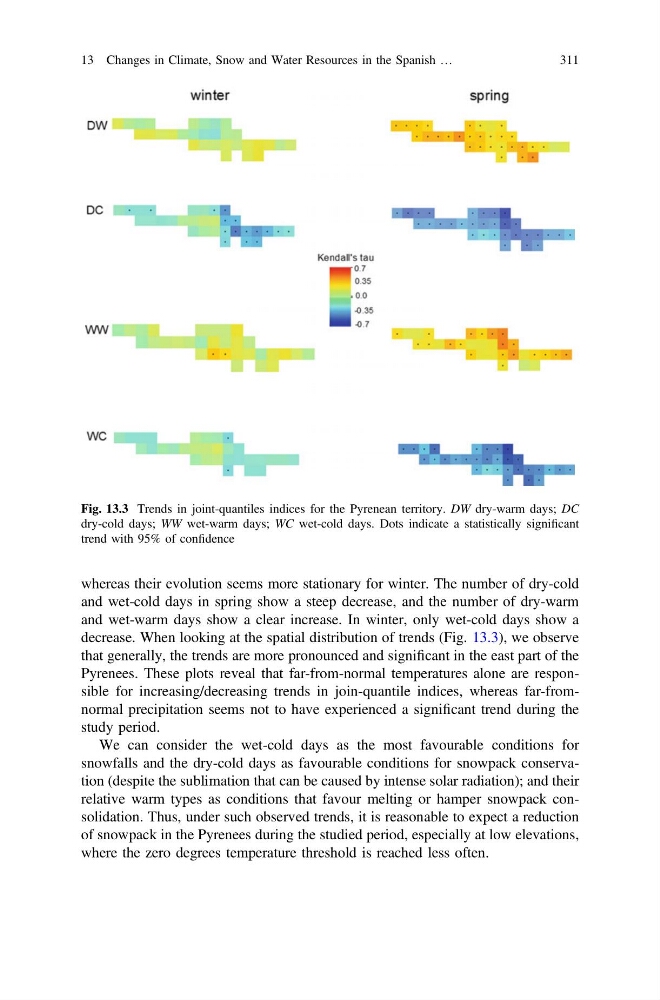
decrease. When looking at the spatial distribution of trends (Fig. 13.3), we observe
that generally, the trends are more pronounced and significant in the east part of the
Pyrenees. These plots reveal that far-from-normal temperatures alone are responsible for increasing/decreasing trends in join-quantile indices, whereas far-fromnormal precipitation seems not to have experienced a significant trend during the
study period.
We can consider the wet-cold days as the most favourable conditions for
snowfalls and the dry-cold days as favourable conditions for snowpack conservation (despite the sublimation that can be caused by intense solar radiation); and their
relative warm types as conditions that favour melting or hamper snowpack consolidation. Thus, under such observed trends, it is reasonable to expect a reduction
of snowpack in the Pyrenees during the studied period, especially at low elevations,
where the zero degrees temperature threshold is reached less often.
Fig. 13.3 Trends in joint-quantiles indices for the Pyrenean territory. DW dry-warm days; DC
dry-cold days; WW wet-warm days; WC wet-cold days. Dots indicate a statistically significant
trend with 95% of confidence
13 Changes in Climate, Snow and Water Resources in the Spanish …
311
and wet-cold days in spring show a steep decrease, and the number of dry-warm
and wet-warm days show a clear increase. In winter, only wet-cold days show a
decrease. When looking at the spatial distribution of trends (Fig. 13.3), we observe
that generally, the trends are more pronounced and significant in the east part of the
Pyrenees. These plots reveal that far-from-normal temperatures alone are responsible for increasing/decreasing trends in join-quantile indices, whereas far-fromnormal precipitation seems not to have experienced a significant trend during the
study period.
We can consider the wet-cold days as the most favourable conditions for
snowfalls and the dry-cold days as favourable conditions for snowpack conservation (despite the sublimation that can be caused by intense solar radiation); and their
relative warm types as conditions that favour melting or hamper snowpack consolidation. Thus, under such observed trends, it is reasonable to expect a reduction
of snowpack in the Pyrenees during the studied period, especially at low elevations,
where the zero degrees temperature threshold is reached less often.
Fig. 13.3 Trends in joint-quantiles indices for the Pyrenean territory. DW dry-warm days; DC
dry-cold days; WW wet-warm days; WC wet-cold days. Dots indicate a statistically significant
trend with 95% of confidence
13 Changes in Climate, Snow and Water Resources in the Spanish …
311