

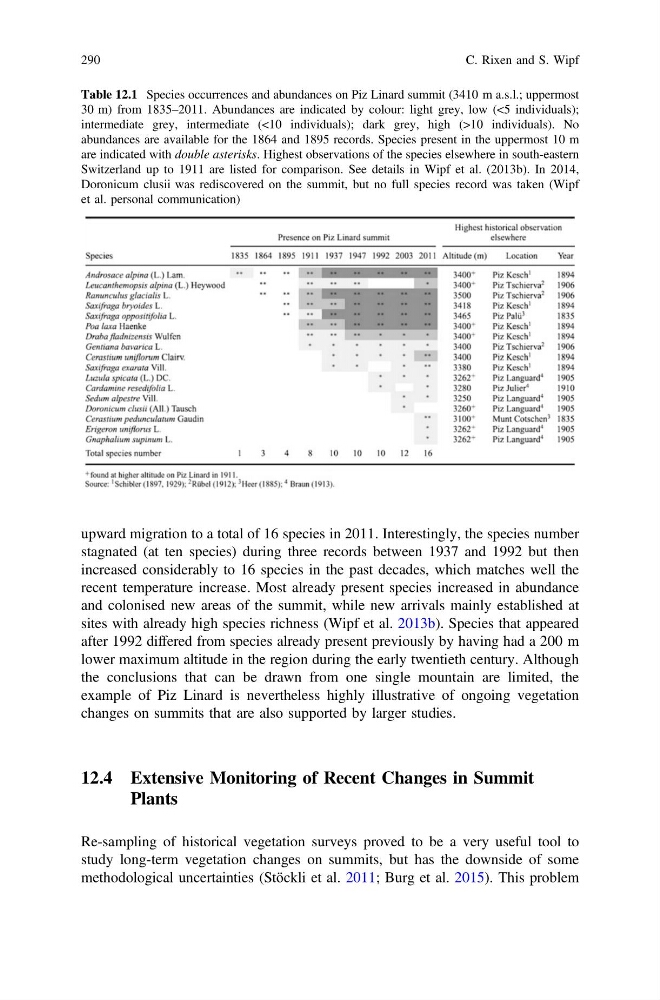
upward migration to a total of 16 species in 2011. Interestingly, the species number
stagnated (at ten species) during three records between 1937 and 1992 but then
increased considerably to 16 species in the past decades, which matches well the
recent temperature increase. Most already present species increased in abundance
and colonised new areas of the summit, while new arrivals mainly established at
sites with already high species richness (Wipf et al. 2013b). Species that appeared
after 1992 differed from species already present previously by having had a 200 m
lower maximum altitude in the region during the early twentieth century. Although
the conclusions that can be drawn from one single mountain are limited, the
example of Piz Linard is nevertheless highly illustrative of ongoing vegetation
changes on summits that are also supported by larger studies.
12.4 Extensive Monitoring of Recent Changes in Summit
Plants
Re-sampling of historical vegetation surveys proved to be a very useful tool to
study long-term vegetation changes on summits, but has the downside of some
methodological uncertainties (Stöckli et al. 2011; Burg et al. 2015). This problem
Table 12.1 Species occurrences and abundances on Piz Linard summit (3410 m a.s.l.; uppermost
30 m) from 1835–2011. Abundances are indicated by colour: light grey, low (<5 individuals);
intermediate grey, intermediate (<10 individuals); dark grey, high (>10 individuals). No
abundances are available for the 1864 and 1895 records. Species present in the uppermost 10 m
are indicated with double asterisks. Highest observations of the species elsewhere in south-eastern
Switzerland up to 1911 are listed for comparison. See details in Wipf et al. (2013b). In 2014,
Doronicum clusii was rediscovered on the summit, but no full species record was taken (Wipf
et al. personal communication)
290
C. Rixen and S. Wipf
stagnated (at ten species) during three records between 1937 and 1992 but then
increased considerably to 16 species in the past decades, which matches well the
recent temperature increase. Most already present species increased in abundance
and colonised new areas of the summit, while new arrivals mainly established at
sites with already high species richness (Wipf et al. 2013b). Species that appeared
after 1992 differed from species already present previously by having had a 200 m
lower maximum altitude in the region during the early twentieth century. Although
the conclusions that can be drawn from one single mountain are limited, the
example of Piz Linard is nevertheless highly illustrative of ongoing vegetation
changes on summits that are also supported by larger studies.
12.4 Extensive Monitoring of Recent Changes in Summit
Plants
Re-sampling of historical vegetation surveys proved to be a very useful tool to
study long-term vegetation changes on summits, but has the downside of some
methodological uncertainties (Stöckli et al. 2011; Burg et al. 2015). This problem
Table 12.1 Species occurrences and abundances on Piz Linard summit (3410 m a.s.l.; uppermost
30 m) from 1835–2011. Abundances are indicated by colour: light grey, low (<5 individuals);
intermediate grey, intermediate (<10 individuals); dark grey, high (>10 individuals). No
abundances are available for the 1864 and 1895 records. Species present in the uppermost 10 m
are indicated with double asterisks. Highest observations of the species elsewhere in south-eastern
Switzerland up to 1911 are listed for comparison. See details in Wipf et al. (2013b). In 2014,
Doronicum clusii was rediscovered on the summit, but no full species record was taken (Wipf
et al. personal communication)
290
C. Rixen and S. Wipf