

colonisers (Holzinger et al. 2008; Vittoz et al. 2009; Matteodo et al. 2013).
Generally, trait characteristics of new colonisers on summits were similar to those
of lowland communities (Matteodo et al. 2013), further illustrating the general
upwards trend of plants in mountain areas. Also, there is evidence that the biodiversity change has accelerated during the past 30 years comparable to recent
temperature increase (Wipf et al. 2013b; Walther et al. 2005).
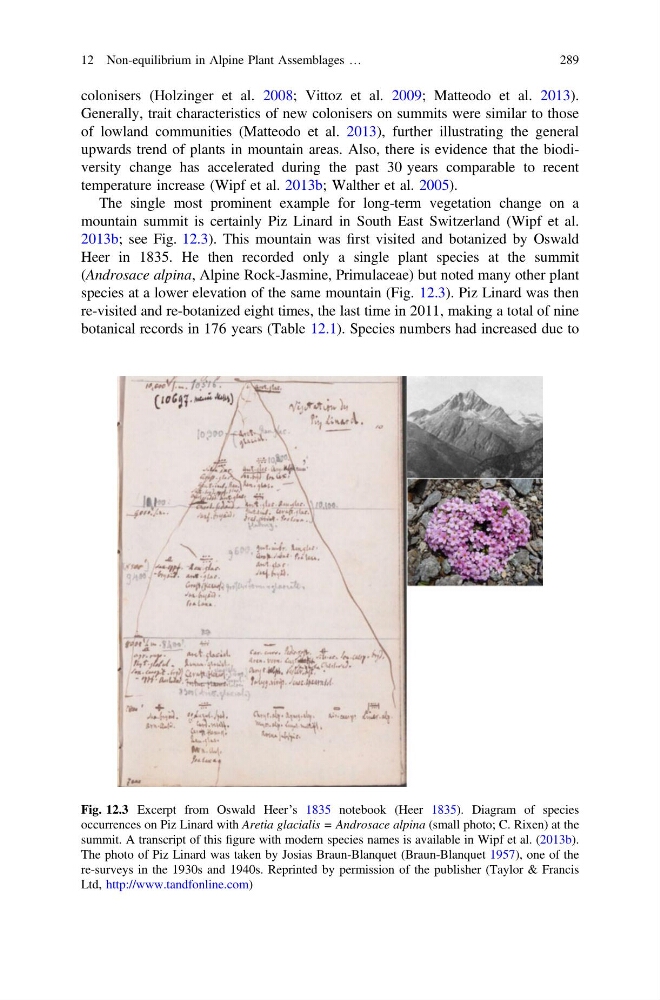
The single most prominent example for long-term vegetation change on a
mountain summit is certainly Piz Linard in South East Switzerland (Wipf et al.
2013b; see Fig. 12.3). This mountain was first visited and botanized by Oswald
Heer in 1835. He then recorded only a single plant species at the summit
(Androsace alpina, Alpine Rock-Jasmine, Primulaceae) but noted many other plant
species at a lower elevation of the same mountain (Fig. 12.3). Piz Linard was then
re-visited and re-botanized eight times, the last time in 2011, making a total of nine
botanical records in 176 years (Table 12.1). Species numbers had increased due to
Fig. 12.3 Excerpt from Oswald Heer’s 1835 notebook (Heer 1835). Diagram of species
occurrences on Piz Linard with Aretia glacialis = Androsace alpina (small photo; C. Rixen) at the
summit. A transcript of this figure with modern species names is available in Wipf et al. (2013b).
The photo of Piz Linard was taken by Josias Braun-Blanquet (Braun-Blanquet 1957), one of the
re-surveys in the 1930s and 1940s. Reprinted by permission of the publisher (Taylor & Francis
Ltd, http://www.tandfonline.com)
12 Non-equilibrium in Alpine Plant Assemblages …
289
Generally, trait characteristics of new colonisers on summits were similar to those
of lowland communities (Matteodo et al. 2013), further illustrating the general
upwards trend of plants in mountain areas. Also, there is evidence that the biodiversity change has accelerated during the past 30 years comparable to recent
temperature increase (Wipf et al. 2013b; Walther et al. 2005).
The single most prominent example for long-term vegetation change on a
mountain summit is certainly Piz Linard in South East Switzerland (Wipf et al.
2013b; see Fig. 12.3). This mountain was first visited and botanized by Oswald
Heer in 1835. He then recorded only a single plant species at the summit
(Androsace alpina, Alpine Rock-Jasmine, Primulaceae) but noted many other plant
species at a lower elevation of the same mountain (Fig. 12.3). Piz Linard was then
re-visited and re-botanized eight times, the last time in 2011, making a total of nine
botanical records in 176 years (Table 12.1). Species numbers had increased due to
Fig. 12.3 Excerpt from Oswald Heer’s 1835 notebook (Heer 1835). Diagram of species
occurrences on Piz Linard with Aretia glacialis = Androsace alpina (small photo; C. Rixen) at the
summit. A transcript of this figure with modern species names is available in Wipf et al. (2013b).
The photo of Piz Linard was taken by Josias Braun-Blanquet (Braun-Blanquet 1957), one of the
re-surveys in the 1930s and 1940s. Reprinted by permission of the publisher (Taylor & Francis
Ltd, http://www.tandfonline.com)
12 Non-equilibrium in Alpine Plant Assemblages …
289