

most sensitive, and longest term indicators for floristic change and species loss due
to climate change in the world. As a baseline for these re-survey studies serves plant
species lists of mountain summits collected in the late nineteenth and early twentieth century by some of the most renowned botanists of their time, who were
aiming to explore the elevation limits of vascular plant life (Stöckli et al. 2011).
Europe is unique in harbouring a large number of such historical datasets, and
Swiss botanists had a leading role. Almost 200 historical summit records of high
quality (Stöckli et al. 2011) exist from Switzerland alone, and dozens more from the
French and Italian Alps, the Pyrenees, the Scottish Highlands and the Scandes (e.g.
Moen and Lagerstrom 2008; Odland et al. 2010; Grytnes et al. 2014; Klanderud and
Birks 2003).
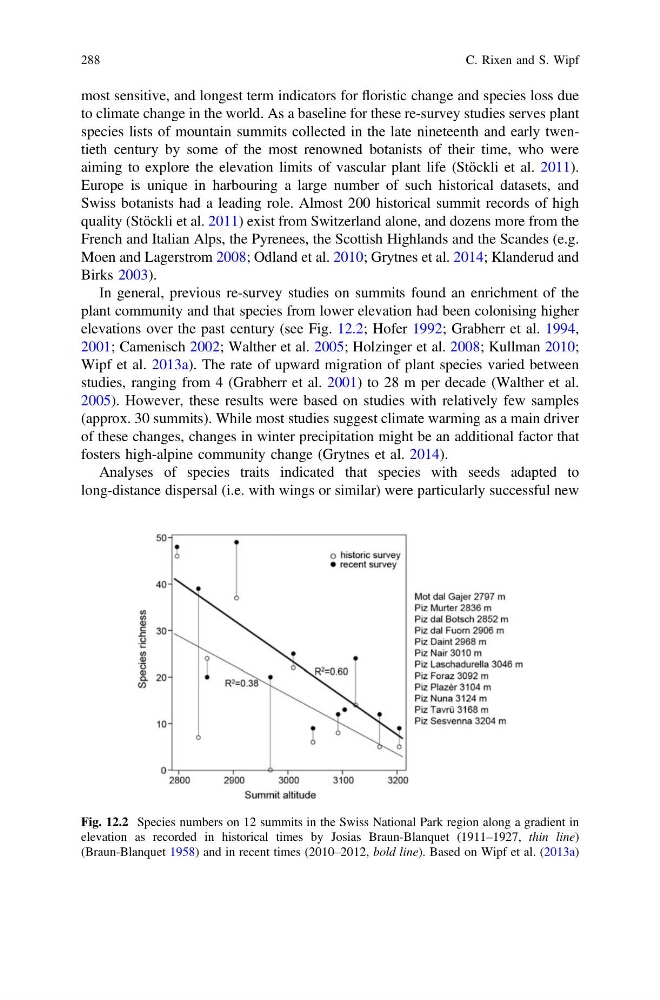
In general, previous re-survey studies on summits found an enrichment of the
plant community and that species from lower elevation had been colonising higher
elevations over the past century (see Fig. 12.2; Hofer 1992; Grabherr et al. 1994,
2001; Camenisch 2002; Walther et al. 2005; Holzinger et al. 2008; Kullman 2010;
Wipf et al. 2013a). The rate of upward migration of plant species varied between
studies, ranging from 4 (Grabherr et al. 2001) to 28 m per decade (Walther et al.
2005). However, these results were based on studies with relatively few samples
(approx. 30 summits). While most studies suggest climate warming as a main driver
of these changes, changes in winter precipitation might be an additional factor that
fosters high-alpine community change (Grytnes et al. 2014).
Analyses of species traits indicated that species with seeds adapted to
long-distance dispersal (i.e. with wings or similar) were particularly successful new
Fig. 12.2 Species numbers on 12 summits in the Swiss National Park region along a gradient in
elevation as recorded in historical times by Josias Braun-Blanquet (1911–1927, thin line)
(Braun-Blanquet 1958) and in recent times (2010–2012, bold line). Based on Wipf et al. (2013a)
288
C. Rixen and S. Wipf
to climate change in the world. As a baseline for these re-survey studies serves plant
species lists of mountain summits collected in the late nineteenth and early twentieth century by some of the most renowned botanists of their time, who were
aiming to explore the elevation limits of vascular plant life (Stöckli et al. 2011).
Europe is unique in harbouring a large number of such historical datasets, and
Swiss botanists had a leading role. Almost 200 historical summit records of high
quality (Stöckli et al. 2011) exist from Switzerland alone, and dozens more from the
French and Italian Alps, the Pyrenees, the Scottish Highlands and the Scandes (e.g.
Moen and Lagerstrom 2008; Odland et al. 2010; Grytnes et al. 2014; Klanderud and
Birks 2003).
In general, previous re-survey studies on summits found an enrichment of the
plant community and that species from lower elevation had been colonising higher
elevations over the past century (see Fig. 12.2; Hofer 1992; Grabherr et al. 1994,
2001; Camenisch 2002; Walther et al. 2005; Holzinger et al. 2008; Kullman 2010;
Wipf et al. 2013a). The rate of upward migration of plant species varied between
studies, ranging from 4 (Grabherr et al. 2001) to 28 m per decade (Walther et al.
2005). However, these results were based on studies with relatively few samples
(approx. 30 summits). While most studies suggest climate warming as a main driver
of these changes, changes in winter precipitation might be an additional factor that
fosters high-alpine community change (Grytnes et al. 2014).
Analyses of species traits indicated that species with seeds adapted to
long-distance dispersal (i.e. with wings or similar) were particularly successful new
Fig. 12.2 Species numbers on 12 summits in the Swiss National Park region along a gradient in
elevation as recorded in historical times by Josias Braun-Blanquet (1911–1927, thin line)
(Braun-Blanquet 1958) and in recent times (2010–2012, bold line). Based on Wipf et al. (2013a)
288
C. Rixen and S. Wipf