

12.2 Rapid Climate Change in Arctic and Alpine Areas
Mountain ecosystems are projected to experience more dramatic climate warming
than most other regions of the world (Pepin et al. 2015; IPCC 2014). The Swiss
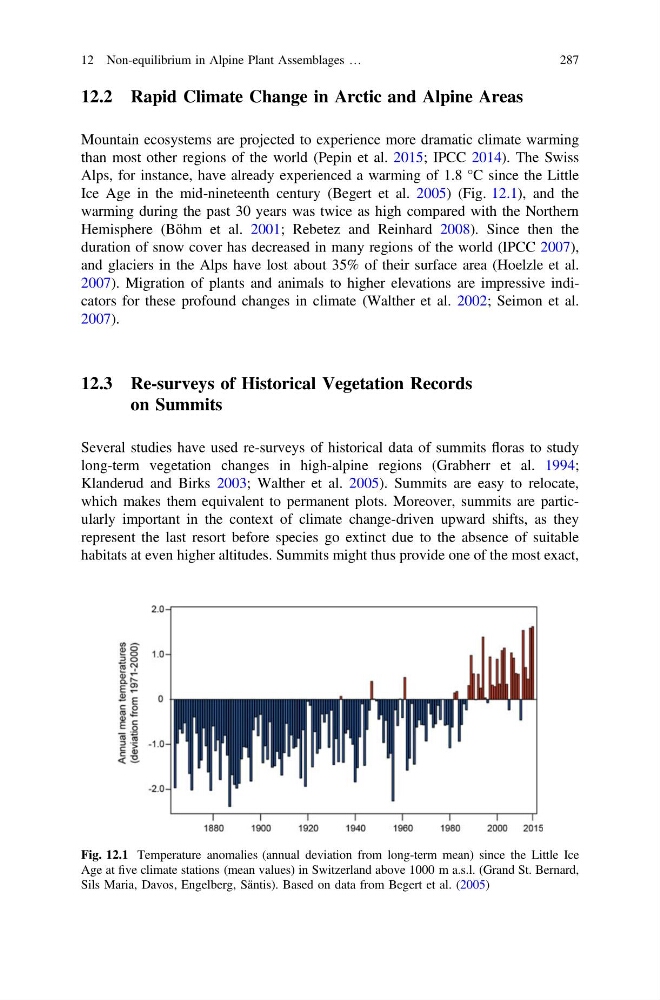
Alps, for instance, have already experienced a warming of 1.8 °C since the Little
Ice Age in the mid-nineteenth century (Begert et al. 2005) (Fig. 12.1), and the
warming during the past 30 years was twice as high compared with the Northern
Hemisphere (Böhm et al. 2001; Rebetez and Reinhard 2008). Since then the
duration of snow cover has decreased in many regions of the world (IPCC 2007),
and glaciers in the Alps have lost about 35% of their surface area (Hoelzle et al.
2007). Migration of plants and animals to higher elevations are impressive indicators for these profound changes in climate (Walther et al. 2002; Seimon et al.
2007).
12.3 Re-surveys of Historical Vegetation Records
on Summits
Several studies have used re-surveys of historical data of summits floras to study
long-term vegetation changes in high-alpine regions (Grabherr et al. 1994;
Klanderud and Birks 2003; Walther et al. 2005). Summits are easy to relocate,
which makes them equivalent to permanent plots. Moreover, summits are particularly important in the context of climate change-driven upward shifts, as they
represent the last resort before species go extinct due to the absence of suitable
habitats at even higher altitudes. Summits might thus provide one of the most exact,
Fig. 12.1 Temperature anomalies (annual deviation from long-term mean) since the Little Ice
Age at five climate stations (mean values) in Switzerland above 1000 m a.s.l. (Grand St. Bernard,
Sils Maria, Davos, Engelberg, Säntis). Based on data from Begert et al. (2005)
12 Non-equilibrium in Alpine Plant Assemblages …
287
Mountain ecosystems are projected to experience more dramatic climate warming
than most other regions of the world (Pepin et al. 2015; IPCC 2014). The Swiss
Alps, for instance, have already experienced a warming of 1.8 °C since the Little
Ice Age in the mid-nineteenth century (Begert et al. 2005) (Fig. 12.1), and the
warming during the past 30 years was twice as high compared with the Northern
Hemisphere (Böhm et al. 2001; Rebetez and Reinhard 2008). Since then the
duration of snow cover has decreased in many regions of the world (IPCC 2007),
and glaciers in the Alps have lost about 35% of their surface area (Hoelzle et al.
2007). Migration of plants and animals to higher elevations are impressive indicators for these profound changes in climate (Walther et al. 2002; Seimon et al.
2007).
12.3 Re-surveys of Historical Vegetation Records
on Summits
Several studies have used re-surveys of historical data of summits floras to study
long-term vegetation changes in high-alpine regions (Grabherr et al. 1994;
Klanderud and Birks 2003; Walther et al. 2005). Summits are easy to relocate,
which makes them equivalent to permanent plots. Moreover, summits are particularly important in the context of climate change-driven upward shifts, as they
represent the last resort before species go extinct due to the absence of suitable
habitats at even higher altitudes. Summits might thus provide one of the most exact,
Fig. 12.1 Temperature anomalies (annual deviation from long-term mean) since the Little Ice
Age at five climate stations (mean values) in Switzerland above 1000 m a.s.l. (Grand St. Bernard,
Sils Maria, Davos, Engelberg, Säntis). Based on data from Begert et al. (2005)
12 Non-equilibrium in Alpine Plant Assemblages …
287