

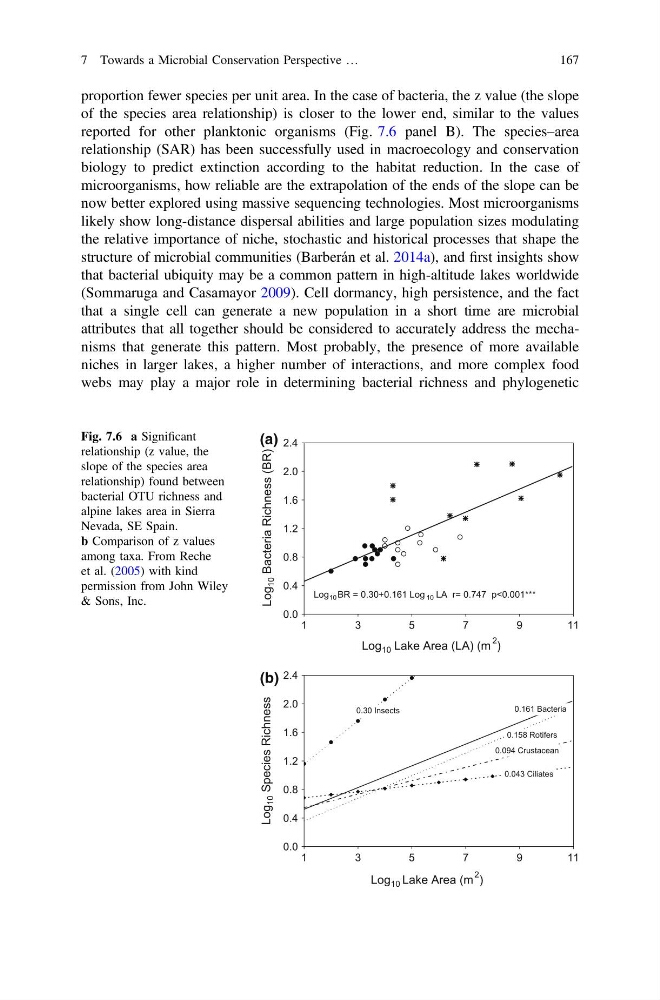
proportion fewer species per unit area. In the case of bacteria, the z value (the slope
of the species area relationship) is closer to the lower end, similar to the values
reported for other planktonic organisms (Fig. 7.6 panel B). The species–area
relationship (SAR) has been successfully used in macroecology and conservation
biology to predict extinction according to the habitat reduction. In the case of
microorganisms, how reliable are the extrapolation of the ends of the slope can be
now better explored using massive sequencing technologies. Most microorganisms
likely show long-distance dispersal abilities and large population sizes modulating
the relative importance of niche, stochastic and historical processes that shape the
structure of microbial communities (Barberán et al. 2014a), and first insights show
that bacterial ubiquity may be a common pattern in high-altitude lakes worldwide
(Sommaruga and Casamayor 2009). Cell dormancy, high persistence, and the fact
that a single cell can generate a new population in a short time are microbial
attributes that all together should be considered to accurately address the mechanisms that generate this pattern. Most probably, the presence of more available
niches in larger lakes, a higher number of interactions, and more complex food
webs may play a major role in determining bacterial richness and phylogenetic
Log 10 Lake Area (LA) (m
2
)
Log
10 Bacteria Richness (BR)
0.0
0.4
0.8
1.2
1.6
2.0
2.4
1
3
5
7
9
1 1
Log 10 BR = 0.30+0.161 Log 10 LA r= 0.747 p<0.001***
Log 10 Lake Area (m
2 )
Log
10 Species Richness
0.0
0.4
0.8
1.2
1.6
2.0
2.4
1
3
5
7
9
1 1
0.094 Crustacean
0.161 Bacteria
0.158 Rotifers
0.30 Insects
0.043 Ciliates
(a)
(b)
Fig. 7.6 a Significant
relationship (z value, the
slope of the species area
relationship) found between
bacterial OTU richness and
alpine lakes area in Sierra
Nevada, SE Spain.
b Comparison of z values
among taxa. From Reche
et al. (2005) with kind
permission from John Wiley
& Sons, Inc.
7 Towards a Microbial Conservation Perspective …
167
of the species area relationship) is closer to the lower end, similar to the values
reported for other planktonic organisms (Fig. 7.6 panel B). The species–area
relationship (SAR) has been successfully used in macroecology and conservation
biology to predict extinction according to the habitat reduction. In the case of
microorganisms, how reliable are the extrapolation of the ends of the slope can be
now better explored using massive sequencing technologies. Most microorganisms
likely show long-distance dispersal abilities and large population sizes modulating
the relative importance of niche, stochastic and historical processes that shape the
structure of microbial communities (Barberán et al. 2014a), and first insights show
that bacterial ubiquity may be a common pattern in high-altitude lakes worldwide
(Sommaruga and Casamayor 2009). Cell dormancy, high persistence, and the fact
that a single cell can generate a new population in a short time are microbial
attributes that all together should be considered to accurately address the mechanisms that generate this pattern. Most probably, the presence of more available
niches in larger lakes, a higher number of interactions, and more complex food
webs may play a major role in determining bacterial richness and phylogenetic
Log 10 Lake Area (LA) (m
2
)
Log
10 Bacteria Richness (BR)
0.0
0.4
0.8
1.2
1.6
2.0
2.4
1
3
5
7
9
1 1
Log 10 BR = 0.30+0.161 Log 10 LA r= 0.747 p<0.001***
Log 10 Lake Area (m
2 )
Log
10 Species Richness
0.0
0.4
0.8
1.2
1.6
2.0
2.4
1
3
5
7
9
1 1
0.094 Crustacean
0.161 Bacteria
0.158 Rotifers
0.30 Insects
0.043 Ciliates
(a)
(b)
Fig. 7.6 a Significant
relationship (z value, the
slope of the species area
relationship) found between
bacterial OTU richness and
alpine lakes area in Sierra
Nevada, SE Spain.
b Comparison of z values
among taxa. From Reche
et al. (2005) with kind
permission from John Wiley
& Sons, Inc.
7 Towards a Microbial Conservation Perspective …
167