

68
P. Krüger
3.4 Absorption Spectra in the Independent Particle
Approximation
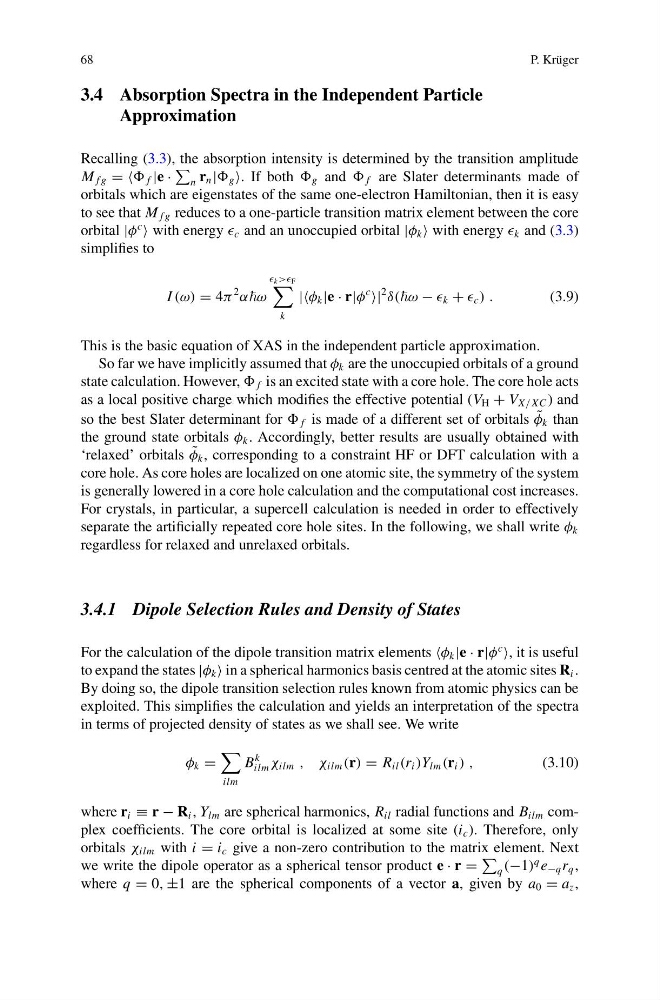
Recalling (3.3), the absorption intensity is determined by the transition amplitude
M f g = = f |e ·
n r n | g . If both g and f are Slater determinants made of
orbitals which are eigenstates of the same one-electron Hamiltonian, then it is easy
to see that M f g reduces to a one-particle transition matrix element between the core
orbital |φ
c
with energy c and an unoccupied orbital |φ k with energy k and (3.3)
simplifies to
I (ω) = 4π
2
αω
k >> F
k
||φ k |e · r|φ
c
|
2
δ(ω − k + c ) .
(3.9)
This is the basic equation of XAS in the independent particle approximation.
So far we have implicitly assumed that φ k are the unoccupied orbitals of a ground
state calculation. However, f is an excited state with a core hole. The core hole acts
as a local positive charge which modifies the effective potential (V H + V X/ XC ) and
so the best Slater determinant for f is made of a different set of orbitals ˜
φ k than
the ground state orbitals φ k . Accordingly, better results are usually obtained with
‘relaxed’ orbitals ˜
φ k , corresponding to a constraint HF or DFT calculation with a
core hole. As core holes are localized on one atomic site, the symmetry of the system
is generally lowered in a core hole calculation and the computational cost increases.
For crystals, in particular, a supercell calculation is needed in order to effectively
separate the artificially repeated core hole sites. In the following, we shall write φ k
regardless for relaxed and unrelaxed orbitals.
3.4.1 Dipole Selection Rules and Density of States
For the calculation of the dipole transition matrix elements φ k |e · r|φ
c
, it is useful
to expand the states |φ k in a spherical harmonics basis centred at the atomic sites R i .
By doing so, the dipole transition selection rules known from atomic physics can be
exploited. This simplifies the calculation and yields an interpretation of the spectra
in terms of projected density of states as we shall see. We write
φ k =
ilm
B
k
ilm χ ilm , χ ilm (r) = R il (r i )Y lm (r i ) ,
(3.10)
where r i ≡ r − R i , Y lm are spherical harmonics, R il radial functions and B ilm complex coefficients. The core orbital is localized at some site (i c ). Therefore, only
orbitals χ ilm with i = i c give a non-zero contribution to the matrix element. Next
we write the dipole operator as a spherical tensor product e · r =
q (−1)
q e −q r q ,
where q = 0, ±1 are the spherical components of a vector a, given by a 0 = a z ,
P. Krüger
3.4 Absorption Spectra in the Independent Particle
Approximation
Recalling (3.3), the absorption intensity is determined by the transition amplitude
M f g = = f |e ·
n r n | g . If both g and f are Slater determinants made of
orbitals which are eigenstates of the same one-electron Hamiltonian, then it is easy
to see that M f g reduces to a one-particle transition matrix element between the core
orbital |φ
c
with energy c and an unoccupied orbital |φ k with energy k and (3.3)
simplifies to
I (ω) = 4π
2
αω
k >> F
k
||φ k |e · r|φ
c
|
2
δ(ω − k + c ) .
(3.9)
This is the basic equation of XAS in the independent particle approximation.
So far we have implicitly assumed that φ k are the unoccupied orbitals of a ground
state calculation. However, f is an excited state with a core hole. The core hole acts
as a local positive charge which modifies the effective potential (V H + V X/ XC ) and
so the best Slater determinant for f is made of a different set of orbitals ˜
φ k than
the ground state orbitals φ k . Accordingly, better results are usually obtained with
‘relaxed’ orbitals ˜
φ k , corresponding to a constraint HF or DFT calculation with a
core hole. As core holes are localized on one atomic site, the symmetry of the system
is generally lowered in a core hole calculation and the computational cost increases.
For crystals, in particular, a supercell calculation is needed in order to effectively
separate the artificially repeated core hole sites. In the following, we shall write φ k
regardless for relaxed and unrelaxed orbitals.
3.4.1 Dipole Selection Rules and Density of States
For the calculation of the dipole transition matrix elements φ k |e · r|φ
c
, it is useful
to expand the states |φ k in a spherical harmonics basis centred at the atomic sites R i .
By doing so, the dipole transition selection rules known from atomic physics can be
exploited. This simplifies the calculation and yields an interpretation of the spectra
in terms of projected density of states as we shall see. We write
φ k =
ilm
B
k
ilm χ ilm , χ ilm (r) = R il (r i )Y lm (r i ) ,
(3.10)
where r i ≡ r − R i , Y lm are spherical harmonics, R il radial functions and B ilm complex coefficients. The core orbital is localized at some site (i c ). Therefore, only
orbitals χ ilm with i = i c give a non-zero contribution to the matrix element. Next
we write the dipole operator as a spherical tensor product e · r =
q (−1)
q e −q r q ,
where q = 0, ±1 are the spherical components of a vector a, given by a 0 = a z ,