

3 Electronic Structure Theory for X-Ray Absorption and Photoemission Spectroscopy
67
inhomogeneous electron gas. The first theorem states that the external potential V ext
is uniquely determined by the ground state electronic density n(r) and that the total
energy E (minus the external potential energy) is a unique and universal functional
of n.
1 The consequence of the theorem is that knowledge of the ground state density
alone is, in principle, sufficient to determine all properties of the system. The second
theorem states that the exact ground state density n 0 (r) minimizes the total energy
functional E[n] in the space of all possible functions n(r). Thus, approximations to
E and n can be found variationally.
The Hohenberg–Kohn theorems are exact mathematical theorems. If the universal
functional E[n] were known, DFT would yield the exact total energy and electron
density of the interacting electron system. But the exact functional E[n] is unknown.
Various approximate functionals have been proposed such as the local density approximation (LDA), generalized gradient approximations (GGA) and hybrid functionals,
i.e. mixtures of GGA and HF exchange. In practical DFT calculations, Kohn–Sham
theory is employed, which introduces an auxiliary, non-interacting system which,
by definition, has the same electronic density as the real, interacting system. In the
auxiliary system, the external potential is called Kohn–Sham potential V KS and it is
the sum of the true external (nuclei) potential and an effective one-electron potential
which replaces the electron–electron interaction. The Kohn–Sham potential V KS is
given by the functional derivative of the total energy functional E[n] with respect to
the electron density. The effective electron–electron potential is written as the sum
of the Hartree potential V H and a rest, which is called exchange–correlation potential
V XC . As the exact energy functional E[n] is unknown, so is V XC , and the actual
expression depends on the approximation used (LDA, GGA, hybrid).
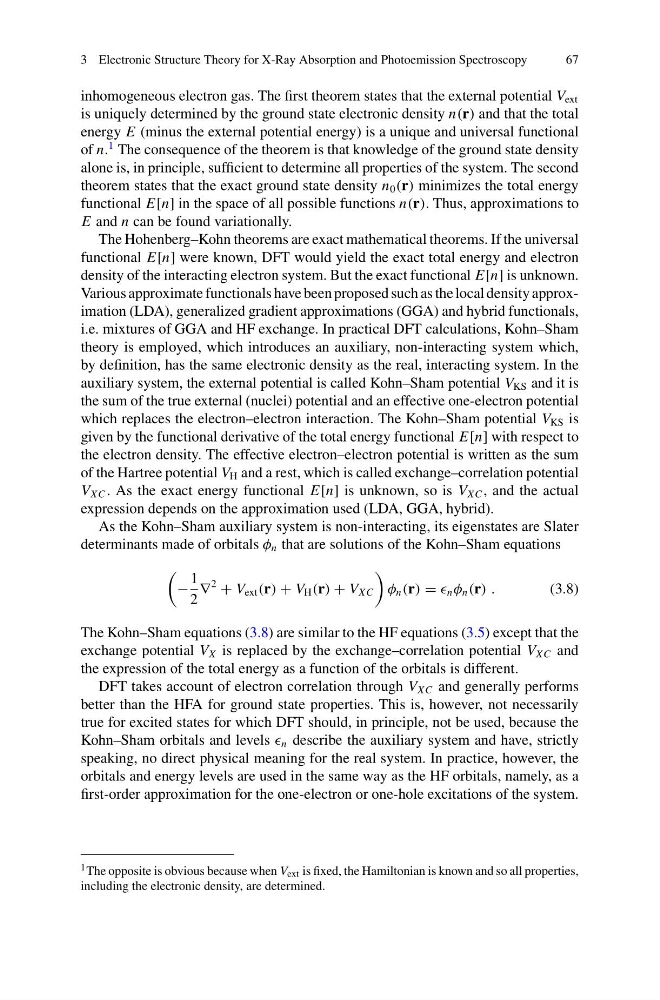
As the Kohn–Sham auxiliary system is non-interacting, its eigenstates are Slater
determinants made of orbitals φ n that are solutions of the Kohn–Sham equations
−
1
2
∇
2
+ V ext (r) + V H (r) + V XC
φ n (r) = n φ n (r) .
(3.8)
The Kohn–Sham equations (3.8) are similar to the HF equations (3.5) except that the
exchange potential V X is replaced by the exchange–correlation potential V XC and
the expression of the total energy as a function of the orbitals is different.
DFT takes account of electron correlation through V XC and generally performs
better than the HFA for ground state properties. This is, however, not necessarily
true for excited states for which DFT should, in principle, not be used, because the
Kohn–Sham orbitals and levels n describe the auxiliary system and have, strictly
speaking, no direct physical meaning for the real system. In practice, however, the
orbitals and energy levels are used in the same way as the HF orbitals, namely, as a
first-order approximation for the one-electron or one-hole excitations of the system.
1 The opposite is obvious because when V ext is fixed, the Hamiltonian is known and so all properties,
including the electronic density, are determined.
67
inhomogeneous electron gas. The first theorem states that the external potential V ext
is uniquely determined by the ground state electronic density n(r) and that the total
energy E (minus the external potential energy) is a unique and universal functional
of n.
1 The consequence of the theorem is that knowledge of the ground state density
alone is, in principle, sufficient to determine all properties of the system. The second
theorem states that the exact ground state density n 0 (r) minimizes the total energy
functional E[n] in the space of all possible functions n(r). Thus, approximations to
E and n can be found variationally.
The Hohenberg–Kohn theorems are exact mathematical theorems. If the universal
functional E[n] were known, DFT would yield the exact total energy and electron
density of the interacting electron system. But the exact functional E[n] is unknown.
Various approximate functionals have been proposed such as the local density approximation (LDA), generalized gradient approximations (GGA) and hybrid functionals,
i.e. mixtures of GGA and HF exchange. In practical DFT calculations, Kohn–Sham
theory is employed, which introduces an auxiliary, non-interacting system which,
by definition, has the same electronic density as the real, interacting system. In the
auxiliary system, the external potential is called Kohn–Sham potential V KS and it is
the sum of the true external (nuclei) potential and an effective one-electron potential
which replaces the electron–electron interaction. The Kohn–Sham potential V KS is
given by the functional derivative of the total energy functional E[n] with respect to
the electron density. The effective electron–electron potential is written as the sum
of the Hartree potential V H and a rest, which is called exchange–correlation potential
V XC . As the exact energy functional E[n] is unknown, so is V XC , and the actual
expression depends on the approximation used (LDA, GGA, hybrid).
As the Kohn–Sham auxiliary system is non-interacting, its eigenstates are Slater
determinants made of orbitals φ n that are solutions of the Kohn–Sham equations
−
1
2
∇
2
+ V ext (r) + V H (r) + V XC
φ n (r) = n φ n (r) .
(3.8)
The Kohn–Sham equations (3.8) are similar to the HF equations (3.5) except that the
exchange potential V X is replaced by the exchange–correlation potential V XC and
the expression of the total energy as a function of the orbitals is different.
DFT takes account of electron correlation through V XC and generally performs
better than the HFA for ground state properties. This is, however, not necessarily
true for excited states for which DFT should, in principle, not be used, because the
Kohn–Sham orbitals and levels n describe the auxiliary system and have, strictly
speaking, no direct physical meaning for the real system. In practice, however, the
orbitals and energy levels are used in the same way as the HF orbitals, namely, as a
first-order approximation for the one-electron or one-hole excitations of the system.
1 The opposite is obvious because when V ext is fixed, the Hamiltonian is known and so all properties,
including the electronic density, are determined.