

66
P. Krüger
V H (r) =
occ
m
dr
|φ m (r
)|
2
|r − r |
=
dr
n(r
)
|r − r |
(3.6)
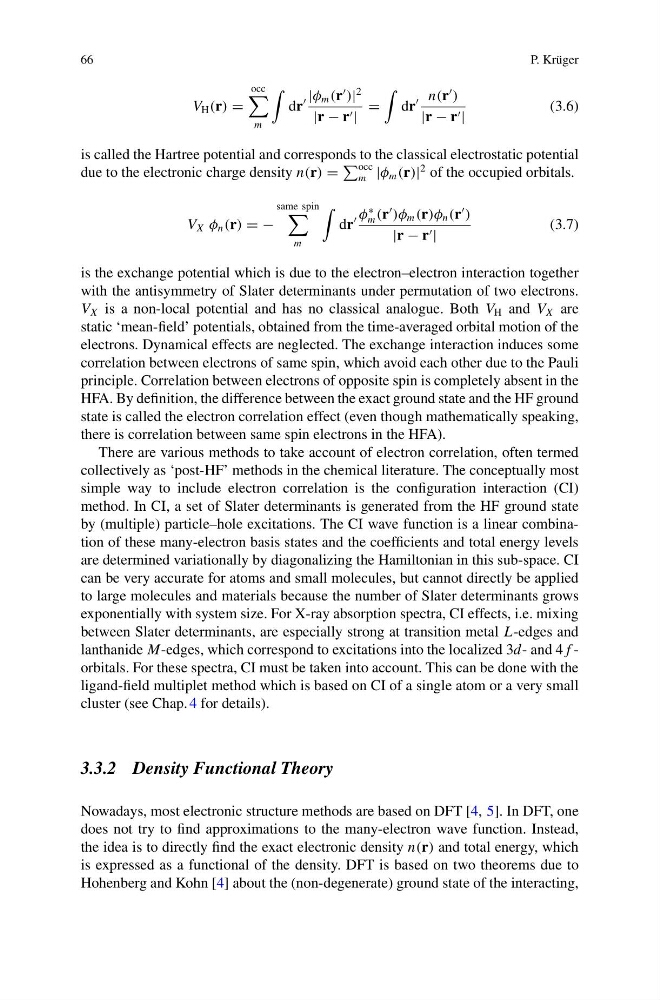
is called the Hartree potential and corresponds to the classical electrostatic potential
due to the electronic charge density n(r) =
occ
m |φ m (r)|
2 of the occupied orbitals.
V X φ n (r) = −
same spin
m
dr
φ
∗
m (r
)φ m (r)φ n (r
)
|r − r |
(3.7)
is the exchange potential which is due to the electron–electron interaction together
with the antisymmetry of Slater determinants under permutation of two electrons.
V X is a non-local potential and has no classical analogue. Both V H and V X are
static ‘mean-field’ potentials, obtained from the time-averaged orbital motion of the
electrons. Dynamical effects are neglected. The exchange interaction induces some
correlation between electrons of same spin, which avoid each other due to the Pauli
principle. Correlation between electrons of opposite spin is completely absent in the
HFA. By definition, the difference between the exact ground state and the HF ground
state is called the electron correlation effect (even though mathematically speaking,
there is correlation between same spin electrons in the HFA).
There are various methods to take account of electron correlation, often termed
collectively as ‘post-HF’ methods in the chemical literature. The conceptually most
simple way to include electron correlation is the configuration interaction (CI)
method. In CI, a set of Slater determinants is generated from the HF ground state
by (multiple) particle–hole excitations. The CI wave function is a linear combination of these many-electron basis states and the coefficients and total energy levels
are determined variationally by diagonalizing the Hamiltonian in this sub-space. CI
can be very accurate for atoms and small molecules, but cannot directly be applied
to large molecules and materials because the number of Slater determinants grows
exponentially with system size. For X-ray absorption spectra, CI effects, i.e. mixing
between Slater determinants, are especially strong at transition metal L-edges and
lanthanide M-edges, which correspond to excitations into the localized 3d- and 4 f -
orbitals. For these spectra, CI must be taken into account. This can be done with the
ligand-field multiplet method which is based on CI of a single atom or a very small
cluster (see Chap. 4 for details).
3.3.2 Density Functional Theory
Nowadays, most electronic structure methods are based on DFT [4, 5]. In DFT, one
does not try to find approximations to the many-electron wave function. Instead,
the idea is to directly find the exact electronic density n(r) and total energy, which
is expressed as a functional of the density. DFT is based on two theorems due to
Hohenberg and Kohn [4] about the (non-degenerate) ground state of the interacting,
P. Krüger
V H (r) =
occ
m
dr
|φ m (r
)|
2
|r − r |
=
dr
n(r
)
|r − r |
(3.6)
is called the Hartree potential and corresponds to the classical electrostatic potential
due to the electronic charge density n(r) =
occ
m |φ m (r)|
2 of the occupied orbitals.
V X φ n (r) = −
same spin
m
dr
φ
∗
m (r
)φ m (r)φ n (r
)
|r − r |
(3.7)
is the exchange potential which is due to the electron–electron interaction together
with the antisymmetry of Slater determinants under permutation of two electrons.
V X is a non-local potential and has no classical analogue. Both V H and V X are
static ‘mean-field’ potentials, obtained from the time-averaged orbital motion of the
electrons. Dynamical effects are neglected. The exchange interaction induces some
correlation between electrons of same spin, which avoid each other due to the Pauli
principle. Correlation between electrons of opposite spin is completely absent in the
HFA. By definition, the difference between the exact ground state and the HF ground
state is called the electron correlation effect (even though mathematically speaking,
there is correlation between same spin electrons in the HFA).
There are various methods to take account of electron correlation, often termed
collectively as ‘post-HF’ methods in the chemical literature. The conceptually most
simple way to include electron correlation is the configuration interaction (CI)
method. In CI, a set of Slater determinants is generated from the HF ground state
by (multiple) particle–hole excitations. The CI wave function is a linear combination of these many-electron basis states and the coefficients and total energy levels
are determined variationally by diagonalizing the Hamiltonian in this sub-space. CI
can be very accurate for atoms and small molecules, but cannot directly be applied
to large molecules and materials because the number of Slater determinants grows
exponentially with system size. For X-ray absorption spectra, CI effects, i.e. mixing
between Slater determinants, are especially strong at transition metal L-edges and
lanthanide M-edges, which correspond to excitations into the localized 3d- and 4 f -
orbitals. For these spectra, CI must be taken into account. This can be done with the
ligand-field multiplet method which is based on CI of a single atom or a very small
cluster (see Chap. 4 for details).
3.3.2 Density Functional Theory
Nowadays, most electronic structure methods are based on DFT [4, 5]. In DFT, one
does not try to find approximations to the many-electron wave function. Instead,
the idea is to directly find the exact electronic density n(r) and total energy, which
is expressed as a functional of the density. DFT is based on two theorems due to
Hohenberg and Kohn [4] about the (non-degenerate) ground state of the interacting,