

3 Electronic Structure Theory for X-Ray Absorption and Photoemission Spectroscopy
65
energies. Thus, the main theoretical problem of XAS is the accurate description of
the electronic structure of the system, both for the ground and core-excited states.
We, therefore, start by reviewing the basics of (ground state) electronic structure
theory before turning to the specific methods for handling core-excited states.
3.3 Ground State Electronic Structure Theory
Consider N electrons interacting with each other and the atomic nuclei. Following
the Born–Oppenheimer approximation, we neglect the coupling between the nuclear
and electronic dynamics. For the electronic problem, this means that the nuclei are
at fixed positions and can be described by a static external potential V ext (r). The
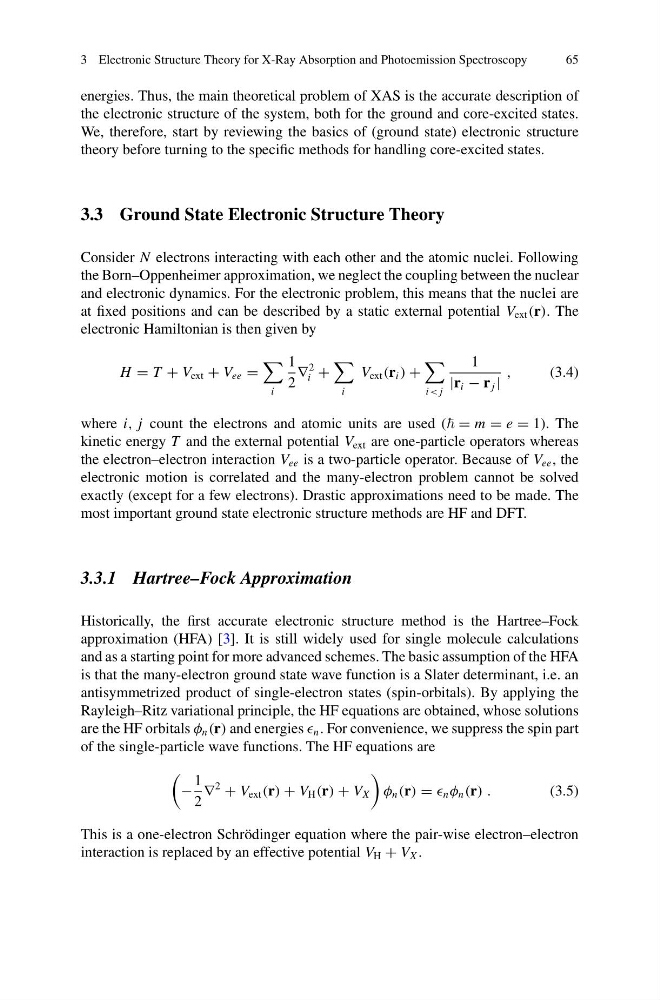
electronic Hamiltonian is then given by
H = T + V ext + V ee =
i
1
2
∇
2
i +
i
V ext (r i ) +
i< j
1
|r i − r j |
,
(3.4)
where i, j count the electrons and atomic units are used ( = m = e = 1). The
kinetic energy T and the external potential V ext are one-particle operators whereas
the electron–electron interaction V ee is a two-particle operator. Because of V ee , the
electronic motion is correlated and the many-electron problem cannot be solved
exactly (except for a few electrons). Drastic approximations need to be made. The
most important ground state electronic structure methods are HF and DFT.
3.3.1 Hartree–Fock Approximation
Historically, the first accurate electronic structure method is the Hartree–Fock
approximation (HFA) [3]. It is still widely used for single molecule calculations
and as a starting point for more advanced schemes. The basic assumption of the HFA
is that the many-electron ground state wave function is a Slater determinant, i.e. an
antisymmetrized product of single-electron states (spin-orbitals). By applying the
Rayleigh–Ritz variational principle, the HF equations are obtained, whose solutions
are the HF orbitals φ n (r) and energies n . For convenience, we suppress the spin part
of the single-particle wave functions. The HF equations are
−
1
2
∇
2
+ V ext (r) + V H (r) + V X
φ n (r) = n φ n (r) .
(3.5)
This is a one-electron Schrödinger equation where the pair-wise electron–electron
interaction is replaced by an effective potential V H + V X .
65
energies. Thus, the main theoretical problem of XAS is the accurate description of
the electronic structure of the system, both for the ground and core-excited states.
We, therefore, start by reviewing the basics of (ground state) electronic structure
theory before turning to the specific methods for handling core-excited states.
3.3 Ground State Electronic Structure Theory
Consider N electrons interacting with each other and the atomic nuclei. Following
the Born–Oppenheimer approximation, we neglect the coupling between the nuclear
and electronic dynamics. For the electronic problem, this means that the nuclei are
at fixed positions and can be described by a static external potential V ext (r). The
electronic Hamiltonian is then given by
H = T + V ext + V ee =
i
1
2
∇
2
i +
i
V ext (r i ) +
i< j
1
|r i − r j |
,
(3.4)
where i, j count the electrons and atomic units are used ( = m = e = 1). The
kinetic energy T and the external potential V ext are one-particle operators whereas
the electron–electron interaction V ee is a two-particle operator. Because of V ee , the
electronic motion is correlated and the many-electron problem cannot be solved
exactly (except for a few electrons). Drastic approximations need to be made. The
most important ground state electronic structure methods are HF and DFT.
3.3.1 Hartree–Fock Approximation
Historically, the first accurate electronic structure method is the Hartree–Fock
approximation (HFA) [3]. It is still widely used for single molecule calculations
and as a starting point for more advanced schemes. The basic assumption of the HFA
is that the many-electron ground state wave function is a Slater determinant, i.e. an
antisymmetrized product of single-electron states (spin-orbitals). By applying the
Rayleigh–Ritz variational principle, the HF equations are obtained, whose solutions
are the HF orbitals φ n (r) and energies n . For convenience, we suppress the spin part
of the single-particle wave functions. The HF equations are
−
1
2
∇
2
+ V ext (r) + V H (r) + V X
φ n (r) = n φ n (r) .
(3.5)
This is a one-electron Schrödinger equation where the pair-wise electron–electron
interaction is replaced by an effective potential V H + V X .