

3 Electronic Structure Theory for X-Ray Absorption and Photoemission Spectroscopy
69
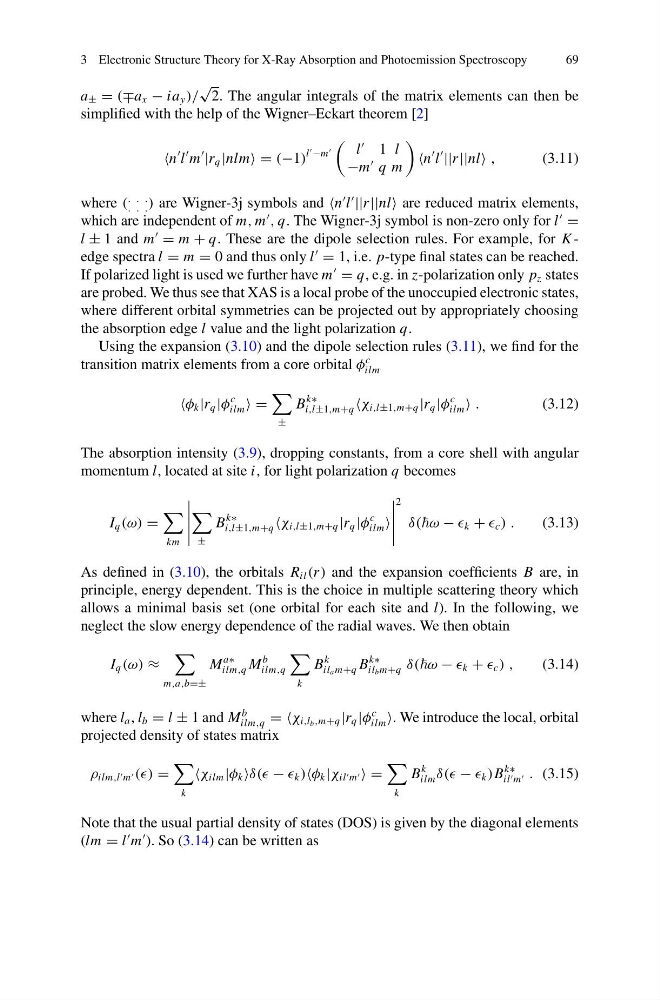
a ± = (∓a x − ia y )/
√
2. The angular integrals of the matrix elements can then be
simplified with the help of the Wigner–Eckart theorem [2]
n
l
m
|r q |nlm = (−1)
l
−m
l
1 l
−m
q m
n
l
||r ||nl ,
(3.11)
where (
.
.
.
.
.
. ) are Wigner-3j symbols and n
l
||r ||nl are reduced matrix elements,
which are independent of m, m
, q. The Wigner-3j symbol is non-zero only for l
=
l ± 1 and m
= m + q. These are the dipole selection rules. For example, for K -
edge spectra l = m = 0 and thus only l
= 1, i.e. p-type final states can be reached.
If polarized light is used we further have m
= q, e.g. in z-polarization only p z states
are probed. We thus see that XAS is a local probe of the unoccupied electronic states,
where different orbital symmetries can be projected out by appropriately choosing
the absorption edge l value and the light polarization q.
Using the expansion (3.10) and the dipole selection rules (3.11), we find for the
transition matrix elements from a core orbital φ
c
ilm
φ k |r q |φ
c
ilm =
±
B
k∗
i,l±1,m+q χ i,l±1,m+q |r q |φ
c
ilm .
(3.12)
The absorption intensity (3.9), dropping constants, from a core shell with angular
momentum l, located at site i, for light polarization q becomes
I q (ω) =
km
±
B
k∗
i,l±1,m+q χ i,l±1,m+q |r q |φ
c
ilm
2
δ(ω − k + c ) .
(3.13)
As defined in (3.10), the orbitals R il (r ) and the expansion coefficients B are, in
principle, energy dependent. This is the choice in multiple scattering theory which
allows a minimal basis set (one orbital for each site and l). In the following, we
neglect the slow energy dependence of the radial waves. We then obtain
I q (ω) ≈
m,a,b=±
M
a∗
ilm,q M
b
ilm,q
k
B
k
il a m+q B
k∗
il b m+q δ(ω − k + c ) ,
(3.14)
where l a , l b = l ± 1 and M
b
ilm,q = =χ i,l b ,m+q |r q |φ
c
ilm . We introduce the local, orbital
projected density of states matrix
ρ ilm,l m (() =
k
χ ilm |φ k δ(( − k )φ k |χ il m =
k
B
k
ilm δ(( − k )B
k∗
il m . (3.15)
Note that the usual partial density of states (DOS) is given by the diagonal elements
(lm = l
m
). So (3.14) can be written as
69
a ± = (∓a x − ia y )/
√
2. The angular integrals of the matrix elements can then be
simplified with the help of the Wigner–Eckart theorem [2]
n
l
m
|r q |nlm = (−1)
l
−m
l
1 l
−m
q m
n
l
||r ||nl ,
(3.11)
where (
.
.
.
.
.
. ) are Wigner-3j symbols and n
l
||r ||nl are reduced matrix elements,
which are independent of m, m
, q. The Wigner-3j symbol is non-zero only for l
=
l ± 1 and m
= m + q. These are the dipole selection rules. For example, for K -
edge spectra l = m = 0 and thus only l
= 1, i.e. p-type final states can be reached.
If polarized light is used we further have m
= q, e.g. in z-polarization only p z states
are probed. We thus see that XAS is a local probe of the unoccupied electronic states,
where different orbital symmetries can be projected out by appropriately choosing
the absorption edge l value and the light polarization q.
Using the expansion (3.10) and the dipole selection rules (3.11), we find for the
transition matrix elements from a core orbital φ
c
ilm
φ k |r q |φ
c
ilm =
±
B
k∗
i,l±1,m+q χ i,l±1,m+q |r q |φ
c
ilm .
(3.12)
The absorption intensity (3.9), dropping constants, from a core shell with angular
momentum l, located at site i, for light polarization q becomes
I q (ω) =
km
±
B
k∗
i,l±1,m+q χ i,l±1,m+q |r q |φ
c
ilm
2
δ(ω − k + c ) .
(3.13)
As defined in (3.10), the orbitals R il (r ) and the expansion coefficients B are, in
principle, energy dependent. This is the choice in multiple scattering theory which
allows a minimal basis set (one orbital for each site and l). In the following, we
neglect the slow energy dependence of the radial waves. We then obtain
I q (ω) ≈
m,a,b=±
M
a∗
ilm,q M
b
ilm,q
k
B
k
il a m+q B
k∗
il b m+q δ(ω − k + c ) ,
(3.14)
where l a , l b = l ± 1 and M
b
ilm,q = =χ i,l b ,m+q |r q |φ
c
ilm . We introduce the local, orbital
projected density of states matrix
ρ ilm,l m (() =
k
χ ilm |φ k δ(( − k )φ k |χ il m =
k
B
k
ilm δ(( − k )B
k∗
il m . (3.15)
Note that the usual partial density of states (DOS) is given by the diagonal elements
(lm = l
m
). So (3.14) can be written as