

42
S. J. Blundell
is full and the σ
∗ level is empty, thus saving the energy overall and leading to the H 2
molecule being a stable entity. The molecule He 2 does not form because it has four
electrons and would, therefore, involve filling both σ and σ
∗ and thus saves no energy
(and in fact, outside the Hückel approximation, it turns out that σ
∗
− E 0 > E 0 − σ
and so helium bonding costs more energy than it saves).
2.2.1 Direct Exchange
Exchange interactions are nothing more than a consequence of electrostatic interactions and the familiar interplay between potential energy and kinetic energy that
we see in chemical bonds. Consider a simple model with just two electrons which
have spatial coordinates r 1 and r 2 , respectively. The wave function for the joint state
can be written as a product of single electron states, so that if the first electron is in
state ψ a (r 1 ) and the second electron is in state ψ b (r 2 ), then the joint wave function
is ψ a (r 1 )ψ b (r 2 ). However, this product state does not obey exchange symmetry,
since if we exchange the two electrons we get ψ a (r 2 )ψ b (r 1 ), which is not a multiple
of what we started with. Therefore, the only states which we are allowed to make
are symmetrized or antisymmetrized product states which behave properly under the
operation of particle exchange.
For electrons, the overall wave function must be antisymmetric so the spin part
of the wave function must either be an antisymmetric singlet state χ S (S = 0) in the
case of a symmetric spatial state or a symmetric triplet state χ T (S = 1) in the case
of an antisymmetric spatial state. Therefore, we can write the wave function for the
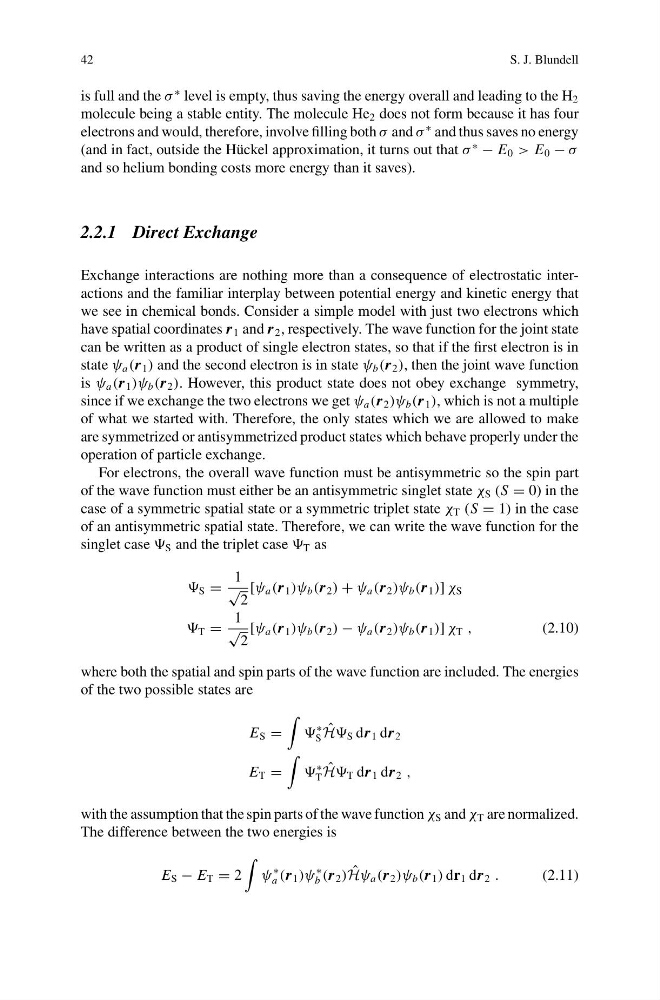
singlet case S and the triplet case T as
S =
1
√
2
[ψ a (r 1 )ψ b (r 2 ) + ψ a (r 2 )ψ b (r 1 )] χ S
T =
1
√
2
[ψ a (r 1 )ψ b (r 2 ) − ψ a (r 2 )ψ b (r 1 )] χ T ,
(2.10)
where both the spatial and spin parts of the wave function are included. The energies
of the two possible states are
E S =
∗
S
ˆ
H S dr 1 dr 2
E T =
∗
T
ˆ
H T dr 1 dr 2 ,
with the assumption that the spin parts of the wave function χ S and χ T are normalized.
The difference between the two energies is
E S − E T = 2
ψ
∗
a (r 1 )ψ
∗
b (r 2 ) ˆ
Hψ a (r 2 )ψ b (r 1 ) dr 1 dr 2 .
(2.11)
S. J. Blundell
is full and the σ
∗ level is empty, thus saving the energy overall and leading to the H 2
molecule being a stable entity. The molecule He 2 does not form because it has four
electrons and would, therefore, involve filling both σ and σ
∗ and thus saves no energy
(and in fact, outside the Hückel approximation, it turns out that σ
∗
− E 0 > E 0 − σ
and so helium bonding costs more energy than it saves).
2.2.1 Direct Exchange
Exchange interactions are nothing more than a consequence of electrostatic interactions and the familiar interplay between potential energy and kinetic energy that
we see in chemical bonds. Consider a simple model with just two electrons which
have spatial coordinates r 1 and r 2 , respectively. The wave function for the joint state
can be written as a product of single electron states, so that if the first electron is in
state ψ a (r 1 ) and the second electron is in state ψ b (r 2 ), then the joint wave function
is ψ a (r 1 )ψ b (r 2 ). However, this product state does not obey exchange symmetry,
since if we exchange the two electrons we get ψ a (r 2 )ψ b (r 1 ), which is not a multiple
of what we started with. Therefore, the only states which we are allowed to make
are symmetrized or antisymmetrized product states which behave properly under the
operation of particle exchange.
For electrons, the overall wave function must be antisymmetric so the spin part
of the wave function must either be an antisymmetric singlet state χ S (S = 0) in the
case of a symmetric spatial state or a symmetric triplet state χ T (S = 1) in the case
of an antisymmetric spatial state. Therefore, we can write the wave function for the
singlet case S and the triplet case T as
S =
1
√
2
[ψ a (r 1 )ψ b (r 2 ) + ψ a (r 2 )ψ b (r 1 )] χ S
T =
1
√
2
[ψ a (r 1 )ψ b (r 2 ) − ψ a (r 2 )ψ b (r 1 )] χ T ,
(2.10)
where both the spatial and spin parts of the wave function are included. The energies
of the two possible states are
E S =
∗
S
ˆ
H S dr 1 dr 2
E T =
∗
T
ˆ
H T dr 1 dr 2 ,
with the assumption that the spin parts of the wave function χ S and χ T are normalized.
The difference between the two energies is
E S − E T = 2
ψ
∗
a (r 1 )ψ
∗
b (r 2 ) ˆ
Hψ a (r 2 )ψ b (r 1 ) dr 1 dr 2 .
(2.11)