

2 Concepts in Magnetism
41
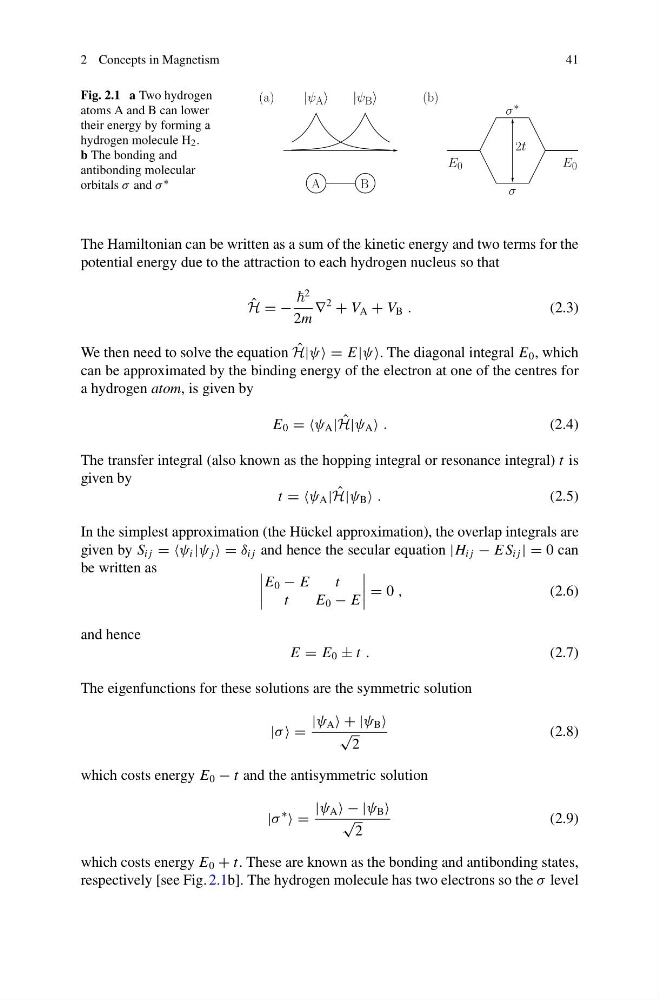
Fig. 2.1 a Two hydrogen
atoms A and B can lower
their energy by forming a
hydrogen molecule H 2 .
b The bonding and
antibonding molecular
orbitals σ and σ ∗
A
B
|ψ A
|ψ B
E 0
E 0
σ
σ ∗
2t
(a)
(b)
The Hamiltonian can be written as a sum of the kinetic energy and two terms for the
potential energy due to the attraction to each hydrogen nucleus so that
ˆ
H = −
2
2m
∇
2
+ V A + V B .
(2.3)
We then need to solve the equation ˆ
H|ψ = E|ψ. The diagonal integral E 0 , which
can be approximated by the binding energy of the electron at one of the centres for
a hydrogen atom, is given by
E 0 = =ψ A | ˆ
H|ψ A .
(2.4)
The transfer integral (also known as the hopping integral or resonance integral) t is
given by
t = =ψ A | ˆ
H|ψ B .
(2.5)
In the simplest approximation (the Hückel approximation), the overlap integrals are
given by S i j = =ψ i |ψ j = δ i j and hence the secular equation |H i j − E S i j | = 0 can
be written as
E 0 − E
t
t
E 0 − E
= 0 ,
(2.6)
and hence
E = E 0 ± t .
(2.7)
The eigenfunctions for these solutions are the symmetric solution
|σ =
|ψ A + |ψ B
√
2
(2.8)
which costs energy E 0 − t and the antisymmetric solution
|σ
∗
=
|ψ A − |ψ B
√
2
(2.9)
which costs energy E 0 + t. These are known as the bonding and antibonding states,
respectively [see Fig. 2.1b]. The hydrogen molecule has two electrons so the σ level
41
Fig. 2.1 a Two hydrogen
atoms A and B can lower
their energy by forming a
hydrogen molecule H 2 .
b The bonding and
antibonding molecular
orbitals σ and σ ∗
A
B
|ψ A
|ψ B
E 0
E 0
σ
σ ∗
2t
(a)
(b)
The Hamiltonian can be written as a sum of the kinetic energy and two terms for the
potential energy due to the attraction to each hydrogen nucleus so that
ˆ
H = −
2
2m
∇
2
+ V A + V B .
(2.3)
We then need to solve the equation ˆ
H|ψ = E|ψ. The diagonal integral E 0 , which
can be approximated by the binding energy of the electron at one of the centres for
a hydrogen atom, is given by
E 0 = =ψ A | ˆ
H|ψ A .
(2.4)
The transfer integral (also known as the hopping integral or resonance integral) t is
given by
t = =ψ A | ˆ
H|ψ B .
(2.5)
In the simplest approximation (the Hückel approximation), the overlap integrals are
given by S i j = =ψ i |ψ j = δ i j and hence the secular equation |H i j − E S i j | = 0 can
be written as
E 0 − E
t
t
E 0 − E
= 0 ,
(2.6)
and hence
E = E 0 ± t .
(2.7)
The eigenfunctions for these solutions are the symmetric solution
|σ =
|ψ A + |ψ B
√
2
(2.8)
which costs energy E 0 − t and the antisymmetric solution
|σ
∗
=
|ψ A − |ψ B
√
2
(2.9)
which costs energy E 0 + t. These are known as the bonding and antibonding states,
respectively [see Fig. 2.1b]. The hydrogen molecule has two electrons so the σ level