

6 p-Wave Superconductivity and d-Vector Representation
195
⎧
⎪ ⎪ ⎪ ⎪ ⎪ ⎪ ⎪ ⎪ ⎪ ⎪ ⎪ ⎪ ⎪ ⎪ ⎪ ⎨
⎪ ⎪ ⎪ ⎪ ⎪ ⎪ ⎪ ⎪ ⎪ ⎪ ⎪ ⎪ ⎪ ⎪ ⎪ ⎩
↑
(k) = −T
n
k
[V
↑↑ G
↑ G
↑
↑
(k
)
+ V
↑↓ G
↓ G
↓
↓
(k
) + V
↑0
(G
↓ G
↑
+ G
↑ G
↓
))
0
(k
)]
↓
(k) = −T
n
k
[V
↓↑ G
↑ G
↑
↑
(k
)
+ V
↓↓ G
↓ G
↓
↓
(k
) + V
↓0
(G
↓ G
↑
+ G
↑ G
↓
))
0
(k
)]
0
(k) = −T
n
k
[V
0↑ G
↑ G
↑
↑
(k
)
+ V
0↓ G
↓ G
↓
↓
(k
) + V
00
(G
↓ G
↑
+ G
↑ G
↓
))
0
(k
)]
,
(6.53)
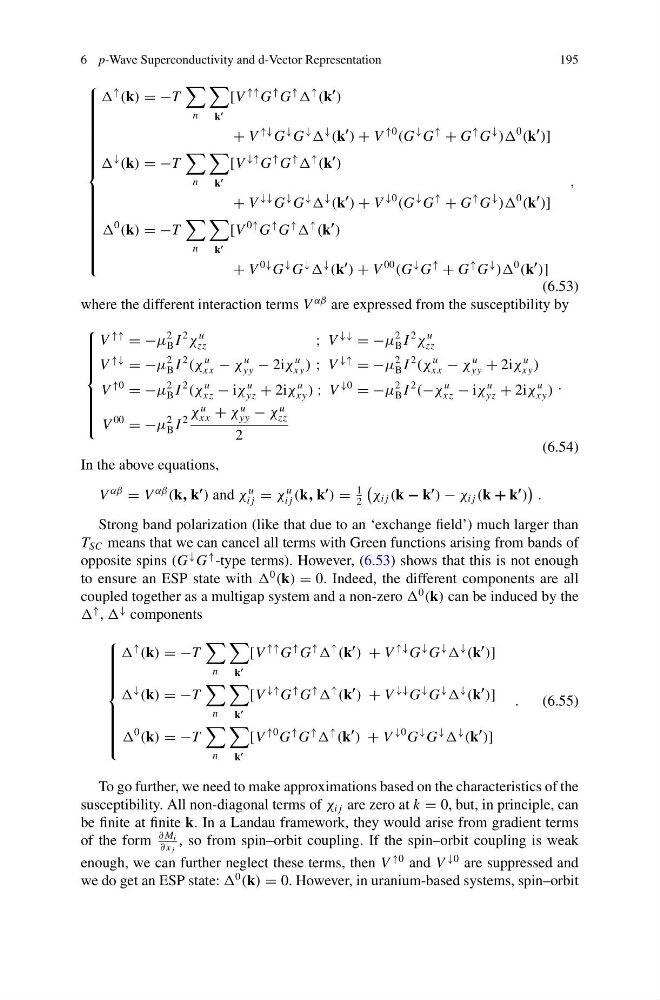
where the different interaction terms V
αβ are expressed from the susceptibility by
⎧
⎪ ⎪ ⎪ ⎪ ⎪ ⎪ ⎨
⎪ ⎪ ⎪ ⎪ ⎪ ⎪ ⎩
V
↑↑
= −μ
2
B I
2
χ
u
zz
; V
↓↓
= −μ
2
B I
2
χ
u
zz
V
↑↓
= −μ
2
B I
2
(χ
u
xx − χ
u
yy − 2iχ
u
xy ) ; V
↓↑
= −μ
2
B I
2
(χ
u
xx − χ
u
yy + 2iχ
u
xy )
V
↑0
= −μ
2
B I
2
(χ
u
xz − iχ
u
yz + 2iχ
u
xy ) ; V
↓0
= −μ
2
B I
2
(−χ
u
xz − iχ
u
yz + 2iχ
u
xy )
V
00
= −μ
2
B I
2
χ
u
xx + χ
u
yy − χ
u
zz
2
.
(6.54)
In the above equations,
V
αβ
= V
αβ
(k, k
) and χ
u
i j = χ
u
i j (k, k
) =
1
2
χ i j (k − k
) − χ i j (k + k
)
.
Strong band polarization (like that due to an ‘exchange field’) much larger than
T SC means that we can cancel all terms with Green functions arising from bands of
opposite spins (G
↓ G
↑ -type terms). However, (6.53) shows that this is not enough
to ensure an ESP state with
0
(k) = 0. Indeed, the different components are all
coupled together as a multigap system and a non-zero
0
(k) can be induced by the
↑ ,
↓ components
⎧
⎪ ⎪ ⎪ ⎪ ⎪ ⎪ ⎪ ⎨
⎪ ⎪ ⎪ ⎪ ⎪ ⎪ ⎪ ⎩
↑
(k) = −T
n
k
[V
↑↑ G
↑ G
↑
↑
(k
) + V
↑↓ G
↓ G
↓
↓
(k
)]
↓
(k) = −T
n
k
[V
↓↑ G
↑ G
↑
↑
(k
) + V
↓↓ G
↓ G
↓
↓
(k
)]
0
(k) = −T
n
k
[V
↑0 G
↑ G
↑
↑
(k
) + V
↓0 G
↓ G
↓
↓
(k
)]
.
(6.55)
To go further, we need to make approximations based on the characteristics of the
susceptibility. All non-diagonal terms of χ i j are zero at k = 0, but, in principle, can
be finite at finite k. In a Landau framework, they would arise from gradient terms
of the form
∂ M i
∂ x j
, so from spin–orbit coupling. If the spin–orbit coupling is weak
enough, we can further neglect these terms, then V
↑0 and V
↓0 are suppressed and
we do get an ESP state:
0
(k) = 0. However, in uranium-based systems, spin–orbit
195
⎧
⎪ ⎪ ⎪ ⎪ ⎪ ⎪ ⎪ ⎪ ⎪ ⎪ ⎪ ⎪ ⎪ ⎪ ⎪ ⎨
⎪ ⎪ ⎪ ⎪ ⎪ ⎪ ⎪ ⎪ ⎪ ⎪ ⎪ ⎪ ⎪ ⎪ ⎪ ⎩
↑
(k) = −T
n
k
[V
↑↑ G
↑ G
↑
↑
(k
)
+ V
↑↓ G
↓ G
↓
↓
(k
) + V
↑0
(G
↓ G
↑
+ G
↑ G
↓
))
0
(k
)]
↓
(k) = −T
n
k
[V
↓↑ G
↑ G
↑
↑
(k
)
+ V
↓↓ G
↓ G
↓
↓
(k
) + V
↓0
(G
↓ G
↑
+ G
↑ G
↓
))
0
(k
)]
0
(k) = −T
n
k
[V
0↑ G
↑ G
↑
↑
(k
)
+ V
0↓ G
↓ G
↓
↓
(k
) + V
00
(G
↓ G
↑
+ G
↑ G
↓
))
0
(k
)]
,
(6.53)
where the different interaction terms V
αβ are expressed from the susceptibility by
⎧
⎪ ⎪ ⎪ ⎪ ⎪ ⎪ ⎨
⎪ ⎪ ⎪ ⎪ ⎪ ⎪ ⎩
V
↑↑
= −μ
2
B I
2
χ
u
zz
; V
↓↓
= −μ
2
B I
2
χ
u
zz
V
↑↓
= −μ
2
B I
2
(χ
u
xx − χ
u
yy − 2iχ
u
xy ) ; V
↓↑
= −μ
2
B I
2
(χ
u
xx − χ
u
yy + 2iχ
u
xy )
V
↑0
= −μ
2
B I
2
(χ
u
xz − iχ
u
yz + 2iχ
u
xy ) ; V
↓0
= −μ
2
B I
2
(−χ
u
xz − iχ
u
yz + 2iχ
u
xy )
V
00
= −μ
2
B I
2
χ
u
xx + χ
u
yy − χ
u
zz
2
.
(6.54)
In the above equations,
V
αβ
= V
αβ
(k, k
) and χ
u
i j = χ
u
i j (k, k
) =
1
2
χ i j (k − k
) − χ i j (k + k
)
.
Strong band polarization (like that due to an ‘exchange field’) much larger than
T SC means that we can cancel all terms with Green functions arising from bands of
opposite spins (G
↓ G
↑ -type terms). However, (6.53) shows that this is not enough
to ensure an ESP state with
0
(k) = 0. Indeed, the different components are all
coupled together as a multigap system and a non-zero
0
(k) can be induced by the
↑ ,
↓ components
⎧
⎪ ⎪ ⎪ ⎪ ⎪ ⎪ ⎪ ⎨
⎪ ⎪ ⎪ ⎪ ⎪ ⎪ ⎪ ⎩
↑
(k) = −T
n
k
[V
↑↑ G
↑ G
↑
↑
(k
) + V
↑↓ G
↓ G
↓
↓
(k
)]
↓
(k) = −T
n
k
[V
↓↑ G
↑ G
↑
↑
(k
) + V
↓↓ G
↓ G
↓
↓
(k
)]
0
(k) = −T
n
k
[V
↑0 G
↑ G
↑
↑
(k
) + V
↓0 G
↓ G
↓
↓
(k
)]
.
(6.55)
To go further, we need to make approximations based on the characteristics of the
susceptibility. All non-diagonal terms of χ i j are zero at k = 0, but, in principle, can
be finite at finite k. In a Landau framework, they would arise from gradient terms
of the form
∂ M i
∂ x j
, so from spin–orbit coupling. If the spin–orbit coupling is weak
enough, we can further neglect these terms, then V
↑0 and V
↓0 are suppressed and
we do get an ESP state:
0
(k) = 0. However, in uranium-based systems, spin–orbit